Wednesday, November 27, 2013

Legong dance

After our exciting morning and afternoon with monkeys and rain in Ubud (Indonesia), we attended a Balinese form of dance called Legong. This is 1 of 3 types of dance and by some is considered the most complex, graceful, and of most interest. Some types of dance have more dance and others have more drama.

The 1 we saw had lots of dance, drama, and music. We were surprised to see the precise but also jerky movements of body parts, especially wrists, hands, and fingers. They could bend their fingers into impossible-seeming positions! All of these movements were significant to the story being expressed as well as their intricate facial expressions throughout the dance.

We noticed very little contact between the dancers, each moving independently as their movements told the story.

The women wore bright makeup and their costumes consisted of brightly brocaded materials and elaborate headdresses full of flowers, with my favourite flower frangipani being used a lot in costumes and also on the stage. The men's costumes were also of very sophisticated workmanship.

Stage presence (courtesy of Dee)

Music was provided by 4 drummers seated on the stage floor along the ornate back wall of the stage. And along both the sides of the stage were several talented musicians playing gamelan music which has abrupt shifts of tempo and dramatic changes between silence and crashing noise.

This group of dancers consisted of 7 women, 2 duelling men, and 2 young boys. It was a very impressive evening of entertainment.

A few of the performers

Ubud delights

First plan today in Ubud on Bali Island (Indonesia) was to visit the Sacred Monkey Forest Sanctuary (www.monkeyforustubud.com). Here the monkeys (macaques) are fed but run free with no cages.They mostly stay within the forest but occasionally wander into the village and nearby rice fields where they can become pests.

Okay, 2 things about this Sanctuary.

No. 1: You feel like you are in a tropical forest jungle albeit there are concrete stairways to take you to lower levels and to the temples that are very remarkable and ancient looking. These are carved with exquisitely intricate detail. There are also a lot of old picturesque statues situated throughout the Sanctuary.

Dee in front of temple (courtesy of Aaron)

No. 2: The monkeys are absolutely adorable but also very mischievous. At the entryway, you can buy bunches of bananas for the monkeys. And believe me, they know when you have them!!! The monkeys are immediately reaching for them, and jumping on you to get at them. You give a monkey an unpeeled banana, which it quickly peels, and then the banana is gobbled down as he grabs for another one! They can be very determined in their quest, looking quite mean in their persistence, but Jordan simply swatted this 1 away with no harm done.

I want more!! (courtesy of Aaron)

But they can also be very gentle. Occasionally you can fool them with just a banana peel. They will approach you, reach for it, and gently take it from you. Their paw pads are SO soft, like baby skin.

For me?

A sneaky monkey grabbed a piece of paper from a woman which she was unable to retrieve. Each time she tried, the monkey just kept retreating ... "Heh, heh, it's mine now" he must have been thinking. And many moms and pops scurried or sauntered along with a baby lazily hanging on.

Religious shrines on the Monkey Sanctuary grounds have the typical offerings placed in them - bits of food, flowers, burning incense, etc. These are frequented by the monkeys as they steal the edibles from the offerings!

Easy offerings

An older monkey was spotted with unusual eyes...1 brown and 1 blue...the blue being a glass eye indicating the good medical treatment these monkeys must receive.

Unusual eyes (courtesy of Dee)

This young monkey made himself right at home sitting on Jordan's shoulder eating his banana with his other hand resting on Jordan's hat!

Monkey pal (courtesy of Dee)

Hangin' out...


Aaron snapping photo of teeny tiny baby (courtesy of Dee)...


Check out my Mohawk! (courtesy of Aaron)...


Family pose (courtesy of Aaron)...


Motherly love (courtesy of Dee)...


At 13:30, shortly after leaving the Sanctuary, we were treated to a torrential downpour! Along with several storekeepers standing in their doorways, we all watched as the streets flooded and the water tried to run downhill. The immense amount created deep flowing rivers in curb crevices which tried to rip my thongs off my feet as I walked through it crossing the street.

Jordan walking down a passageway

A quick lunch as we dried off and then - Balinese massage!

Tuesday, November 26, 2013

On to Bali

With everything ready, we dropped the mooring line at Labuanbajo (Indonesia) on November 22nd for our destination of Bali. Did you know that Bali is an island and not a city? We always thought Bali was a city on an island!

It was of course very calm with no wind, so once again we motored for most of the way. Occasionally we motor-sailed and very rarely sailed. We experienced some problems with our digital charts with several computer crash dumps. The computer kept wanting to install a new driver for our GPS system (our "hockey puck") but we have no internet out at sea which is needed to install any new driver. Hopefully we can solve this problem at Bali.

As backup, we printed digital screen shots of our route and also our computer waypoints just in case the computer refused to restart.

On our 2nd evening, we ran into choppy seas and a countercurrent which slowed us down to only 1 nautical mile in 1 hour. Sea Turtle should be averaging around 5 nautical miles per hour so we tacked.

We saw dolphins a couple of times, and as we finally approached the mountainous island of Bali, we suddenly noticed literally hundreds of fishboats with sails and NO lights! They were obviously avoiding us as we could barely see them till the sun came up a bit more. Apparently they leave Bali shores to fish every morning with their bright coloured sails flying.

Watch out!

We picked up a Royal Bali Yacht Club mooring ball at S08°43.157' E115°14.442' on November 25th at 11:00. We moored at small Serangan Island, a 15-second dinghy ride from main Bali Island.

With a message from Jordan's son and our daughter-in-law (Aaron and Dee), we quickly found a local man's van to rent for cheap at $20/day and headed out to meet them, leaving behind Serangan (aka Turtle Island). What an amazing drive!

We passed temple after temple, yards filled with religious-offering structures, shops filled with wood carvings or stone carvings or glass carvings...exquisite carvings far and wide. It was non-stop, everywhere you looked, you couldn't take it all in.

Traffic was unbelievable and moved urgently. Hundreds of motor scooters zipped in and out of 4-wheeled traffic. The lanes were ignored as several scooters were in each lane with a car or truck - no such thing as 1 vehicle per lane as back home! Being in a van, it was difficult to pass but the scooters moved much quicker with their size.

We checked into the same bungalows as Aaron and Dee in a charming town named Ubud (pronounced Oo bood), and as the rain came down in buckets, we had dreams of sights to see tomorrow...

Our Warsa Bungalow

Friday, November 22, 2013

Departures and arrivals

Our visitors Aaron and Dee (Jordan's son and his wife) wanted 1 last snorkel before flying to other parts of Flores Island, Indonesia. So after booking their flights on the 19th, we quickly motored over to a nearby small island (S08°29.001' E119°50.399') only an hour away where we had been previously. It was a dreary day with rain and choppy seas. Snorkelling was not as good as the water was a bit murky this time because of the onslaught of rain.

We left the island early the next morning, returning to Labuanbajo, and said our temporary goodbyes as Aaron and Dee hopped on a bus for the airport. After touring around, they will meet us in Bali in 4 or 5 days.

Jordan and I tried to fill our propane tank but this was impossible in Labuanbajo. We should have enough in our other until we reach Bali where they should be able to be filled. We noticed a sailboat anchored off in the distance and we discovered that it was 1 we know - Merilelu. We arranged to meet them for dinner and caught up on stories.

Merilelu had travelled a different route through Indonesia than we had (they took the northern route and we took the southern route). Unfortunately they had encountered a lot of thunderstorms and non-stop rain and were rather discouraged with Indonesia. We have had pretty much constant hot sun until the last couple of days even though it is now the rainy season here.

Tuesday, November 19, 2013

Manta rays

This morning, we took the dinghy around the point from Sea Turtle at Komodo Island (Indonesia) as we were told that is where the official Pink Beach is located. We wanted to check this out after finding the other amazing pink beach yesterday. The official Pink Beach was NOT as pink, in our opinion, and the red coral was mixed with golden coloured sand rather than white sand like the other beach.

There was good snorkelling but the current was really fast and strong; the water was just a tad cooler. We saw very large trevally fish and a few turtles. This 1 looked a bit grumpy.

Back off dude...

Another turtle was very interested in the coral and at 1 point he even had a piece in his mouth. He kept pushing his nose deep into the coral digging around for something.

I can see you...

We also found another fish with scales that resembled camouflage. Swimming over the soft corals, he just seemed to blend right in. We have seen several but do not know their official name. One day we will see it in a book somewhere!


Back at Sea Turtle, we went in search of the world's largest ray, manta rays. Anchoring at S08°33.356' E119°37.917', we spread out in the water to start looking. Before we got more than a few feet apart, Aaron (Jordan's son) yelled out "I see them!" Jordan, Dee (Aaron's wife), and I joined Aaron and we all looked down at 1 of the largest manta rays we have ever swum with!

Dee approaching the manta ray

He gracefully flapped his muscular "wings" that extended out from his body; mantas can be up to 4.8 m (16 feet) from tip to tip. This 1 was about 3 metres. We snorkelled down and swam over him, towards him, behind him. He did not seem to mind at all and did not move away. I had been practicing deep diving so even I was able to swim down near them.

Jordan and me getting close

At 1 point, we were joined by 2 other smaller mantas but they did not stay around as long and would come and go...


Manta rays have skeletons of cartilage, not bone as most fish do, and they have a diet of plankton. We won't be on their menu so no need to fear these large gentle creatures.

Jordan swam off and found a huge moray eel emerging from his lair in a coral reef crevice but the 3 of us were not yet ready to leave the mantas. Then a dive boat appeared and asked us not to anchor in the area as we were unknowingly in a National Park area, so we graciously boarded Sea Turtle and moved off. As the dive boat's motor also scared off the manta rays, we probably would have left even if we had not been asked to.

We motored (yes, we are still motoring as so seldom is there any wind) and anchored in front of a resort. We planned to go ashore for cocktails and/or a meal later. After being anchored for about 2 hours, the resort officials asked us to move to a mooring ball around the corner. It was almost 19:00 and getting dark. We could not find any mooring balls so decided to just head back to Labuanbajo. We had our track to follow on digital charts so were not too worried about moving in the dark. We tied up to our same mooring ball at 22:00, safe and secure for the night.

Wow - what a great day!

Monday, November 18, 2013

Dragons and pink beaches

We weighed anchor early this morning at 06:00 as the tide was getting too low for Sea Turtle (only 2 metres). Looking back, we saw 3 deer on shore where we had had our bonfire the night before. Seems weird to see deer way over here in Indonesia near Rinca Island.

Today was the day for the 4 of us to see the Komodo dragons, the world's biggest monitor lizard, and found only on the 2 islands of Rinca and Komodo. But first we had to find the bay where we could anchor. The guidebooks and charts had it marked wrong but we found it at S08°39.180' E119°48.872' and went ashore.

Komodo National Park (guide, Aaron, Dee, Judy)

Our 1st sight ashore was of monkeys around the camp. These monkeys are sometimes caught by the Komodo dragons for food but not too often as they are thankfully too fast for the dragons. The dragons can spring short distances, lifting their tails as they run. They also hunt goat, deer, boar, miniature wild ponies, and even water buffalo.

Too cute to eat

You must have a guide as the dragons can be dangerous. One climbed the stairs into the office and bit a volunteer who had to be rushed to hospital by speedboat for antibiotics as the dragon's saliva quickly induces blood poisoning. When motionless, they can be hard to spot in the dry scrub.

Speak with forked tongue?

Our guide filled us in with information about the lizards as we went on a hike. They can measure over 3 metres (10 feet) long. They have a muscular tail, huge claws, fearsome teeth, and a long yellow forked tongue. They kill their prey with their tail or by biting. When bit, their victim will slowly die and the Komodo just lies back and waits. They only eat about once a month. Surprisingly, they are also cannibalistic.

Komodos hanging out

The 1st 5 years of their lives are spent living in trees for safety, until they are about 1 metre in length. Approximately 1,100 Komodo live on Rinca and 1,300 on Komodo Island.

Enjoying the sun

Now finished with Komodos, it was time to snorkel to cool off so we moved Sea Turtle to Padar Island (S08°38.038' E119°35.169'). Do not get in the water at Rinca as crocodiles are there!

Once again we had a successful viewing of the creatures and coral in the ocean. This large clam had shades of brown and was about a foot across in size (the 1 that I saw when I was snorkelling while the others were diving was even bigger!)

Large clam

As well as black starfish and purplish-blue starfish, this bumpy orange starfish lying on the sandy bottom surrounded by seagrass was discovered...


Dee found a few lion fish hiding in the rocks and hailed everyone over. We cautioned Aaron and Dee on the venomous nature of these dangerous and spiky fish. There was also a large moray eel trying to stay out of sight.

Dangerous lion fish

We dinghied ashore and were stunned to see the colour of the sand - a very bright reddish pink! This beach was being created by the breaking up of red coral as it washed ashore and broke down into finer pieces, mixing with the white sand.

PINKEST beach we have ever seen

Red coral found on shore

We motored the short distance to Komodo Island (S08°35.805' E119°31.142') where we were asked by a longboater if we were interested in buying any souvenirs from his family. We bought a couple of trinkets as we like to support the locals whenever possible.

Under a full moon, we then had another bonfire on shore and watched as later in the evening the rising tide doused it and washed the wood out to sea. Easiest way yet to put out a bonfire!

Sunday, November 17, 2013

Near Rinca Island

Another hot day at Labuanbajo (Indonesia) so another day of snorkelling. We motored to a small island (S08°35.964' E119°42.372') near Rinca where Jordan and I and family Aaron and Dee were all alone with no other boats around.

We swam with schools of fish - safety in numbers - they were everywhere! Fish in schools make it harder for their predators to pick them out of the crowd. We also watched fish flitting in and out of the coral heads, hiding as we approached. If you didn't see them go in the coral, you would think there were no fish there, till they peeked out to see if it was safe.

The very cute clown fish live and hide among the tentacles of sea anemones on coral reefs. There are 27 different species of clown fish, each with its own distinguishing pattern of brightly coloured bands. It's always fun to watch as they try to hide from us in the anemones.

We saw some unusual sea creatures this time. This sea snake, 1 of many varieties, had a jointed body and a tentacled head and must have been 3 metres long...


Then there were these clear, see-through, tiny orange fish keeping acquaintance with black and white striped fish...


Another that we don't know the name of, perhaps a "spaghetti worm"? Whatever it is, it's not fishing line or spaghetti! You can see on the left what looks like a "mouth" where the tentacles all seem to originate from as they stretch out and wrap around corals. Very interesting...


We had just read about the unusual razorfish earlier in the morning in a National Geographic magazine when, lo and behold, eagle-eyed Dee spotted 4 swimming in a line!! We watched them swim upside down (their head points toward the sea bottom) flapping their little wing-like fins. Razorfish have big eyes and their long "noses" are pinkish coloured. They are small and very skinny; the ones we saw were only about 7.5 cm (3 inches) long.
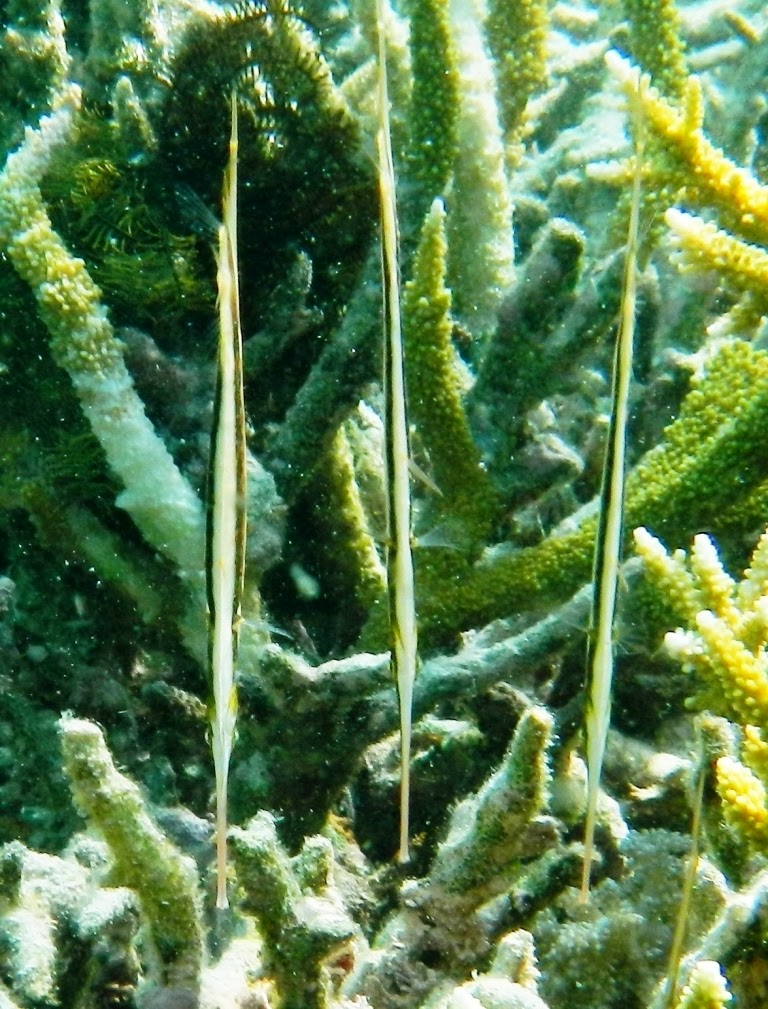

Trumpet fish have elongated bodies and long tubular snouts with minute teeth. They have dorsal fins near the tail fin and inflexible bodies...


An Indonesian fishboat arrived attempting to retrieve fish baskets that it had left on the ocean floor. Jordan dove down to help locate and lift them onto the fishboat, making the fishermen very happy as they didn't need to get in the water!

Helping hand

After an exciting day of exploring the wonders of the ocean, we went in search of the anchorage to the Komodo dragon park off Rinca Island before he sun set. However, we had erroneous directions from a couple of sources and couldn't locate it. So we dropped the hook at a nice quiet spot - Goats Island - (S08°37.781' E119°42.294') where we enjoyed a bonfire on the lonely beach.

Saturday, November 16, 2013

Divine diving

Today in Labuanbajo Indonesia, Jordan and I with family Aaron and Dee all boarded the dive boat (Komodo Dive) for a day of scuba diving. Right from Sea Turtle they picked us up, and at the end of the day dropped us off. The 3 dives were at different and diverse locations. As I am not yet a licensed diver, I snorkelled while everyone else went down exploring the depths.

Komodo Dive

The divers had a great day seeing things such as the usual array of tropical fish, Hawksbill turtles, ribbon and moray eels, giant cuttlefish as large as a rugby ball, black tip and white tip reef sharks, and BIG angel fish twice the size of your average dinner plate! They were also treated to the sight of scorpion fish, including a leaf scorpion which is very rare and hard to spot.

Jordan (with facial hair!)

I too had a great day snorkelling. On my first outing, a guide from the dive boat accompanied me as the current was very strong and I was a little leery to be on my own. A deep hole in the area has such strong current that if you go too deep into it, it can suck you down making it very difficult to swim back out of. The guide and I kept closer to shore where we would not cross over the hole and we could still feel the strong current.

On my 3 snorkelling adventures, I picked out 1 small Hawksville turtle, an unusual clam with lips that weren't the common blue or brown shades but instead were such a multiple colour I would call it a paisley pattern. It was very beautiful and I had never seen such before. I also saw a giant clam, with the usual brown shades of colour, but was so large it couldn't even close when I approached it! And of course the prodigious array of tropical fish with many new ones for my eyes.

After Komodo Dive dropped the 4 of us off at Sea Turtle, we showered off the saltwater and went ashore for a nice evening out. It was still very hot but we dressed to ward off the pesky bugs and mosquitoes!

Aaron, Dee, Judy, Jordan

Friday, November 15, 2013

Snorkel day

Jordan's son and our new daughter-in-law (Aaron and Dee) arrived today! We were very surprised to see how much luggage they had come with as usually they are both very light travellers, but they were not sure what to expect in Indonesia so brought a bit of everything for attire. Reminded us of when my daughter and her fiancé (now husband) visited us in New Zealand and brought heaps of luggage - tough to find a place to put so much stuff on a small boat!

Once all settled, we untied from the mooring ball at Labuanbajo (Indonesia) and set sail to a small island called Bidadari (S08°28.998' E119°50.406') so we could all snorkel to cool off from the hot sun. We found a lovely spot with lots of good coral - both soft and hard varieties, many varieties of colourful fish including angel fish and clown fish, blue starfish, blue lipped clams that closed up when we got too close, and even a few small lobsters.

All underwater photos are courtesy of Aaron and Dee as once again we are without an underwater camera. (Our GoPro finally bit the dust after its unfortunate excursion into saltwater with an open casing.)

Feather stars swaying

Soft coral waving (in front)

Bright fish swimming

We also saw a blue spotted stingray which was a first for all of us. It moved very quickly along the bottom of the seabed.


Jellyfish are capable of movement but largely are at the mercy of currents and tides. We saw several small pink jellyfish which felt quite weird to hold. But then this very unusual lacy jellyfish appeared. Its appearance was quite stunning.


This unusual creature reminded Jordan and I of the exquisite sea dragons we saw at the Monterey Aquarium (USA) when we were there a few years ago (see November 2009 blog posting entitled At Monterey Bay for a photo of the sea dragon).

After only 2 hours of snorkelling, but feeling very happy with what we had seen, we headed back to Labuanbajo to tie up for the night.

Wednesday, November 13, 2013

Sabibi and Labuanbajo

We left our anchorage at the "hidden bay" on a calm sunny November 10th morning for an overnighter to the southwest side of Sabibi Island (Indonesia). We dropped the hook at S08°22.098' E120°00.814' and immediately leaped into the water. The water was at the highest temperature that we have encountered yet at 31.5°C and the day was more sultry than yesterday.

There was some coral not too far from Sea Turtle: green stag, blue stag, lots of vivid purple coral and yellow coral. Fish: the regular small bright blue fish and colourful angel fish. We took the dinghy ashore to extremely white sandy beaches where we noticed some folks bagging sand for cement but quickly had to leave as Sea Turtle was dragging and heavy rain clouds were overhead.

We left November 12th on a glassy calm day and we had to motor all the way to Labuanbajo (S08°29.685' E119°52.290').

Too calm to see horizon

On our passage, we saw mostly brown hills with little greenery, lots of floating sea grass, and baby blue water colour. The green hills seem to be in the past now at least until the rainy season.

Sunday, November 10, 2013

Small villages

When we awoke at our isolated Indonesian anchorage, all of the small longboats that had anchored next to us had quietly slipped away in the pre-dawn hours for their day of fishing. We lowered the dinghy and went ashore to meet the people. It was very hot out.

We were greeted by a couple of exuberant villagers and many curious dogs. The very small village seemed to be separated by penurious family groups. At 1 grouping, we were offered plantain, dried fish, and bananas. This village was the most subsistence village we have yet seen and felt an overwhelming sense of immense poverty. They lived in basic huts with no furniture and cooked outdoors over a fire.

Very simple hut

They grew fruit and starches and caught fish, and also had a couple of pigs. Seaweed was being farmed in their little bay. We brought them some needed rope, batteries, and a few other items requested. A man who offered us coconuts with juice in them had a hard time seeing so we brought several reading glasses for the villagers to choose from.

These villagers had a hard time communicating through hand gestures and we got the definite feeling that they were not appreciative of anything that we brought them. No smiles, no head nods, just blank stares. Hopefully, we were reading them wrong. The kids were continually asking for stuff even after we gave them things. Most people were attired in T-shirts and shorts, some of which had probably been donated by other sailors.

There were 2 women expertly weaving baskets and this very skinny woman with very bad teeth allowed us to take her photo. Her face was dotted with small bumps and she had probably never seen a doctor or dentist.

Basket building

Another woman was weaving attractive multi-coloured cloth and she tried on several pairs of reading glasses before choosing the best pair for her eyes. A young girl was very insistent that she wanted glasses but we said no as we were worried it was more of a fashion statement than a need in her case.

Hard at work

After visiting, we scooted up around the point in the dinghy and we were shocked when we saw the water rise from a blast in the ocean. A fisherman with a few kids was using explosives to kill fish. After the blast, they would swim from their outrigger and collect the stunned and dead fish as they floated to the top and also dive down to collect others.

This fishing practice is illegal. It destroys the coral. They don't seem to consider that if they destroy the fish habitats they won't have fish in the future. They think in terms of food today, and don't worry about the future.

Youngsters swimming for dead fish

We knew there was another village named Dondo about 2 km down the coast so we took our dinghy. When first stepping ashore, I noticed the dark sand had gold-coloured flecks in it. We've noticed silver flecks in other sand but never golden ones. We walked over the sand and through a shallow river till we reached the village.

A few were about to dismantle this old fishing boat that had seen better days. These very common boats have side extensions that nets hang from, with lights that attract the fish.

Seen better days

These villagers from Dondo were friendly and more communicative. After a short visit, we walked back to our dinghy with a few villagers trailing behind. They were all lined up to see us off (westerners with inflatable dinghies seem to attract a lot of attention in Indonesia). But after several metres from shore, our outboard quit (fuel line vapour lock) and would not start!

We sheepishly rowed back to shore and pulled it up on land. The villagers offered us a tow back to Sea Turtle if we could supply them with a bit of fuel for their motor. We really appreciated this kindness but the pleasure was all theirs. Jordan and I got in their longboat with 3 men and watched as 2 others quickly hopped into our dinghy!

Will it sink?

The boat motor has a crank to start the 1-cylinder Chinese diesel motor with a big flywheel which is primitively connected to a plastic jug with fuel. We always hear the "bap bap bap" percussion of these mufferless boats but never realized how ear-splitting LOUD they are when you are actually in 1 of them. When cranking starts, the motor spits out black smelly smoke. Someone is always bailing water from the slow leaks.

Upon arriving back to Sea Turtle, we invited the eager men aboard to have a look. They were quite amazed with everything, especially all the electronic equipment such as the depth sounder, auto-pilot, compass, watermaker, etc.

After cold drinks and snacks, they left to tell their wives and other villagers all about their excursion. Jordan tried the outboard again, and it started!! He thinks it got overheated from the roasting heat of the sun. Next project - an engine cover to reduce the sun exposure.

Homeward bound

We went in search of a spot to snorkel to cool off and found the coral to be very disappointing, probably because of all the blasting in the area. However we saw colourful starfish including a big fat orange one, several fish that we usually see, and lots of little fish. We always see a new fish or something that we have never noticed on previous underwater occasions, this time a bright green fish with purple fins. We also swam through a HOT spot which was very uncomfortable. We suspected a natural hot water venting.