Thursday, October 11, 2012

Vava'u Island

We left Niuatoputapu (Kingdom of Tonga) at 17:15 on October 8th after saying goodbye to everyone. We had a strong east wind that we had to beat into to get out of the lagoon around the Island before we could set our southerly course to Vava'u. Winds became southeast and strong for most of the trip but Sea Turtle does well in strong winds from most any angle.

Once we got in the lee of the main islands in Vava'u in the early hours of the morning, the islands sheltered us from the winds and we motored up the channel and into Koko Bay. On the way in, we passed lush green slopes and some interesting shore cliffs with caves. There were many boats sheltered at Koko Bay that use it as a base for great local cruising in and about the many islands here.

We tied up to a mooring ball at 08:15 (S18°39.846' W173°58.972') in front of the capital town of Neiafu. After a bit of a rough passage, it was so nice to be in such a calm harbour. It was exciting to see a few friends that we had not seen in a long while, including SV AKA and SV Buena Vista that we met in Mexico and SV Suvretpa that we met while in Chile.

After checking in with Customs, we wandered around the small town of Neiafu. There were a lot of waterfront restaurants, 2 teeny tiny grocery/hardware stores stocked with only a few basics, and the open air Utukalungalu Market of fresh fruit and vegetables. Glad I don't have to remember these complicated Tongan names! The market, besides produce, also has a section of homemade crafts such as tapas (pounded and painted bark of trees), baskets and other weavings, and carvings of bone and wood including ironwood (a type of hardwood).

It looks like this small building next to the gas station probably really needed an expansion but this blue addition really hangs over the road down below it. I wonder what Jordan is thinking?

Architectural disaster or wonderment?

One gentleman we spotted decided his pet pig needed a bath. So into the ocean they went as he gave his pink friend a wash with a bottle of pink soap.

Scrub-a-dub-dub

Monday, October 08, 2012

More experiences

It has been raining off and on for several days at the Tongan island of Niuatoputapu, but when it was announced on the VHF radio that humpback whales were spotted nearby, Jordan and I hopped in the dinghy to see if we could spot them up close. It started to pour but we continued and did see several spouting. We even saw 1 large whale tail as the whale came up to dive down (no whale tale!)

The next day, all the women sailors (and a few men too) came to the community hall to watch the local women weave their intricate mats.

Mat in process of being made

The hall, a basic wooden structure with no furniture, was filled with women weaving and singing, women caring for babies, the occasional woman resting or napping, and of course all the sailor spectators. The locals at first weaved very slowly so we could see how they did it and then later displayed their speedy Gonzales fingers as they weaved unbelievably fast.

Each mat, usually about 6 feet by 15 feet, would be worked on by 4 women all day every Friday. Then each group of 4 would meet at 1 of their homes to continue working on the mat each and every day except Sundays and only occasionally on Saturdays. The mat would take about 1 week to complete - if the mat was 20 feet long, it would take about 2 weeks.

Busy weaving with many spectators

These mats are used on floors to sit and/or walk on but smaller versions are also worn by the women, men, and children for special occasions and can even be worn daily. They can be painted with a dye, decorated quite lavishly, or kept fairly simple. When a death occurs, the degree of mourning can be established by how close the mat extends to the woman's underarms. They are worn over black clothing when in mourning and are tied around the waist. I think folks must get incredibly hot beneath these heavy mats.

On Sundays, work is not allowed. Locals can only sleep, eat, and go to church which is considered to be very important in their lives. We had the occasion to see several of the beautiful mats being worn when we attended church one Sunday. They all seemed to have exceptional singing voices as we listened to the hymns sung in native Tongan language.

Getting ready to enter church

Posing with Jordan after church - check out the beaded detail

Thursday, October 04, 2012

Pig roast and kava

We have been noticing an abundance of animals at Niuatoputapu (Kingdom of Tonga) since our arrival...horses, dogs, chickens, and so many pigs with their cute little piglets! Everywhere you turn, the piglets are running as fast as they can after their moms, some even as young as 2 days old.

Cutest 2-day old piglet with its mom

All the sailors in the anchorage were invited to a pig roast including traditional food and fish. Everything was cooked outside with 2 pigs being roasted on a spit.

Our hosts, Sia and her husband Niko (who had been the guide on yesterday's volcanic hike), explained what all the different dishes were once they were lavishly spread out on the table. There was taro root, taro root leaves cooked in cream shredded and squeezed from coconuts, fish, roasted pig, freshly squeezed mango juice, some type of dessert, and many other dishes that I can't remember the names of. The entire meal was delicious.

Outdoor kitchen that produced excellent food

We also had the experience of tasting the kava drink. This is something that we had been dreading since reading literature about it. In the old days, the women would all chew the kava roots till it was the right consistency and then spit it into a large kava bowl. The Chief would declare when it was ready to be consumed and a coconut cup would be passed around for everyone to partake. It would be considered rude to decline.

But fortunately, kava is now prepared in a more sanitary manner. The roots were pounded and the juice sieved into the large kava bowl and mixed with water. With everyone sitting around the bowl cross-legged, an amount was ladled into a few empty coconut shells and passed around for anyone wanting to taste and share the experience. We both did - more than once! - and found it to be quite bland, kind of like dishwater, and it made our tongues and lips numb. But it was not the horrid taste we had been expecting.

Jordan tasting his first kava under watchful eyes

Adoption among relatives is very popular and widely accepted in Tonga. Many couples adopt children of relatives for an abundance of reasons, as did Sia and Niko. And it is customary for older male children to sleep in a separate abode as we also saw while visiting this family.

Our gracious hosts, Sia and Niko

Wednesday, October 03, 2012

Volcanic hike

Jordan joined many of the other sailors in 2 pangas for a wet ride over to Tafahi Island, about 6 miles to the north of Niuatoputapu Island (Kingdom of Tonga) for a hike to its summit.

Tafahi Island is a cone-shaped extinct volcano, covered in lush tropical vegetation with less than 40 inhabitants, mostly living there to farm the slopes. There was no barrier reef to form a protected lagoon. The beach landing was done through a short channel dug out of the coral that fringed the island. All hands hauled the boats over small logs up the beach for protection from the waves.

2 loaded pangas heading to volcanic island

At first, the hike was down the beach before climbing stairs to the smattering of shacks that make up what is called a village. On the way up, they were met by a farmer with his horse carrying huge stalks of taro root and a couple other villagers carrying a squealing pig hung upside down on a stick, all heading to the pangas for a ride back to the main island of Niuatoputapu.

It was a strenuous 2-hour hike up to the top, through thick tropical bush patched here and there with small plantations of banana, papaya, taro root, kava, mango, even a mandarin orange tree dripping with ripe fruit. Oh yes, of course the ever present coconut palms, one of which the guide (Niko) climbed, knocked down enough coconuts for all, and hacked the tops with a machete for the thirst quenching liquid inside.

For the collected fruit, Niko chopped down a palm frond, and within 5 minutes, weaved a carrying basket.

Nature's basket


The summit was shrouded in misty clouds so the photo shots didn't see the island they had departed from (Niuatoputapu) but the stop made a great spot to do lunch. The down-hike was through dense Jurassic Park-like forest, woven with vines, vanilla plants, giant ferns, orchids, and many other topical species.

No dinosaurs

Before boarding the pangas again, a local lady had cooked up some taro root in a chicken broth and spices that all sampled. Jordan thought it to be similar to potatoes but more delicious.

On the ride back, Niko threw out a line and within 10 minutes caught about a 12-pound tuna!

Tuesday, October 02, 2012

TONGA - Niuatoputapu

After a 36-hour passage (1 day and 2 nights with a full moon), we entered a narrow pass into the protection of the lagoon behind the barrier reef of Niuatoputapu (S15°56.443' W173°46.013'). Our arrival made us boat #14 in the anchorage of this remote island settlement of the Kingdom of Tonga. Our passage had been a combination of sailing with good winds but also a few hours of motoring.

Tonga was called the Friendly Islands by Captain James Cook. There are 150 islands but only 36 are inhabited.

Another boat, SV Gypsy Blues, made it in just before us and the Customs, Immigration, and Agriculture officials were already out in the anchorage processing them, so they came right over to check us in. A straightforward process, with a payment of about $50 - that required us to go ashore and walk for about 45 minutes in the HOT sun and pesky mosquitoes to the Western Union shack to have some US dollars exchanged into the Tongan currency called Pa'anga. Then the expected visits to the officials' office for payment and receipt. Offices were very basic, a wooden structure with only 1 or 2 desks and a couple of chairs, not a lot of furniture or supplies.

As we approached shore in our dinghy, this young man appeared quite surprised to see us...

Hey, who are you!?

There are about 800 residents here now. A couple of years ago, the island and its residents (then about 1,000) were seriously affected by a tsunami from an earthquake about 100 miles north. The waves washed inland as much as a mile and 9 people lost their lives and caused many to move away. We could see the results still today in the dead trees, some washed out to the shallows.

We had several sea turtles swimming in the vicinity of our boat and we also saw this one on the road as we walked towards officialdom!

Sea turtle road patch

Sunday, September 30, 2012

Leaving Samoa

The next few days of our stay at Apia (Samoa) had Jordan recuperating from a tiring head cold, doing a few boat jobs, and the usual provisioning and check-out. Regrettably, he had passed the bug along to several cruisers during our 2-day tour...sorry guys!

It has been SOOO hot and humid. And no wind. We couldn't even turn on our fans as the controller for our solar panels broke down so we could no longer get any charge from them. This meant having to run the engine every now and again as there was no wind for our wind generator.

We couldn't plug in at the marina as power is 220 volt. Fortunately, another cruiser had a spare controller and graciously lent it to us till we can replace ours in New Zealand. Our list of boat jobs to do in New Zealand is constantly growing. Maybe Jordan should run a fast food business here instead - it already carries his name!

Fish and Chips, anyone?

We untied from the docks at Apia (Samoa) at 17:30 on September 29th for a 2-nighter to Niuatoputapu (Kingdom of Tonga). Sailors often refer to it as New Potatoes but once we arrive, we will have to pronounce it properly so we have been practicing!

Wednesday, September 26, 2012

Daring feats

Day 2 of our Upolu Island (Samoa) tour for our group of sailors, we picked up a guide to direct us to a long extinct volcano to view the crater where flying fox bats make their home. It would have been very difficult to find the entrance to the trail without a guide.

Our guide, Lafo (call him Max he said), explained the bats were all unfortunately across on the far side of the crater due to frequent visitors. We could see a lot of small, black, flying objects flitting among the trees but they were so far away. Click on following photo to enlarge.

Cute face of flying fox bat circled in red

Upon our return from the steep crater walk, Max shimmied up a coconut tree, tossed down several, and then removed the husks with a tree twig that he whittled to a sharp point - passing them around for us to quench our thirst with the delectable liquid.

Our guide Max with first taste

We saw 3 different waterfalls yesterday and went to 1 more today - Fuipisia Waterfall, 55 metres of cascading water in the jungle. We could see the falls as they crashed into the vast gorge...


...and then we walked the short trail for a closer look. Jordan and I sat at the edge and peered way down below.


One person got a little too close, losing a thong, but no one was brave enough to grab it as it tumbled over the edge!

Heading back towards Apia and everyone's sailboats, our next experience was the Papase'ea Sliding Rocks. Here, you walk down about 150 stairs to where the sliding rocks are. Then you sit at the top of the rocks where water cascades over them and you slide down 5 metres or so into a deep freshwater pool. If you dare.

I was scared-stupid and it took me awhile before I worked up the nerve to propel myself down. Jordan was down below in the water with the video camera, trying to encourage me. When I finally did it, it was a riot!


Nearby was another slide where you would fly off the end of the rocks and land in the water below. Here is Jordan landing in the water after soaring off the rock edge...


Good idea to get safety advice from the regulars if you plan to come here.

To finish off the day, we all met at an ice cream shop across from the marina and watched an excellent performance of local Fire and Sword Dancers, both experienced and new trainees.

Tuesday, September 25, 2012

Tour time

SV Gypsy Blues organized a 2-day tour of Upolu Island (Samoa) in a rented van for 15 cruisers. The first day included 3 different waterfall sites and an unusual swimming trench.

Here is a photo of the group: Judy and Jordan (Sea Turtle), Roderick (Happy Bird), Andy (Tina), Lisa (Lisa Kay), Helena and Gary (Merilelu), Dennis and Virginia (Libertad), Matt (Gypsy Blues), Yvonne (Happy Bird), Rene and Cheryl (Gypsy Blues), and Ben (Lisa Kay). Recognize anyone you know?

Photo taken by and courtesy of Larry of SV Lisa Kay

Behind the group was beautiful Papapapai-Tai Falls which is a 100-metre fall that you can only view from a distance.

First waterfall we visited

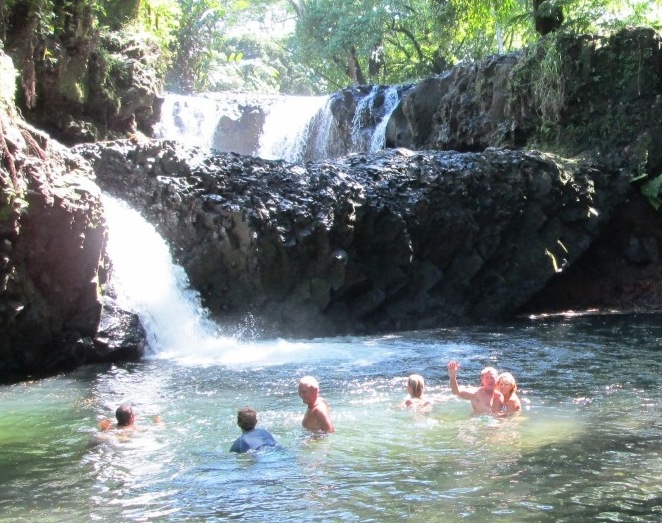
Next was Togitogiga Waterfalls where we swam under the lower falls which were not very high, but the current was very strong and it was difficult to get up close!

That's us waving on the far right!

Our 3rd waterfall of the day was Sapoaga Falls. By the entrance to the falls was a mailbox called the Honesty Box - if no one was at the gate, you were to put your entry fee into the box!

Falls crashing into vast gorge behind us...

The grounds had displays of an old Umukuka cooking house, Lali wooden drums, Kava plants, and a coconut shredder. We watched as a guide husked and shredded coconut meat and then squeezed the white flakes with raffia into a half coconut shell for everyone to try. Delicious!

Jordan holding shell as flakes are being squeezed

Jordan and I had purchased such a shredder several months ago and now, after tasting this treat, we'll be shredding and squeezing our own coconut meat.

Next stop: the To Sua ocean trench where we had a picnic lunch in an oceanside fale. A fale (pronounced fah-leh) is a round traditional covered structure with posts but no walls, is usually raised off the ground, and they vary a lot in size. Most homes have a fale in their front yards for family gatherings and/or celebrations. In fact, some even live in their fales, dropping mats or tarps around the sides for privacy when needed.

The gardens, flowers, and trees were immaculate as we wandered around the large, well-kept grounds. We also watched as a blowhole burst sea spume high into the air. Another fun formation was a tunnel originally formed by a lava tube that was in the rocks just at sea level and we had to make a run for it as the occasional ocean wave rushed through. Here is Cheryl of SV Gypsy Blues leaping up to escape the inrush of ocean!

Watch out!

The first trench, Le Sua, was for peering down into only but the second, To Sua, was an amazing sight. The tall steep ladder continued through the platform right into the ocean trench...

Time for a swim

The climb down was a little nerve wracking but the water was the perfect temperature for a hot day. You can only swim through the trench to the ocean at low tide. The tide was high when we were there but everyone could really feel the pull in and out from the surges of the sea through the underwater passage.

After great swimming, snorkelling, and even a bit of water ballet, we packed up and went back to the van for our last stop of the day.

SV Gypsy Blues had made reservations for everyone to spend the night at Taufau Fales next to the ocean.

Checking out our 4-person accommodation

The fales were very basic: mattresses on the floor with sheets, pillows, and mosquito netting provided. But what a view!! Also included was dinner and breakfast and as much coffee/tea as you wished. What a way to end a great day - lounging on the beach sand with a cold beer, swimming and snorkelling in the ocean, and visiting with great friends.

Sunday, September 23, 2012

Robert Louis Stevenson

Today at Samoa, along with friends from SV Libertad, we went to visit the Robert Louis Stevenson home and plantation, now a museum, on our rented motorcycles.

Robert Louis Stevenson (Teller of Tales as he was known by Samoans) is a well-known author of books such as Dr. Jekyll & Mr. Hyde, Treasure Island, Kidnapped...plus many more.

Stevenson home and museum as we approach

We toured rooms that still contained personal belongings including the Great Hall, library, sick room, smoking room, plus many bedrooms. And of course, there is now a Gift Shop on the premises for mementos and books, etc. if you so desire.

The family kitchen as pictured below was built as a separate building so that in case of fire it would be the only loss, not the main residence.
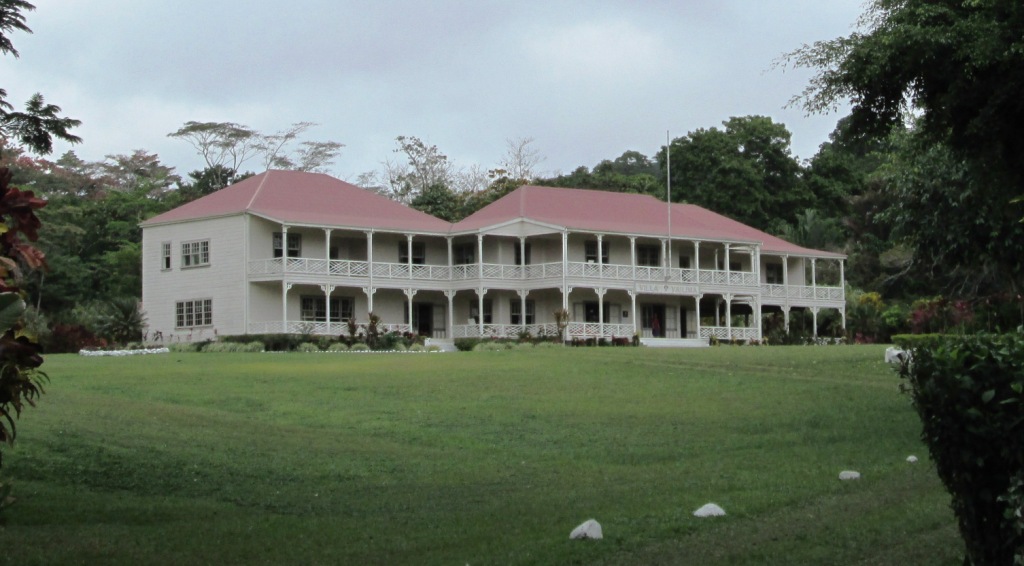
Quaint separate kitchen viewed from main house window

He and his family settled in Samoa after building their beautiful large home. His tomb is located atop Mt. Vaea above their home and plantation, where he was buried in a ceremony for royalty. We hiked up Mt. Vaea through the rainforest and looked down on the grandiose view.

Robert Louis Stevenson lived a short life, 1850 to 1894, and only lived in the Samoan family home for 4 years before passing away of tuberculosis after leading a full and accomplished life.

A favourite quote of ours by Robert Louis Stevenson is as follows:
Life is not always a matter of holding good cards, but sometimes of playing a poor hand well.

Saturday, September 22, 2012

To market, to market

We rented a motorcycle to explore Upolu, an island in (Western) Samoa, after picking up a couple of tourist maps and brochures.

It sure seemed strange to be driving on the left-hand side of the road instead of the right as we are used to. Jordan also had to purchase an additional page for his Driver's License validating it for use in Samoa.

We investigated the Savalalo Flea Market, full of beautiful Samoan handcrafts such as kava bowls, jewellery made from coconut shells, sarongs, etc. and next the Fugalei Market selling more handcrafts but also produce and local food. As we were hungry, we ordered some food and sat at a table. This ended our exploring as a sneaky older woman snatched our camera from behind our helmets on the table while Jordan was fetching a chair for her in the crowded market!

She had disappeared by the time we discovered her foul deed and we spent the rest of the day trying to find another reasonably priced camera (which we did). As the camera she had made off with was getting on in years, it wasn't a real loss and we had previously downloaded all the photos except for a couple from that day. Samoans are very friendly, honest people - this was a 1-time incident and we should have been more attentive.

A different market with produce in hand-woven baskets

Friday, September 21, 2012

(WESTERN) SAMOA

We left American Samoa on September 18th for an overnighter to (Western) Samoa. But we did not arrive until September 20th as we crossed the International Date Line! So we are now 1 day older than we should be. September 19th did not exist for us - we went straight from the 18th to the 20th as we travelled from east to west.

Any travellers going the opposite direction from west to east would gain 1 day - leaving on an overnighter on the 18th, they would arrive 1 day later but it would still be the 18th - I think we're going the wrong way! We heard someone on the HAM radio net saying that he was able to celebrate his birthday for 2 days instead of just 1.

Samoa switched time zones on December 29, 2011, to be in sync with New Zealand and Australia and in 1997 changed from being called Western Samoa to just Samoa, except on older globes or maps of course. But most people still refer to it as Western Samoa.

Dating back to about 1000 BC, Samoa is believed to have been inhabited from the west about 3,000 years ago. Consisting of 10 islands and 362 villages, Sea Turtle tied up to the marina docks on the Island of Upolu in Apia Harbour (S13°49.667' W171°45.565') on September 20th at 08:30 as anchoring is not allowed. Turtles were swimming in the harbour around the boats.

All officials arrived soon to check us in: Samoa Port Authority, Health and Quarantine services, Customs, and finally Immigration. As soon as we were all cleared in, we left for a refreshing walk to explore Apia, the capital city of Upolu, with a current population of around 35,000.

If you want to know where to find anything, first question to you is always Do you know where the clock tower is? and then directions are given from there.

Infamous clock tower

Another well-known landmark is the hotel Aggie Grey's which was a place for World War II GIs to rest.

Currency is Tala (dollars) and Sene (cents), currently being at the equivalent of about half: 1 Tala = about $0.50 USA. As all prices are indicated with the dollar sign, at first look you would think how expensive the item was until you remembered that it was in Tala and cost about one half the indicated price in USA dollars.

Monday, September 17, 2012

Near miss

Very strong williwaws have been blowing since our calm arrival in American Samoa but our anchor has been holding strong. Unfortunately, another boat dragged when it was unattended. It was almost upon Sea Turtle's bowsprit (we were ashore and unaware) when the owners returned and quickly boarded and re-anchored their boat. A happy ending for all concerned. Whew!

A traditional and very popular form of dress in American Samoa for both men and women is the lava-lava which is a wraparound skirt that is secured with an overhand knot in front. Bright patterns are for daily wear and solid colours are always worn in church. This skirt suits their body frames quite well as a very high percentage are on the rather rotund side. Perhaps this is due to the American influence of all the Pizza Huts, McDonald's, Kentucky Fried Chicken, Carl's Jr., etc. The following is worn for school, without the knotted front.

2 dudes ready for school

It is election time here, just as back in the USA. Signs are everywhere showing the candidates running for Governor, etc. I bet the USA candidates' signs are much different than here:

Complete with leis!

There are many, many, many churches on Tutuila Island. Did I say many? A strange custom, in our view, is to bury their deceased in their front yards, sometimes with large elaborate cement plots. It is also popular to have a structure, called a fale, similar to our gazebos in their front yards for parties and such.

We sensed that the economy is down and evidenced by the lack of new construction, dilapidated buildings, and signs indicating food stamps are accepted. This Island of Tutuila is obviously less affluent.

We had been hoping to do a few boat errands while here and thought that as American Samoa is a territory of the USA and as it is a marine-based industrial harbour, there would be some marine stores with available supplies, but there was not a single one on the island!

Our plan was to leave American Samoa today but when checking the weather, the winds were too intense. But we will do an overnight passage tomorrow evening towards (Western) Samoa...

Sunday, September 16, 2012

Great amenities

The American Samoans are THE friendliest people that we have ever visited! A few minutes after we anchored yesterday, a local boater came over and handed us a sheet listing the amenities in town, location of them and the cost, as well as any other important information that boater's always need.

The Samoans are always smiling and would go out of their way to talk to us or help us. Twice, someone rushed to help when we were carrying groceries to the dinghy along the rickety plastic dock and then held the dinghy in place in the heavy wind. When checking in, even the officials were sidetracked in friendly conversation with us and would ask if we knew where to go next. Just walking past a gas station, the attendant yelled out a friendly Hello to us!

Rickety docks in front of McDonald's

You have 2 choices for internet. The local McDonald's, 1 right by the docks, provides it for free even if you don't buy anything. (It was funny to see at 1 point about 22 computers going at once there.) Or you can buy a card from a company for $20 for 168 hours. Yes that's right - it works out to only about 0.12 cents per hour!! And we were paying $5.00 per hour in French Polynesia.

There are 2 great grocery stores (many more smaller ones) for provisioning and we stocked up - 1 has bulk items like Costco back in Canada (but a much smaller store) and the other is not bulk but has everything you could want. They are a bit out of town but the buses are only $1.00 each for almost anywhere you would want to go ($2.00 for a bus to the end of the route which is quite a long distance). The buses are pretty neat: very brightly painted and the driver appears to be sitting on the floor. They are old rigs with the cab cut off and a new passenger section built mostly of wood.

Very low and brightly painted rig-bus

There are several good restaurants here and very reasonable. We had excellent Chinese food for lunch one day and at a reasonable price too. And served by friendly happy waitresses. We have noticed a large Asian presence as we move farther west.

Saturday, September 15, 2012

AMERICAN SAMOA

On the second day of our passage from Suwarrow (Cook Islands), Sea Turtle chalked up another milestone: 20,000 nautical miles under her keel! For you land lubbers, that is about 40,000 kilometres or about 25,000 miles. Wow! It has been such a surpassing journey to date.

Our passage was very uneventful and much, much calmer than from Bora Bora to Suwarrow. Too calm in fact. We even had to motor the last day and a half.

The islands here are not surrounded by a reef like an atoll - but the coral (fringing coral) is against the island shores instead and there is no interior lagoon. The scene on approach is of tropical green mountains.

Five miles out, we detected the fish odour from the tuna processing facilities in the main harbour, Pago Pago, that we had heard about.

American Samoa in the distance

We have noticed as we move northwards that the sun is rising later in the morning and setting later in the evening; we set anchor at American Samoa (Pago Pago Harbour, Tutuila Island) on September 14th at 07:30 (S14°16.403' W170°41.767'), just as the sun was rising in very calm conditions. This meant that the boats in the anchorage were drifting around willy-nilly and we were not certain where anyone's anchor was; where we dropped ours at what we thought was a safe distance between other boats proved later to be no good as the subsequent winds stretched out an adjacent boat which then sat over our anchor float.

Soon the contrast between tropical beauty and a messy human element became evident. The debris in the harbour was a reflection of the rubbish on land. We were presented with the din of commerce as well as the wafting odours.

Tuesday, September 11, 2012

History

We snorkelled with great visibility near the reef at Suwarrow (Cook Islands), seeing the usual fish but very few shells. But an interesting item on the ocean bottom just inside the reef was remains of the keel of a sailboat which could be clearly seen. Wonder what the sad story behind that is?

A chore before our next passage had Jordan diving to clean certain parts of Sea Turtle's bottom and her propeller. As soon as he splashed into the water, an overly inquisitive 4-foot black tip shark was a menacing presence that he had to chase off several times. Yikes! They are not known to be the dangerous type but it still makes you uneasy when they are not near the reef.

Harry and Ants (the 2 Park Rangers) agreed to give a talk on the history and culture of the Polynesian and Cook Islands. With an inquisitive Question & Answer session, a lot was learned from these 2 gentlemen, including that it is considered an insult to say No when requested to dance with a Polynesian! After the discussion, the cruisers then laid out their potluck treats for everyone to enjoy.

We weighed anchor with difficulty at 15:00 on September 10th. The sandy bottom was scattered with small coral heads that our anchor chain kept grabbing as it was being raised. Bill of SV Watermusic jumped in the water and continually pointed us in the right direction so our chain could be dragged clear with as little damage as possible to the coral. Thanks Bill!

Jordan preparing to weigh anchor

Leaving idyllic Suwarrow behind

Sunday, September 09, 2012

High winds

As our anchorage near the mouth of the entrance to Suwarrow (Cook Islands) was getting quite windy, we moved closer to shore (S13°14.880' W163°06.493') once a few boats had left a couple of days later.

Park Ranger Harry told us that weather patterns have been changing. Winds have been increasing at Suwarrow in the last several years, and in the past, they were never over 16 knots. A beach hut that was built just last year, and should last for about 5 years, now needs to be re-roofed because of the strong winds. Cruisers offered to fix the roof but were told that Polynesian women would soon be coming to make a new one from the palm fronds.

Falling down sailors' hangout

So we hunkered down and I sewed the next 2 flags we would need for Samoa and Tonga. Jordan fixed the slackened prop break (it engages while the motor is off to stop the prop shaft from turning which is a safety for the transmission) and painted a picture of Sea Turtle on a scrap piece of wood to hang at the shack on shore, affectionately called Suwarrow Yacht Club, along with all the other hangings and flags left by previous cruisers.

Jordan and Judy with Jordan's painting

Our snorkelling, bird watching, and coconut crab excursion with Park Ranger Ants (Antony's nickname) and other cruisers was cancelled due to the high winds. We had been so looking forward to finally tasting this delectable crustacean.

Friday, September 07, 2012

Double jeopardy

Jordan went fishing near the entrance to the lagoon of Suwarrow (Cook Islands) with a couple of other young cruisers in their inflatable dinghy. They caught a few fish but also ran out of gas. Smartly, Jordan had taken the handheld VHF. It was late in the day when he radioed me and after telling me of their problem, the batteries of the VHF started to fade. Double jeopardy!! I put out a call for help which SV Lisa Kay thankfully answered with a tow as the sun set beneath the horizon.

We later cooked one of the fish of the foray and discovered its red meat was very delectable - a Rainbow Runner.

Fish are very abundant in the lagoon - sailors are even catching them right off their boats. After cleaning of the daily catch, people would throw the scraps to the waiting frenzied sharks on the outside of the lagoon (never on the inside of the lagoon where boats anchor and everyone swims and snorkels because it encourages sharks).

We watched as the mostly black tip sharks (plus 1 large gray and a few white tip sharks) voraciously snapped up the meat scraps. Falcon, who is about 20 and has lived all his life aboard SV Beaujolais with his parents, hand fed them and even grabbed one by the tail and lifted it up to the woo's of all the spectators.

Thrashing black tip sharks in a feeding frenzy

With so many boats in the lagoon, there were also several youngsters aboard. So someone arranged a pirate treasure hunt followed by a wiener and marshmallow roast. The host also brought bread dough for the kids to roast over the fire on sticks. Jordan and I also brought some of our own bread dough to try in this manner and discovered how tasty it is. Another first and something that we would do again!

A sailors' beach get-together

Unfortunately, a fast moving squall passed over us and it poured rain for at least half an hour after the treasure hunt but no one seemed to mind and once it stopped, the festivities continued.

As evening approached, Harry brought out his guitar and both he and Antony (the 2 park Rangers) sang a few Polynesian songs as well as several popular songs. The cruisers joined in but everyone seemed to struggle with the words and at times words were just made up when no one could remember - where are the song sheets!

Thursday, September 06, 2012

COOK ISLANDS - Suwarrow

It was once again time to continue our westward track so we broke the bonds of Bora Bora at 14:00 on August 30th - the last island/atoll of the French Polynesia Archipelago for us. We had wanted to stop at 1 more - Maupiti - but the wind was blowing too strong for a safe entry.

The strong winds whipped up a confused sea and the motion was very rolly. As the sun sank and night overtook us, we had 1 young, tired, yellow-footed boobie bird spend the night on the dinghy davits at the rear of our solar panel with its beak perilously close to our spinning wind generator. The concern was not only for our visitor's well being but if he was to make contact with the spinning blades, it would be sure to damage them, making the generator non-functional.

Our wind generator has been a valuable supplemental charging unit, to the extent that we rarely have to use the motor's generator. It was amazing to see how our avian visitor was able to perch and even sleep with its head tucked back under its feathers while the boat pitched and yawed in the turbulent seas. Jordan went out and reached under the solar panel and poked the young bird who immediately withdrew his buried head and gawked around dumbfounded. It was evident that he was there to stay for the night.

Our destination is the remote atoll of Suwarrow which is 1 of the northern Cook Islands. Among many boaters, it was a great debate whether to take this more northerly route or the more southerly one, weather being the great decider.

A few boaters leaving Bora Bora around the same time as us headed towards the south islands of Rarotonga and Palmerston, etc. but soon changed course for Suwarrow as they were bashing into heavy headwinds. We had originally wanted to go south but after checking grib files, we chose the more northern Suwarrow route, and even then, we got a bit of a whomping. We checked into the HAM net daily, giving our position and progress, and listened to the other boats enroute who all complained about the sea state.

It's always a joy though to be out to sea again. To enjoy the solitude of just me and my favourite Captain under a full moon. To witness the shades of the differing blues of the open ocean - this time a deep purple blue. To revel in the total silence from city life. To feel free!
The six degrees of freedom are what naval architects call the six different motions that a floating vessel makes: Rolling, Pitching, Yawing, Heaving, Swaying, Surging.
The above quote is from a great book, Moby-Duck, by Donovan Hohn. (Yes, Moby-Duck, not Moby Dick.) I think we felt all 6 on this rough 6-day passage!

After dropping anchor (S13°14.962' W163°06.724') at 10:00 in the protected waters of Suwarrow's lagoon, we both let out a breath of relief and relaxed briefly to the gentle sway of the calm waters with 29 other boats nearby!

Suwarrow was indeed a great choice. The Cook Islands are now self-governing and has been declared a National Park. There are only 2 residents - 2 Park Rangers - for 6 months each year. (The Park closes down in November each year.)

Suwarrow is a very peaceful and beautiful with clear blue waters and the best visibility we have found yet. It is a typical atoll, comprised of mostly lagoon, ringed and protected by coral reefs with waves breaking over interspersed very low-lying motus covered with mostly coconut palms.

These atolls are a danger to the nocturnal mariner as they are barely visible in the blackness of night. As one approaches, there is a heightened awareness and uneasiness. But the attentive sailor is usually rewarded with the sight of shimmering foam and the roaring of the breakers that makes the reef outline discernible. This atoll was originally called Suvorov after a Russian general who claimed to the first to discover it years ago. Of course the native Polynesians beg to differ and they are sure to tell you that now it is called Suwarrow, the preferred name by these ancestral people.

(This place is known by several other names also: aka Suvarov, Suvarou, and with many other spellings of Suwarrow.)

Once ashore, we completed the check-in procedures with hospitable Harry, a Polynesian native of Cook Islands and 1 of the 2 Park Rangers, for a cost of $50 per boat. It's so nice to once again be back in areas where English is considered a main language!

Tied up at the dinghy dock

Park's amenity (swing hanging from tree)

Where to next?

The assistant Park Ranger, Antony (nicknamed Ants) was escorting about 10 cruisers in the Park's panga to another motu 4.5 to 5 km (7 to 8 miles) away for snorkelling, bird watching, and coconut crab collecting. This is something that Ants is amenable to doing if the cruisers congregate themselves and provide fuel for the panga as there is NO fuel available here.

Harry and Antony both love their paradise reclusive jobs at idyllic Suwarrow even though they have to leave their families behind for 6 months each year - Antony has 8 children and 8 grandchildren! Both intend to return next year...

Harry's and Antony's kitchen