Saturday, October 20, 2012

Ha'apai Group: Lifuka and Uoleva

After leaving the Vava'u Group of islands (Tonga) yesterday, we checked into the Ha'apai Group at Lifuka Island at 10:00 (S19°47.983' W174°21.239'). The gentleman was very friendly and allowed us to check in and check out of the Ha'apai Group at the same time. This meant that we could visit different islands and then not have to return to Lifuka to check out several days later. SV Buena Vista was allowed the same courtesy.

Next stop was the Mariner's Cafe for lunch where everyone was craving burgers but I tried Ota Ika, raw fish mixed with coconut cream, lime juice, and spices. It was very tasty - similar to ceviche but with coconut cream.

Jordan, Debbie, and Don at cafe

The village seemed to be very laid back and rather poor, with several decrepit buildings and homes. But the people were friendly and these giggling young ladies, wearing traditional Tongan mats, were thrilled to have their photo taken. One young lady also took a photo of the group of us with her own camera.

Lots of colour

It was hot out so we tried 2 small grocery stores for ice cream but all they had were large 2-litre pails. We finally bought a small container of banana ice cream at a liquor store! We were also able to pick up a bit of fresh produce at the small market.

Several youngsters were at the pier when we returned to our dinghy. After we climbed down the steep ladder, 1 youngster jumped into the ocean and was then quickly followed by the rest of the pack!

Should we jump? YES!

All stocked up, we left Lifuka for the next island only 4 miles away and set anchor at 16:50 at Uoleva (S19°51.070' W174°24.987'). We walked along the long, sandy beach but only collected a couple of shells.

Jordan in contemplation

We passed by a camping structure that was equipped with solar panels, water catcher, a cooking area, and sleeping quarters. We briefly talked to the young Australian couple living in it who said their dad owned a boat anchored out front. From the growth on the hull we could see the boat had been there for some time. The boat was an Endurance, same hull as ours.

Just like Gilligan's Island!

Further along the beach, there was a small resort (the word resort is a stretch) with very basic cabins where you could just veg out and get away from it all.

Friday, October 19, 2012

Matamaka Island

We felt a strong boat vibration early this morning and were wondering if it was an earthquake. We later heard on the VHF Net it was indeed an earthquake tremor measuring 5.5 at 06:23 and was approximately 32 km (20 miles) away from our anchorage. This was the second tremor felt in this area in the last 2 weeks. We were surprised that we could actually feel the tremor in a boat. A sailor reported seeing many fish jumping about 10 to 15 seconds prior to the tremor.

Humidity has been quite high at 73%. I will need to scrub the dodger again with bleach to get rid of the mold that has started to grow again. It's been a long time since it needed to be done.

We pulled anchor from Lape Island (#17) to make the short voyage to nearby Matamaka Island (#15) which was only about 2.6 km (1.6 mi) away (S18°42.635' W174°04.146') where we were escorted by a couple of friendly young girls to their school. School was out but the teacher was still there. She told us that there are 20 pupils who will later attend secondary school at Vava'u Island. Once in secondary school, the students will spend the week at Vava'u Island and come back to Matamaka Island on weekends and holidays.

The school was brightly decorated with learning posters, English library books donated by cruisers for the students (and teacher) to read, and postcards. The students love to receive postcards from all over the world as they examine the globe to see where the postcards came from. If you wish, please send a postcard to the school at the following address:

G.P.S. Matamaka
P.O. Box 138
Neiafu, Vava'u
Kingdom of Tonga

The students are also taught the importance of not littering, especially around the ocean. The teacher showed us a video of coral being planted in the ocean around Matamaka. What a great concept if the planted coral is able to survive. The children are taught the importance of all sea life and coral so therefore never to walk on it or destroy it. She also told us that sea turtles nest on Matamaka beach.

Jordan in doorway of Matamaka School

After our visit, we pulled anchor at 17:30 for an overnighter to the next group of Tongan Islands which is called the Ha'apai Group. SV Buena Vista left at about the same time as we did and we chatted with them on VHF during the passage.

We have been using a new set of digital charts called OpenCPN which are actually New Zealand paper charts that have been digitized. They have been bang-right-on every time so far. So we mapped our track on the chart, weaving through the islands and set out for an overnight voyage.

Thursday, October 18, 2012

Coral Wonder

Still anchored at #17 Lape Island (Vava'u Group, Kingdom of Tonga), Jordan dinghied me over to what is called the Coral Wonder (in the area of S18°43.67' W174°05.49'). The tide was coming up but was not quite yet high enough to motor across the reef in the dinghy. So we got out, raised the motor, and slowly and carefully pulled the dinghy over the reef as the tide surged in.

I had to snorkel alone as Jordan could not get his stitched wound wet with salt water. Colourful coral was everywhere and I saw a few varieties that I had never seen before such as the large flat circular ones that rose from the ocean bottom on a stalk just like a flower.

Coral Wonder was very beautiful, or perhaps I should say wondrous! Jordan was able to peek in by holding a snorkel mask on top of the water. I also saw a few fish and colourful blue starfish.

(Unfortunately, no photos as no replacement underwater camera until we return home to Victoria for a visit at the end of the year.)

We pulled the dinghy back over the reef with a higher tide and then beached it on the other side of the island where we walked along the sandy untrodden seashore and collected a few shells.

Vacant beach

Wednesday, October 17, 2012

Lape Island

As Jordan was feeling perky after getting stitches in his scalp wound yesterday, we once again left Vava'u Island. We arrived around 13:30 at Lape Island which is #17 on the Moorings Chart and anchored by 4 other boats that were either anchored or on a mooring ball (S18°42.975' W174°05.125').

We went ashore to check out the village, which was very small with only 24 persons as of 2010. We walked past the market just in front of the dock where there was a little fruit, cloth wraps and dresses, and some creative weavings. We admired the intricate work of the young lady with her round mats and purses.

Very small market

Her dad gave us a few mangos from the hundreds that he was in the process of bagging for shipping to the main island and then pointed us up the path toward the village and school. As we were walking, we saw a man sleeping in the middle of the path. Yes, it's a tough life in the village!

We visited the primary school that has only 9 students, aged 6 through 11. Upon reaching the age of 11, students are then boated to Vava'u Island where they stay during the week to continue secondary school and return to Lape Island on the weekends.

As we headed back to Sea Turtle, we noticed a walking path so we beached the dinghy and walked through the trees and coconut strewn path. It was very peaceful and quiet and we did not see another soul.

Jordan heading back towards Sea Turtle

Tuesday, October 16, 2012

Caving and misfortune

Today we dinghied from Port Maurelle to the northwest end of Kapa Island (Kingdom of Tonga) to see the much talked about Swallow's Cave (around S18°40.933' W174°02.865'). We identified it by streaks of colour on the rocks. This cave is not actually nested by Swallow birds, but by Swift birds, many of which were present. We dinghied right into the large beautiful cave...

Should be called Swift's Cave

...where we saw a few snorkellers and other admirers of this beauty where you could see the sky through a hole in the top of the cave. We noticed 1 young man walking a ridge going farther back into the cave but we had unfortunately not brought our reef shoes with good traction.

Looking out the entrance from inside Swallow's Cave

Next we dinghied across a stretch of ocean over to another island where we could check out Mariner's Cave (around S18°41.4' W174°04.4'). We had been given the GPS reading, so once in the area we looked for a dark spot in the ocean water. This dark spot identifies where you dive into the water, swim under the ledge, and come up into Mariner's Cave. Sound scary? I thought so!

But Jordan said he would hold my hand and pull me down under the water. I know this sounds strange but I cannot yet dive down wearing snorkelling gear, my body just keeps floating on the surface until I am pushed down or pulled under.

We had been told of the beauty inside this cave so we both wanted to see it. Jordan dived in alone the first 2 times and said it was indeed very beautiful with a green mist of fog every time the tide surged in and out. There was a bright blue where the light would shine from outside the cave. He said I would be able to easily make it in with his help.

So I grabbed his hand, and with big breaths, we both went down. But as Jordan pushed me in, he came up too soon and soundly bashed his head into the sharp volcanic rocks. He was bleeding profusely so we left immediately before any sharks got whiff of blood. After a quick glance around inside Mariner's Cave, we both dove down and back out.

As we climbed back into the dinghy, Jordan was still bleeding very badly, as all head wounds do, and he had a flap of scalp hanging. We knew it had to be treated by a professional so once back at Sea Turtle, we immediately headed back to Vava'u Island, about 1 hour away.

Jordan called on the VHF radio for a doctor and the sailors back at Vava'u Island immediately started calling around. They arranged for the local doctor to wait at her office until we arrived, saved a mooring ball for us to tie up to, and dinghied us ashore when we arrived so we would not waste time putting our own dinghy back into the water. On board 1 boat, there was a doctor who said she could patch up Jordan if we could not reach the doctor ashore. Wow - sailors are always there when you need them and all this help was sure appreciated by both of us!

Once at the doctor's office, she agreed that Jordan's head was in quite a mess. She shaved the area and put 8 stitches in the 2 flaps of torn scalp. Don't look at the next pictures if you are squeamish!!!

2 flaps of scalp hanging open for cleaning

Jokingly, Jordan refers to the 2 cut open flaps of skin as his 2 burgees on the port side. Amazingly, he said it hardly hurt at all. And now, sadly, he cannot be in the salt water, so no snorkelling for 7 to 10 days until it has healed and I remove the stitches.


Monday, October 15, 2012

Vava'u Group - Kapa Island

We released the ties of our mooring ball at Vava'u Island (Kingdom of Tonga) on a sunny day around 14:00 to explore some of the islands and anchorages, the first and most northern set being the Vava'u Group.

A Moorings Chart is produced that has several circled numbers on it (along with several published guides). These numbers correspond to moorings/anchorages/places of interest. Sailors always refer to these numbers, especially when conversing on the VHF radio: Where are you? with a reply such as Oh, I'm at #16.

Our first stop was at #7, Port Maurelle of Kapa Island, only about an hour away where we set anchor at 15:00 amongst 12 other boats (S18°42.014' W174°01.788').

We immediately went snorkelling in the warm water and walked the sandy beach. We saw many of the usual fish but were treated to an eyeful of 3 very large and very bright purple starfish! Purple seemed to be the dominant colour as we also spotted purple coral. Snorkelling is always a new adventure!

Sunday, October 14, 2012

Too many officials

Most of today was spent checking out from Vava'u Island of the Kingdom of Tonga. We had to go to Immigration, the Port Authority, and Customs. This was strange as we weren't leaving the Kingdom of Tonga, we were only leaving this Island.

The walk to Immigration was at the middle of town where we had to wait for about an hour for people ahead of us. Then the official was upset with us as we did not go to Immigration when we checked in. We had been told previously by officials that we only had to check in with Customs as we had already checked into the Kingdom of Tonga at Niuatoputapu, but he disagreed.

Next was the Port Authority. This tiny hole-in-the-wall office was several long blocks from the town center and nowhere near the water. Very strange.

Jordan filling in the paperwork

Finally, was Customs with more papers to fill out - almost identical to the ones we filled out when we checked in. Hmmm, is this not already stored in their computers? He also said we were not allowed to stop at any islands in the Vava'u Group but had to go directly to the Ha'pai Group. We said we definitely wanted to stop in the Vava'u Group so he agreed to give us a few days grace. This was an issue we had never encountered before in our travels but smiled and said goodbye.

We were expecting company for dinner on Sea Turtle but it was late and our dinghy's motor was out of operation as the shear pin had broken once again. So we called our guests-to-be on VHF and had them meet us at a restaurant instead where we treated them for helping us with our computer. They then towed us back in our dinghy to Sea Turtle.

A nice end to a long and frustrating day.

Sea Turtle at Vava'u Island

Saturday, October 13, 2012

Taste of Tonga

We made a date with Sam of SV Suvretpa to take a tour of Taste of Tonga. This is a zero waste enterprise (www.tasteoftonga.com) that was fully explained to us by the owners, Ian and Vanessa. We saw how they:
  • make virgin coconut oil for baking and frying, using on salads and ice cream, or just eating from a spoon
  • make taro and manioke chips for snacks
  • make coconut vinegar and cheese
  • using dried shredded coconut, make pig and chicken food
  • grow maggots in shredded coconut as protein for pig and chicken food
  • from discarded coconut husks, make a type of peat  moss
  • make charcoal by burning scrap wood and tree cuttings around barrels filled with empty coconut shells
Ian and Vanessa have fully automatic, biodegradable, multiplying lawn mowers - sheep! They also have chickens, a rooster, and pigs. At the start of our tour, we witnessed 1 of many wild roosters being trapped in a Tongan trap which Ian then discreetly slaughtered for dinner that night (this was not supposed to be part of the tour!)

After the tour, we were treated to a sample of their coconut cheese with Vanessa's homemade chili jam. We purchased some of this delicious cheese along with the coconut oil after learning of all of its benefits. We chose to buy the coconut oil packaged in a squeezable pouch rather than a round hard container as the pouch would not spill in a moving boat!

Coconut oil, as well as tasting great, has claims of showing improvement for Alzheimer's Disease patients, is good for diabetics as it has zero cholesterol and helps to stabilize blood sugars, and contains Lauric Acid which has the same benefits as breast milk.

Jordan and Sam at Taste of Tonga

Friday, October 12, 2012

Fleas!

Several folks suggested Augustine's Circus Spectacular at The Baby Grand Theater was a must-see. A circus, I thought, I don't want to see a circus. But we bought tickets and were told NOT to be late.

There was only a small group of us (13) when the ticket taker opened the doors to the small foyer where we all squished in as he took our tickets and locked the doors behind us - ergo, don't be late!

Next, after a quick change of clothes, Augustine (who was also the ticket taker) opened the curtains of the foyer and escorted us into the teeny theater that seats 12 on 3 rows of foam padded wooden seats. The 13th person sat on a chair in the center aisle.

This was a 1-man show that was very comedic. He had a fabulous puppet, telling the story of a doomed presentation of a flea circus as it was acted out by fleas (Fifi, Jimmy, and Hercules) which were quite invisible but very entertaining nevertheless.

A very bad photo of the story-telling puppet...


Thursday, October 11, 2012

Vava'u Island

We left Niuatoputapu (Kingdom of Tonga) at 17:15 on October 8th after saying goodbye to everyone. We had a strong east wind that we had to beat into to get out of the lagoon around the Island before we could set our southerly course to Vava'u. Winds became southeast and strong for most of the trip but Sea Turtle does well in strong winds from most any angle.

Once we got in the lee of the main islands in Vava'u in the early hours of the morning, the islands sheltered us from the winds and we motored up the channel and into Koko Bay. On the way in, we passed lush green slopes and some interesting shore cliffs with caves. There were many boats sheltered at Koko Bay that use it as a base for great local cruising in and about the many islands here.

We tied up to a mooring ball at 08:15 (S18°39.846' W173°58.972') in front of the capital town of Neiafu. After a bit of a rough passage, it was so nice to be in such a calm harbour. It was exciting to see a few friends that we had not seen in a long while, including SV AKA and SV Buena Vista that we met in Mexico and SV Suvretpa that we met while in Chile.

After checking in with Customs, we wandered around the small town of Neiafu. There were a lot of waterfront restaurants, 2 teeny tiny grocery/hardware stores stocked with only a few basics, and the open air Utukalungalu Market of fresh fruit and vegetables. Glad I don't have to remember these complicated Tongan names! The market, besides produce, also has a section of homemade crafts such as tapas (pounded and painted bark of trees), baskets and other weavings, and carvings of bone and wood including ironwood (a type of hardwood).

It looks like this small building next to the gas station probably really needed an expansion but this blue addition really hangs over the road down below it. I wonder what Jordan is thinking?

Architectural disaster or wonderment?

One gentleman we spotted decided his pet pig needed a bath. So into the ocean they went as he gave his pink friend a wash with a bottle of pink soap.

Scrub-a-dub-dub

Monday, October 08, 2012

More experiences

It has been raining off and on for several days at the Tongan island of Niuatoputapu, but when it was announced on the VHF radio that humpback whales were spotted nearby, Jordan and I hopped in the dinghy to see if we could spot them up close. It started to pour but we continued and did see several spouting. We even saw 1 large whale tail as the whale came up to dive down (no whale tale!)

The next day, all the women sailors (and a few men too) came to the community hall to watch the local women weave their intricate mats.

Mat in process of being made

The hall, a basic wooden structure with no furniture, was filled with women weaving and singing, women caring for babies, the occasional woman resting or napping, and of course all the sailor spectators. The locals at first weaved very slowly so we could see how they did it and then later displayed their speedy Gonzales fingers as they weaved unbelievably fast.

Each mat, usually about 6 feet by 15 feet, would be worked on by 4 women all day every Friday. Then each group of 4 would meet at 1 of their homes to continue working on the mat each and every day except Sundays and only occasionally on Saturdays. The mat would take about 1 week to complete - if the mat was 20 feet long, it would take about 2 weeks.

Busy weaving with many spectators

These mats are used on floors to sit and/or walk on but smaller versions are also worn by the women, men, and children for special occasions and can even be worn daily. They can be painted with a dye, decorated quite lavishly, or kept fairly simple. When a death occurs, the degree of mourning can be established by how close the mat extends to the woman's underarms. They are worn over black clothing when in mourning and are tied around the waist. I think folks must get incredibly hot beneath these heavy mats.

On Sundays, work is not allowed. Locals can only sleep, eat, and go to church which is considered to be very important in their lives. We had the occasion to see several of the beautiful mats being worn when we attended church one Sunday. They all seemed to have exceptional singing voices as we listened to the hymns sung in native Tongan language.

Getting ready to enter church

Posing with Jordan after church - check out the beaded detail

Thursday, October 04, 2012

Pig roast and kava

We have been noticing an abundance of animals at Niuatoputapu (Kingdom of Tonga) since our arrival...horses, dogs, chickens, and so many pigs with their cute little piglets! Everywhere you turn, the piglets are running as fast as they can after their moms, some even as young as 2 days old.

Cutest 2-day old piglet with its mom

All the sailors in the anchorage were invited to a pig roast including traditional food and fish. Everything was cooked outside with 2 pigs being roasted on a spit.

Our hosts, Sia and her husband Niko (who had been the guide on yesterday's volcanic hike), explained what all the different dishes were once they were lavishly spread out on the table. There was taro root, taro root leaves cooked in cream shredded and squeezed from coconuts, fish, roasted pig, freshly squeezed mango juice, some type of dessert, and many other dishes that I can't remember the names of. The entire meal was delicious.

Outdoor kitchen that produced excellent food

We also had the experience of tasting the kava drink. This is something that we had been dreading since reading literature about it. In the old days, the women would all chew the kava roots till it was the right consistency and then spit it into a large kava bowl. The Chief would declare when it was ready to be consumed and a coconut cup would be passed around for everyone to partake. It would be considered rude to decline.

But fortunately, kava is now prepared in a more sanitary manner. The roots were pounded and the juice sieved into the large kava bowl and mixed with water. With everyone sitting around the bowl cross-legged, an amount was ladled into a few empty coconut shells and passed around for anyone wanting to taste and share the experience. We both did - more than once! - and found it to be quite bland, kind of like dishwater, and it made our tongues and lips numb. But it was not the horrid taste we had been expecting.

Jordan tasting his first kava under watchful eyes

Adoption among relatives is very popular and widely accepted in Tonga. Many couples adopt children of relatives for an abundance of reasons, as did Sia and Niko. And it is customary for older male children to sleep in a separate abode as we also saw while visiting this family.

Our gracious hosts, Sia and Niko

Wednesday, October 03, 2012

Volcanic hike

Jordan joined many of the other sailors in 2 pangas for a wet ride over to Tafahi Island, about 6 miles to the north of Niuatoputapu Island (Kingdom of Tonga) for a hike to its summit.

Tafahi Island is a cone-shaped extinct volcano, covered in lush tropical vegetation with less than 40 inhabitants, mostly living there to farm the slopes. There was no barrier reef to form a protected lagoon. The beach landing was done through a short channel dug out of the coral that fringed the island. All hands hauled the boats over small logs up the beach for protection from the waves.

2 loaded pangas heading to volcanic island

At first, the hike was down the beach before climbing stairs to the smattering of shacks that make up what is called a village. On the way up, they were met by a farmer with his horse carrying huge stalks of taro root and a couple other villagers carrying a squealing pig hung upside down on a stick, all heading to the pangas for a ride back to the main island of Niuatoputapu.

It was a strenuous 2-hour hike up to the top, through thick tropical bush patched here and there with small plantations of banana, papaya, taro root, kava, mango, even a mandarin orange tree dripping with ripe fruit. Oh yes, of course the ever present coconut palms, one of which the guide (Niko) climbed, knocked down enough coconuts for all, and hacked the tops with a machete for the thirst quenching liquid inside.

For the collected fruit, Niko chopped down a palm frond, and within 5 minutes, weaved a carrying basket.

Nature's basket


The summit was shrouded in misty clouds so the photo shots didn't see the island they had departed from (Niuatoputapu) but the stop made a great spot to do lunch. The down-hike was through dense Jurassic Park-like forest, woven with vines, vanilla plants, giant ferns, orchids, and many other topical species.

No dinosaurs

Before boarding the pangas again, a local lady had cooked up some taro root in a chicken broth and spices that all sampled. Jordan thought it to be similar to potatoes but more delicious.

On the ride back, Niko threw out a line and within 10 minutes caught about a 12-pound tuna!

Tuesday, October 02, 2012

TONGA - Niuatoputapu

After a 36-hour passage (1 day and 2 nights with a full moon), we entered a narrow pass into the protection of the lagoon behind the barrier reef of Niuatoputapu (S15°56.443' W173°46.013'). Our arrival made us boat #14 in the anchorage of this remote island settlement of the Kingdom of Tonga. Our passage had been a combination of sailing with good winds but also a few hours of motoring.

Tonga was called the Friendly Islands by Captain James Cook. There are 150 islands but only 36 are inhabited.

Another boat, SV Gypsy Blues, made it in just before us and the Customs, Immigration, and Agriculture officials were already out in the anchorage processing them, so they came right over to check us in. A straightforward process, with a payment of about $50 - that required us to go ashore and walk for about 45 minutes in the HOT sun and pesky mosquitoes to the Western Union shack to have some US dollars exchanged into the Tongan currency called Pa'anga. Then the expected visits to the officials' office for payment and receipt. Offices were very basic, a wooden structure with only 1 or 2 desks and a couple of chairs, not a lot of furniture or supplies.

As we approached shore in our dinghy, this young man appeared quite surprised to see us...

Hey, who are you!?

There are about 800 residents here now. A couple of years ago, the island and its residents (then about 1,000) were seriously affected by a tsunami from an earthquake about 100 miles north. The waves washed inland as much as a mile and 9 people lost their lives and caused many to move away. We could see the results still today in the dead trees, some washed out to the shallows.

We had several sea turtles swimming in the vicinity of our boat and we also saw this one on the road as we walked towards officialdom!

Sea turtle road patch

Sunday, September 30, 2012

Leaving Samoa

The next few days of our stay at Apia (Samoa) had Jordan recuperating from a tiring head cold, doing a few boat jobs, and the usual provisioning and check-out. Regrettably, he had passed the bug along to several cruisers during our 2-day tour...sorry guys!

It has been SOOO hot and humid. And no wind. We couldn't even turn on our fans as the controller for our solar panels broke down so we could no longer get any charge from them. This meant having to run the engine every now and again as there was no wind for our wind generator.

We couldn't plug in at the marina as power is 220 volt. Fortunately, another cruiser had a spare controller and graciously lent it to us till we can replace ours in New Zealand. Our list of boat jobs to do in New Zealand is constantly growing. Maybe Jordan should run a fast food business here instead - it already carries his name!

Fish and Chips, anyone?

We untied from the docks at Apia (Samoa) at 17:30 on September 29th for a 2-nighter to Niuatoputapu (Kingdom of Tonga). Sailors often refer to it as New Potatoes but once we arrive, we will have to pronounce it properly so we have been practicing!

Wednesday, September 26, 2012

Daring feats

Day 2 of our Upolu Island (Samoa) tour for our group of sailors, we picked up a guide to direct us to a long extinct volcano to view the crater where flying fox bats make their home. It would have been very difficult to find the entrance to the trail without a guide.

Our guide, Lafo (call him Max he said), explained the bats were all unfortunately across on the far side of the crater due to frequent visitors. We could see a lot of small, black, flying objects flitting among the trees but they were so far away. Click on following photo to enlarge.

Cute face of flying fox bat circled in red

Upon our return from the steep crater walk, Max shimmied up a coconut tree, tossed down several, and then removed the husks with a tree twig that he whittled to a sharp point - passing them around for us to quench our thirst with the delectable liquid.

Our guide Max with first taste

We saw 3 different waterfalls yesterday and went to 1 more today - Fuipisia Waterfall, 55 metres of cascading water in the jungle. We could see the falls as they crashed into the vast gorge...


...and then we walked the short trail for a closer look. Jordan and I sat at the edge and peered way down below.


One person got a little too close, losing a thong, but no one was brave enough to grab it as it tumbled over the edge!

Heading back towards Apia and everyone's sailboats, our next experience was the Papase'ea Sliding Rocks. Here, you walk down about 150 stairs to where the sliding rocks are. Then you sit at the top of the rocks where water cascades over them and you slide down 5 metres or so into a deep freshwater pool. If you dare.

I was scared-stupid and it took me awhile before I worked up the nerve to propel myself down. Jordan was down below in the water with the video camera, trying to encourage me. When I finally did it, it was a riot!


Nearby was another slide where you would fly off the end of the rocks and land in the water below. Here is Jordan landing in the water after soaring off the rock edge...


Good idea to get safety advice from the regulars if you plan to come here.

To finish off the day, we all met at an ice cream shop across from the marina and watched an excellent performance of local Fire and Sword Dancers, both experienced and new trainees.

Tuesday, September 25, 2012

Tour time

SV Gypsy Blues organized a 2-day tour of Upolu Island (Samoa) in a rented van for 15 cruisers. The first day included 3 different waterfall sites and an unusual swimming trench.

Here is a photo of the group: Judy and Jordan (Sea Turtle), Roderick (Happy Bird), Andy (Tina), Lisa (Lisa Kay), Helena and Gary (Merilelu), Dennis and Virginia (Libertad), Matt (Gypsy Blues), Yvonne (Happy Bird), Rene and Cheryl (Gypsy Blues), and Ben (Lisa Kay). Recognize anyone you know?

Photo taken by and courtesy of Larry of SV Lisa Kay

Behind the group was beautiful Papapapai-Tai Falls which is a 100-metre fall that you can only view from a distance.

First waterfall we visited

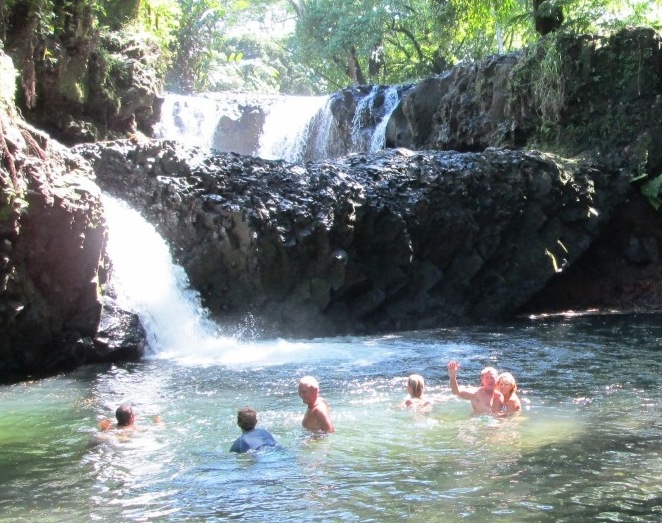
Next was Togitogiga Waterfalls where we swam under the lower falls which were not very high, but the current was very strong and it was difficult to get up close!

That's us waving on the far right!

Our 3rd waterfall of the day was Sapoaga Falls. By the entrance to the falls was a mailbox called the Honesty Box - if no one was at the gate, you were to put your entry fee into the box!

Falls crashing into vast gorge behind us...

The grounds had displays of an old Umukuka cooking house, Lali wooden drums, Kava plants, and a coconut shredder. We watched as a guide husked and shredded coconut meat and then squeezed the white flakes with raffia into a half coconut shell for everyone to try. Delicious!

Jordan holding shell as flakes are being squeezed

Jordan and I had purchased such a shredder several months ago and now, after tasting this treat, we'll be shredding and squeezing our own coconut meat.

Next stop: the To Sua ocean trench where we had a picnic lunch in an oceanside fale. A fale (pronounced fah-leh) is a round traditional covered structure with posts but no walls, is usually raised off the ground, and they vary a lot in size. Most homes have a fale in their front yards for family gatherings and/or celebrations. In fact, some even live in their fales, dropping mats or tarps around the sides for privacy when needed.

The gardens, flowers, and trees were immaculate as we wandered around the large, well-kept grounds. We also watched as a blowhole burst sea spume high into the air. Another fun formation was a tunnel originally formed by a lava tube that was in the rocks just at sea level and we had to make a run for it as the occasional ocean wave rushed through. Here is Cheryl of SV Gypsy Blues leaping up to escape the inrush of ocean!

Watch out!

The first trench, Le Sua, was for peering down into only but the second, To Sua, was an amazing sight. The tall steep ladder continued through the platform right into the ocean trench...

Time for a swim

The climb down was a little nerve wracking but the water was the perfect temperature for a hot day. You can only swim through the trench to the ocean at low tide. The tide was high when we were there but everyone could really feel the pull in and out from the surges of the sea through the underwater passage.

After great swimming, snorkelling, and even a bit of water ballet, we packed up and went back to the van for our last stop of the day.

SV Gypsy Blues had made reservations for everyone to spend the night at Taufau Fales next to the ocean.

Checking out our 4-person accommodation

The fales were very basic: mattresses on the floor with sheets, pillows, and mosquito netting provided. But what a view!! Also included was dinner and breakfast and as much coffee/tea as you wished. What a way to end a great day - lounging on the beach sand with a cold beer, swimming and snorkelling in the ocean, and visiting with great friends.

Sunday, September 23, 2012

Robert Louis Stevenson

Today at Samoa, along with friends from SV Libertad, we went to visit the Robert Louis Stevenson home and plantation, now a museum, on our rented motorcycles.

Robert Louis Stevenson (Teller of Tales as he was known by Samoans) is a well-known author of books such as Dr. Jekyll & Mr. Hyde, Treasure Island, Kidnapped...plus many more.

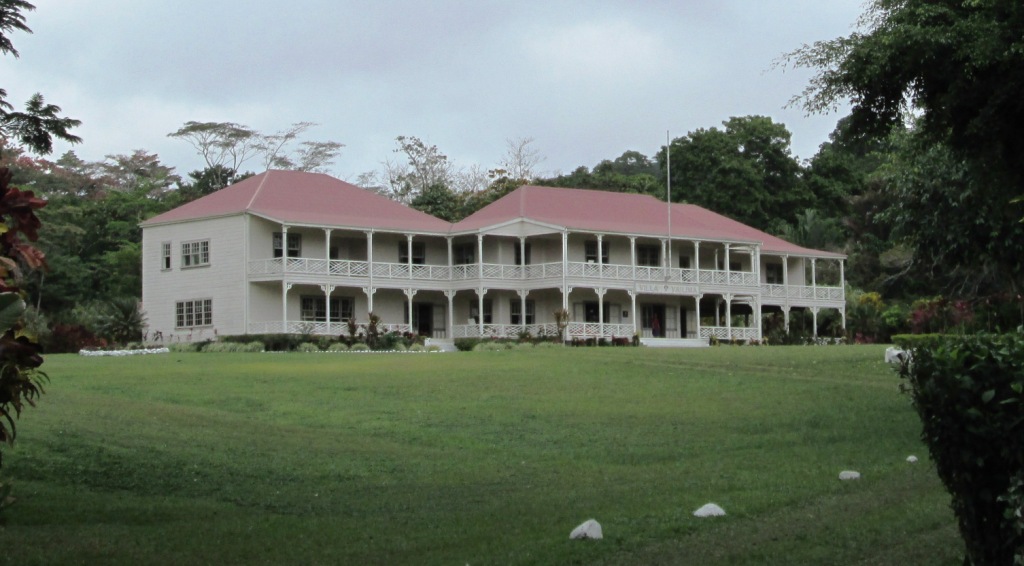
Stevenson home and museum as we approach

We toured rooms that still contained personal belongings including the Great Hall, library, sick room, smoking room, plus many bedrooms. And of course, there is now a Gift Shop on the premises for mementos and books, etc. if you so desire.

The family kitchen as pictured below was built as a separate building so that in case of fire it would be the only loss, not the main residence.

Quaint separate kitchen viewed from main house window

He and his family settled in Samoa after building their beautiful large home. His tomb is located atop Mt. Vaea above their home and plantation, where he was buried in a ceremony for royalty. We hiked up Mt. Vaea through the rainforest and looked down on the grandiose view.

Robert Louis Stevenson lived a short life, 1850 to 1894, and only lived in the Samoan family home for 4 years before passing away of tuberculosis after leading a full and accomplished life.

A favourite quote of ours by Robert Louis Stevenson is as follows:
Life is not always a matter of holding good cards, but sometimes of playing a poor hand well.

Saturday, September 22, 2012

To market, to market

We rented a motorcycle to explore Upolu, an island in (Western) Samoa, after picking up a couple of tourist maps and brochures.
It sure seemed strange to be driving on the left-hand side of the road instead of the right as we are used to. Jordan also had to purchase an additional page for his Driver's License validating it for use in Samoa.

We investigated the Savalalo Flea Market, full of beautiful Samoan handcrafts such as kava bowls, jewellery made from coconut shells, sarongs, etc. and next the Fugalei Market selling more handcrafts but also produce and local food. As we were hungry, we ordered some food and sat at a table. This ended our exploring as a sneaky older woman snatched our camera from behind our helmets on the table while Jordan was fetching a chair for her in the crowded market!

She had disappeared by the time we discovered her foul deed and we spent the rest of the day trying to find another reasonably priced camera (which we did). As the camera she had made off with was getting on in years, it wasn't a real loss and we had previously downloaded all the photos except for a couple from that day. Samoans are very friendly, honest people - this was a 1-time incident and we should have been more attentive.

A different market with produce in hand-woven baskets

Friday, September 21, 2012

(WESTERN) SAMOA

We left American Samoa on September 18th for an overnighter to (Western) Samoa. But we did not arrive until September 20th as we crossed the International Date Line! So we are now 1 day older than we should be. September 19th did not exist for us - we went straight from the 18th to the 20th as we travelled from east to west.

Any travellers going the opposite direction from west to east would gain 1 day - leaving on an overnighter on the 18th, they would arrive 1 day later but it would still be the 18th - I think we're going the wrong way! We heard someone on the HAM radio net saying that he was able to celebrate his birthday for 2 days instead of just 1.

Samoa switched time zones on December 29, 2011, to be in sync with New Zealand and Australia and in 1997 changed from being called Western Samoa to just Samoa, except on older globes or maps of course. But most people still refer to it as Western Samoa.

Dating back to about 1000 BC, Samoa is believed to have been inhabited from the west about 3,000 years ago. Consisting of 10 islands and 362 villages, Sea Turtle tied up to the marina docks on the Island of Upolu in Apia Harbour (S13°49.667' W171°45.565') on September 20th at 08:30 as anchoring is not allowed. Turtles were swimming in the harbour around the boats.

All officials arrived soon to check us in: Samoa Port Authority, Health and Quarantine services, Customs, and finally Immigration. As soon as we were all cleared in, we left for a refreshing walk to explore Apia, the capital city of Upolu, with a current population of around 35,000.

If you want to know where to find anything, first question to you is always Do you know where the clock tower is? and then directions are given from there.

Infamous clock tower

Another well-known landmark is the hotel Aggie Grey's which was a place for World War II GIs to rest.

Currency is Tala (dollars) and Sene (cents), currently being at the equivalent of about half: 1 Tala = about $0.50 USA. As all prices are indicated with the dollar sign, at first look you would think how expensive the item was until you remembered that it was in Tala and cost about one half the indicated price in USA dollars.