Monday, July 30, 2012

Tikehau

We exited Rangiroa through the westernmost pass and with a following breeze. We were on our way to Tikehau, another atoll of the Tuamotus of French Polynesia, a short distance away.

Abandoned sailboat and dream at Ava Toru Pass

We followed the north coast of Tikehau and entered its wide Tuheiva Pass with a strong tide running from the west end of the atoll. We dropped anchor before sunset just inside the entrance (S15°00.359' W148°16.227') along with SV Jabula at 17:20 on July 25th.

Fisherman's hut at pass entrance

Jabula graciously invited us to feast on their freshly caught mahi mahi.

The next morning, we pulled anchor to sail further into the lagoon about 8 to 10 nautical miles towards the village. Under a clear cerulean blue sky, brilliant and cloudless in the sunshine, we set anchor at noon (S15°06.951' W148°13.782') in front of the Pension Hotu, a small family-run establishment with 6 bungalows for guests (www.pensionhotu.com).

Peaceful atoll

On the 27th, we snorkelled near the white sandy beach in the clearest water yet. The visibility of all the coral and tropical fish was excellent. It seems to just keep getting better and better at each atoll.

On Saturday, we polished off a delicious but expensive continental-type breakfast at the Pension Hotu and then went for a long walk. We passed the quiet village, the deserted airport, and went as far as the end of the motu where we saw a small stingray swimming in the shallow water near the shore. By the end of our return walk, the heat of the mid-day sun overhead had tapped our energy.

On July 29th, we took Sea Turtle with Bruce and Jeannie (SV Jabula) aboard to a defunct pearl farm about half an hour away where we expected to find several manta rays at their feeding station. We snorkelled all around but no mantas were there at the time so we returned to our anchorage.

Abandoned pearl farm

Monday, July 23, 2012

Drift snorkelling

Jordan was fishing from Sea Turtle in the Rangiroa lagoon when he snagged a Remora fish which are common in warm seas. These are very unusual fish as they have a flat sucking disk on the top of their heads. They use this disk to attach themselves to other sea life such as sharks or mantas and feed on parasitic copepods found on their hosts' bodies. They also attach to boat bottoms and may rarely attach themselves to swimmers!

Jordan with hitchhiking Remora fish

The suction disk on top of its head consists of a series of ridges sloping backwards and the outside ring creates the suction between the Remora and its host. By sliding itself backwards, it can increase the suction; by swimming forward it can release itself. As Jordan tried to release the fish from the hook, it attached itself to the dinghy floor board. He had to poke a knife under the disk to break the suction and then successfully returned it to the sea!

Sea Turtle, Jabula, and Birka went snorkelling in the afternoon. We first went to a small motu (islet) within the Rangira lagoon that the locals call the aquarium where the visibility was excellent and there was a prodigious array of sea life - the best we have experienced to date. The most exciting sight was watching hundreds of small yellow fish all feeding in a large coral. The variety of coloured and patterned tropical fish was amazing (haven't I said that before?) One small black tipped shark was spotted and Bruce found a perfect shell.

We then dinghied out to the entrance of the Tiputa Pass where we donned our snorkelling gear. Hanging onto our dinghy ropes, we jumped into the water and drift snorkelled through the Pass back into the lagoon being carried along by the brisk incoming tidal currents. What a riot! The visibility wasn't as good as at the motu but it was still a first-rate experience.

The Kia Ora hotel was having a Polynesian dance exhibition so we dressed up to attend. (The luxury hotel has overwater bungalows for $1,000 per night!) It felt good to be dressed up for an evening as usual attire is a swimsuit or shorts. The exhibition was enjoyable with the Moari warrior costumes and the women in hula-type skirts but the Manihi competition had been the best so far.

Sunday, July 22, 2012

Swedish Happy Birthday

We rented a car along with Bruce and Jeannie of SV Jabula so we could tour the Rangiroa atoll of the Tuamotus and also do a bit of provisioning at the village which was 9.5 km (6 miles) away.

Jordan and I also wanted to find a doctor and/or pharmacy as we both had infected coral cuts near our ankles. The doctor was an attractive young woman from Camaroon (South Africa) who had been trained in Belgium. With proper dressings and antibiotics from the pharmacy, we were on our way for lunch where Jordan had the best fish burger ever. (The pharmacy owners had just come back from a trip to Canada, including Victoria, which they said was beautiful!)

We met up with 2 young Swedish sailors (SV Birka) who told us of a party that evening not too far from where we were anchored. So the 6 of us met up there to the sound of loud music and dancing. After which we went to SV Birka for a cocktail where they entertained us with a drink of rum poured from their small oak cask. When told it was Jordan's birthday, they immediately launched into singing a Swedish version of Happy Birthday. Another first!

Saturday, July 21, 2012

Rangiroa

The passage to Rangiroa, our third Tuamotu atoll, had us running downwind in strong wind with rough choppy seas. We had out a small handkerchief of a jib and were still making 5 knots. We caught a few snapshots of our friends aboard SV Jabula...

SV Jabula disappears for a moment in heavy seas

We had to slow down somehow as we couldn't make the entrance through the pass of the atoll into the lagoon until around 13:30 when tide and currents were favourable.

To slow down, we sort of heaved-to. When one heaves-to in their boat, they should not be making any headway at all but we were going less than 1 knot. (In order to heave-to properly, we would need to have another [third] reef in our mainsail.) But as it was, it quieted down the motion while we waited.
We entered the easternmost pass called Tiputa and set anchor at 13:30 (S14°58.108' W147°38.185') at Rangiroa near the Kia Ora hotel cabins on stilts (www.hotelkiaora.com). Rangiroa is one of the few atolls with 2 passes.

Expensive rooms on the water

It was also very blustery in the lagoon.

Friday, July 20, 2012

Ahe Idol

A male pearl farmer came to Sea Turtle on July 18th in "her" outrigger to inquire if we would be interested in purchasing black pearls from "her" plentiful stock. We carefully picked out a few flawless beauties.

Pearl seller attired in "her" dress

The next night, we watched a dance and/or song competition that is the Islander's version of American Idol. There were some women who could really shake their hips hula style but a couple of the singers were hilariously bad. The competition lacked the costumes and quality of the one at Manihi (which we did not see as we were at the Blue Lagoon but we watched a video taken by SV Jabula).

A group of costumed and talented singers

We left Ahe with an easy exit on July 19th at 16:30 for an overnighter to Rangiroa which would be our third Tuamotu atoll to visit.

Wednesday, July 18, 2012

Ahe

Nice downwind on 1-day passage (courtesy of SV Jabula)

At 10:30, we left Manihi for a daytime passage to Ahe, our next atoll in the Tuamotus. Our friends, Bruce and Jeannie (SV Jabula) left at the same time which turned out to be a fortunate thing because of a mishap when we started into the entrance pass of Ahe.

Jordan had furled the sail as we wanted to motor in. Unfortunately, there had been a miscommunication between the two of us - I said I've got it meaning that I was going to turn the valve that opens the exhaust. Jordan thought I meant I had completed turning the valve so it was okay to start the engine. He turned on the key and the muffler blew apart, spraying sea water and filling the engine compartment with fumes which began choking and stalling the motor!

In a frenzy, the engine was turned off and Jordan dropped the anchor at the pass entrance in a stiff breeze with an opposing current next to several coral heads. We radioed our emergency to Bruce and Jeannie who were right behind us. They suggested a tow and readied a line.

We pulled anchor, no easy chore without a motor in strong currents, and they tossed us a line which we secured just as the current drifted us perilously close to the reef (we registered less than 1 metre below our keel) and they began the tow through the pass. The rip and opposing wind had us bashing into short steep waves, and with each, our bowsprit buried itself and gave us green water over the decks. But we persisted as it was a short distance till we were out of the rip.

Sea Turtle being towed by Jabula

Jabula and Sea Turtle were both able to raise a bit of a headsail to take the strain off the towrope; we finished the day as the sun was sinking crossing the lagoon to anchor in front of the little village of Ahe by 2 other boats at 16:30 (S14°32.248' W146°21.480'). Mission well done - Thanks Jabula!

That evening, Jordan opened up the engine compartment and without too much of a problem remedied the muffler within the hour. Fortunately, the muffler was designed to blow apart and be reassembled.

Ahe has a small village with paved roads, nice concrete dinghy dock, and several coral heads in the anchorage area. We had to watch carefully when dropping our anchor under tow. Other than a small magasin (grocery and knick knack store), there were no amenities.

Tuesday, July 17, 2012

Blue Lagoon

The Blue Lagoon sounded irresistible and romantic. So we weighed anchor today at 08:45 to see for ourselves. After 2.5 hours of motoring, we set anchor (S14°24.282' W145°53.015') at the Blue Lagoon of Manihi of the Tuamotus of French Polynesia.


At the Blue Lagoon, we anchored the dinghy and walked south along the beach and then drift snorkelled back to the dinghy. We drifted quite fast in the shallow current that was flowing into the lagoon from the ocean that passes over the reef. We had a great view of all the coral and shells but did not see a lot of fish.

We next snorkelled in deeper water on the other side of the sand spit but again didn't see a lot of fish, not typical. But as usual, we did see a couple of fish that we had not yet seen anywhere else before.

We deposited our shell treasures in the dinghy and rinsed off in fresh rainwater from on onshore barrel and then lounged all alone of the deserted beach till dusk...heavenly!

Sunday, July 15, 2012

Festival

We were informed by the locals that Bastille Day is celebrated during the next few days throughout the islands of French Polynesia. We caught a ride ashore with Fernand in his panga where we watched pairs of competitors, men and women, one frantically breaking open with an axe 20 coconuts and their partner wildly shucking out the white meat. The first couple to stuff all the meat into a sack and race it to the finish line were declared the winners. There was a brief downpour of rain as the men were finishing up.

The winning men's team

There were also various races of several laps around a large field as the competitors carried heavy coconuts mounted decoratively on different types of homemade carrying poles.

Everything was decorated with braided palm fronds, and luxurious snacks prepared by Fernand's family were devoured by everyone.

Officials ready to hand out awards

Our panga ride back to Sea Turtle was once again a real soaking due to weather conditions.

Saturday, July 14, 2012

Front moves in

Strong winds have been blowing with clouds rolling in. Not very nice out. What should we do today? Jordan decided to paint a picture that is very indicative of this area. I think, as usual, that it turned out very beautiful.

Jordan's talent

Our friend Fernand (village baker and pearl farmer) popped by with more freshly baked baguettes and asked if we wanted to see all the local fish that was to be delivered to Tahiti by the Navy. So off we went with him and our friends Bruce and Jeannie of SV Jabula.

One of several tubs of local fish

Then he delivered us to the nearby Manihi Pearl Beach Resort as we had been previously invited by the manager. We would never have made it in a dinghy as the water was too rough in the strong wind. As it was, the guys got completely soaked in the panga ride but beneath heavy rain gear thoughtfully provided by Fernand, Jeannie and I stayed dry.

The Resort folks treated us very graciously and allowed us to use their facilities. We of course returned the hospitality by purchasing a couple of very expensive cocktails. We lounged by and swam in their infinity swimming pool, swam in the ocean, and played a fun round of mini golf and a couple games of snooker.

Manihi Pearl Beach Resort

Fernand returned later in the day (with several loaves of his special coconut bread) and took us back to our respective boats where Jabula later joined us for a joint supper and games. The coconut bread was so yummy as the aroma tantalized our senses!

Another great day even with lousy weather! The weather forecast predicted this system with high winds to stay around for a couple more days.

Friday the 13th. A quiet day on board. Windy most of the day but for a time it settled down so we went for a fantastic snorkel. The interior waters were experiencing an algae bloom making for poor visibility. However in the gaps between the islets, the open ocean surged its crystal clear waters through to the lagoon so that's where we headed.

We had 22+ metre (75-foot) visibility and saw an amazing motley array of sea life including octopus, moray eels, spectacularly coloured schools of reef fish, and even a couple of black tipped sharks.

Wednesday, July 11, 2012

Pearls

Today we had delicious freshly baked baguettes delivered to Sea Turtle by Fernand, the Village of Manihi's baker. Fernand is a friendly heart-warming gentleman who loves people. He's the man about town as it seems he can fulfill your every need. Throughout our stay, he was able to provide boats with bread, panga rides in rough weather, washing machine for laundry, internet, water, diesel, news about island happenings, etc. Fernand is on the go 24/7 - he also operates his own pearl farm!

Fernand picked up Jordan and me and Bruce and Jeannie (SV Jabula) in his panga and took us out into the lagoon where he harvests his oysters.

Great view as we head to dive for pearl oysters (Jordan and Bruce)

We all got in the water with snorkelling gear to collect the hanging ropes of oysters.

Judy and Jordan in panga with oysters

We then motored to the location where Fernand demonstrated to us how he opens the oysters, extracts the pearl(s), and then performs his delicate operation of inserting a piece of oyster mantle and seed into each oyster - all under a very strict timeline of 1 hour before the mantle of the oyster perishes! So fascinating. And difficult. After watching him, he let Jordan and Bruce attempt the procedure. Not easy at all. Yet he does hundreds a day.

Jordan attempting the delicate operation

Fernand let each of us choose 2 oysters and keep whatever we found in them. We walked away very happy with our freshly harvested pearls, even though most that we chose were far from perfect (but Bruce and Jeannie found 2 large perfect pearls in their harvest). Fernand has the amazing ability to look at an oyster and state whether or not it will contain a pearl. He was never wrong. The tiny pearls are called keshis and they are natural pearls formed without a seed.

Our harvest

After pearling, Fernand took us to his house for a scrumptious lunch where he received a VHF radio call from a Russian boat needing guidance into the harbour. We went with him, and on the way, we stopped to chat with Fernand's jolly fishing buddies who had just caught gigantic yellowfin tuna, 1 was a good 80 kilograms (175 lbs).

Local fisherman with fat catch

Fernand also sent us home with lots of fresh oyster meat to cook and also fresh oyster foot or muscle (the equivalent to scallops) to be eaten raw or cooked. I didn't think I would like the raw scallop but it was delicious with lemon, salt, and pepper. Jordan didn't care for it.

As we were enjoying our feast aboard Sea Turtle, Bruce bit into a cooked oyster and suddenly felt something hard - he had found a keshi. What a great ending to a fabulous meal, fabulous day, and fabulous pearling adventures!

Jordan and Bruce went lobstering late in the evening but no luck as it was too windy and the waves were too high. Perhaps will try again when the wind abates.

Monday, July 09, 2012

First conning

To describe a typical atoll of the Tuamotus, just imagine a beaded necklace laid on a table in a circular pattern. The atoll is made up of motus (small, low lying, palm covered islets) linked together by reefs to make the continuous circle.

The atolls vary in size, some as large as 35 km (25 miles) across. Most atolls have at least one passage entry through to the inside lagoon. These passes have sufficient depth and width that enables boats to pass. Once inside, you are of course more protected and can usually find a nice anchorage in turquoise clear waters in front of a sand beach.

We arrived at the entrance of our first atoll of the Tuamotus around 10:00. We could not enter yet as the tide was too strong and the sun position was preventing the required visibility for spotting coral heads. So we drifted around with our friends SV Jabula who had arrived just behind us. Jordan caught a fish while we lazed around.

When the supply ship left the dock area at the entrance, both Sea Turtle and Jabula tied up to the concrete dock and went ashore to the village as we waited for the slack tide before entering the pass into Manihi's lagoon.

Tied to the dock

There are about 300 persons living in the village and about another 200 that live on the islets of the lagoon.

Local lovely ladies

We entered with me standing on the bowsprit to watch for shallow coral in spots (called conning) as Jordan was at the helm. I was a little nervous as this was a first but all was well.

First conning with Jabula in lead

We safely set anchor in the lagoon of Manihi (S14°27.881' W146°02.167') at 16:30 on July 8th. The palm trees were lining the reef shores along the beaches. Another beautiful paradise!!

The next morning, Jordan and I went snorkelling. The water was apparently not as clear as it usually is but we spotted several fish and the most amazing clams that I have ever seen in my life. Why, you ask? Because the opening of these clams was not a straight line, as usual, but was wavy (just like the giant clams) and they had the most amazing colours visible at their opening - some with vivid blues with wavy streaks, some plain black, some a purplish pink, some a golden brown... The blues were my favourite.

Colourful clam and drab sea cucumber

Afternoon activities included Jordan fixing our depth sounder that is very much needed in these low lying atolls. Then we went beachcombing and collected shells, dead coral, sea biscuits, etc. with our friends Bruce and Jeannie (SV Jabula).

We saw multitudes of black sea cucumbers in the water. We call them sea turds because that is exactly what they look like! Hard to imagine that they are actually living creatures. See the small one in above photo with the blue clam. We also saw a couple of octopus in the shallows which squirted ink and instantly camouflaged themselves when we got too close.

Sunday, July 08, 2012

TUAMOTUS - Manihi

We weighed anchor at half past midnight on July 4th from Fatu Hiva in the Marquesas to head for Manihi, an atoll in the paradise of the Tuamotus.

In the wee hours of the morning with a single reef in the main and a 20-knot wind on the beam, the mainsail answered the strong wind by ripping at #1 reef. So we set 2 reefs to prevent any further tearing. Our mainsail is getting quite old now (it was on the boat when we purchased Sea Turtle back in 2005 and we don't know how long it had been used previously). We are hoping it will last until we get to New Zealand where we will then replace it.

On July 5th, we saw the most vivid rainbow ever. The colours of the total arc were so distinct and bright. Then to top that off, another half arc rainbow appeared over it.

We experienced a lot of squalls and at times with almost gale force winds, going too fast for landfall! (Meaning we would be arriving at the entrance to the atoll too early as we have to enter at slack tide and with the sun directly overhead to be able to see the coral heads.) At one point, we were down to bare poles and still doing 5 knots as we tried to slow our passage time. Very lumpy seas and unsettled weather...

Land Ho after 4 days and 5.5 hours!

Tuesday, July 03, 2012

Fatu Hiva

Early on June 29th, we left for a short stop at our 4th and last bay on this island of Tahuata in the Marquesas. We dropped anchor at Hapatoni Bay (aka Hanatefau Bay) a short distance away (S09°57.755' W139°07.112'). We dinghied a couple of miles to the landing and walked the ancient road lined with volcanic rock at the wee village.

Village road

We spoke with a bone and shell carver and admired his work. A couple hours later at 10:00, we left for Fatu Hiva. This will be our last Marquesan island to visit before we proceed more southern to the Tuamotu atolls.

By the light of a 3/4 moon, we set anchor at 19:40 on June 29th at what has been called the most beautiful bay in the world (S10°27.869' W138°40.085'). This bay is known by 3 different names: Penis Bay, which was later changed by the Catholic Priests to Bay of Virgins, and finally Hanavave Bay.

Rocks of phallic form

The anchorage was tight and crowded as there were about 10 other boats all trying to get close in as the bottom drops off deep and quick.

Sea Turtle at world's most beautiful bay

On Saturday, the last day of June, we wandered the main street - not much here - but the island is indeed very beautiful. We listened as the church singers practiced their songs with a ukulele player. Talent was in abundance.

On July 1st, we watched young boys and teenagers (and 1 girl) partake in boxing matches. It was all handled very professionally with a referee, boxing attire, trophies, and medals.

After the matches, Bruce and Jeannie aboard SV Jabula arrived with a much appreciated gift of their freshly caught large Dorado.

Later, 3 of the young boxers approached Sea Turtle and we traded items for loads of freshly picked fruit from them. One of the boxers stated that he had carvings for sale if we wished to meet him the next day. Which we did, along with Bruce and Jeannie. His carvings, as well as his mother's and father's, were all exquisitely done. We purchased a sea turtle of his and Jabula acquired one of his father's carvings.

Jordan and Judy with carver/boxer Matia

We were asked by 4 young children if they could see our boat so we brought them out by dinghy. Their first words aboard were Any candy? Laughing, we gave them treats and surprises to take back to shore. We had been expecting this question as we had heard that the kids on Fatu Hiva can be quite forward as they so seldom ever see candy.

2 of the 4 youngsters aboard Sea Turtle

Then it started to rain and continued on and off for the next 1.5 days. Therefore sadly we were not able to walk the 45 to 60 minute trail to Fatu Hiva's tall waterfall and pool as it was now too muddy.

Throughout our stay at the Marquesas, we found it necessary to usually have bug spray handy for mosquitoes and the pesky, biting no-see-ums (also called no-nos here). The islands have all been very beautiful with their high cliffs and green growth. Next stop for us is the Tuamotus which will have a lot of low-lying atolls and few mountains and cliffs.

Final rig check by Jordan before 4-day passage to the Tuamotus...


Friday, June 29, 2012

Just like kids!

Yesterday we snorkelled again at Hanamoenoa Bay of the Marquesan island called Tahuata and then went ashore to collect some fruit from the many trees that we had seen yesterday. We collected only a couple of papayas as they were still a bit small and not quite ready yet. But the pamplemousse trees were full of these very large and very sweet grapefruit-type fruits.

We ate 3 on the sandy beach with juice dripping down our faces and bodies, feeling like little kids again! With 10 more in bags along with the papayas and a few limes, we swam out from the shore to where our dinghy was anchored and headed back to Sea Turtle.

We finally pulled ourselves away from this splendid bay today at 11:00 but only went to the very next bay, Ivaiva, a few minutes away. Ivaiva (S09°54.750' W139°06.450') had better visibility for snorkelling and we saw an array of very bright coloured tropical fish in the warm water.

Jordan deep snorkelled on the other point searching for supposed lobster, but no luck. He did spot one 6-foot black tip shark though (they do not pose a threat).

We pulled anchor 3.5 hours later at 14:30 for the next bay about half an hour away. We dropped the hook at Vaitaha Bay, also known as Resolution Bay (S09°56.200' W139°06.620'). Captain Cook landed at this same bay with his ship Resolution back in 1774.

Vaitaha Bay

We dinghied ashore, bought a couple of things from the store, and asked where we could get bananas and mangoes. The store clerk said to just ask around outside so we did. A man took us to his house where he handed us several bananas on a stalk and then we followed him outside to a tall mango tree which he climbed in bare feet and tossed several down to Jordan's waiting hands. He charged us a meagre $5 for all this fruit which we happily paid.

As we settled in for the evening on Sea Turtle, we watched several children frolicking in the warm ocean water.

Tuesday, June 26, 2012

Tahuata

We left Taahuka Bay at Hiva Oa Island (Marquesas) at 12:45 on June 24th to go to a nearby island called Tahuata. At 15:00 as we approached the island, we spotted several large beautiful manta rays in the clear baby blue water. As soon as we dropped anchor in Hanamoenoa Bay (S09°54.439' W139°06.270'), we leaped into the water and snorkelled the nearby northern rocky shoreline. The water was so clear we could see our anchor in 15 metres (50 feet). Jordan excitedly pointed out a brilliant lionfish to me. This fish is very venomous but so amazing to watch as its long spiny feather-like fins swayed in the water. We did not see any mantas as they had vacated the bay as we anchored.

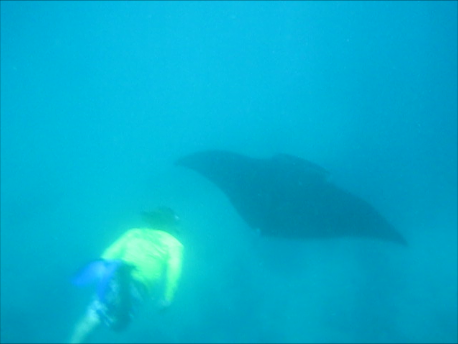
The next day, we spotted a manta from Sea Turtle so we got in the water with our snorkelling gear on and were able to swim with this graceful creature!!

Later we dinghied ashore to check out the sandy beach and Jordan climbed a coconut tree and tossed down several coconuts which we took back to Sea Turtle. Over the next several days, we drank the juice and gorged on the sweet meat.

Once again the next day (June 26th), we spotted a couple of manta rays. Unfortunately we had broken our underwater GoPro camera so we were using another not very good camera. The manta was coming real close and doing multiple somersaults - almost as if it was performing for us. Jordan dove and swam alongside of it but sadly we were only able to get poor shots of this spectacular encounter.

Jordan approaching the manta ray

Performing somersaults as we view his underbelly

Later in the day, our friends Bruce and Jeannie of SV Jabula caught up with us but were too tired to join us ashore to watch the sun sink away and relax in front on the bonfire.

Jordan stoking the fire

Sunday, June 24, 2012

Hiva Oa

After a fun day of breadmaking lessons from friends Bruce and Jeannie (SV Jabula), we pulled anchor from Daniel's Bay (Nuku Hiva) on the 20th of June at 10:00 to head for another Marquesan island called Ua Pou (pronounced Wa-Poo). It was just starting to sprinkle a bit and once we cleared the bay, we looked back and saw it was entirely socked in and pouring. But we were in 60% cloud cover and no rain - perfect timing to leave!

Distant island of Ua Pou...


...and getting a closer look.


We bypassed the main village on Ua Pou as there was a NE wind making it difficult to get to and it would have been a very rolly anchorage. We scouted out several anchorages on the SW side but none were suitable so we decided to continue on to Hiva Oa, doing an overnighter on a close reach point of sail.

About 1 hour from Hiva Oa as we were going through a channel, we were surrounded by about 15 dolphins with some jumping high out of the water. I briefly caught this one in the distance.


At Hiva Oa, we stern tied with 20 other boats on June 21st at Taahuku Bay (S09°48.258' W139°01.943') at 11:00. Here our eyes were treated to a splendid scene of verdant landscaping with steep rocky cliffs covered in tropical growth as the backdrop.

Judy washing laundry at the seaside sink and shower

One day we walked and hitchhiked into the town, Atuona, and checked in with the "Gendarmerie" (French officials). Famous French painter Paul Gauguin spent time at Hiva Oa and was buried in the cemetery of Autuona at the age of 54 in 1903.

Sunday, June 17, 2012

Cascade Tevaipo

We lifted anchor from Taiohae Bay on Nuku Hiva (Marquesas) at 12:15 on June 15th for a 1.5 hour motored voyage to Hakatea Bay (S08°56.594' W140°09.847'), also known as Daniel's Bay, and also on Nuku Hiva Island. This is the location of the Tevaipo Waterfall, the 3rd tallest in the world at 350 metres.

On June 17th, with Bruce and Jeannie of SV Jabula, we hiked the long trail - depending on one's hiking ability, anywhere from 1 to 2 hours. The forested trail varied with rocky areas, a lot of gnarly trees, a few muddy areas from the evening's rain, about 3 creeks to cross - some knee-deep - and a narrow path through a lush green field of groundcover.

Judy and Jordan traipsing through creek

Along the way, we travelled at times on footpaths built up by the ancient inhabitants of this valley as well as passing by remains of their long abandoned village.

Upon arrival at the falls, it was not what we had been envisioning. We had seen several pamphlets and postcards showing the entire 350-metre stretch of the waterfall surrounded by verdant green cliffs - perhaps aerial photos.

However, at the end of our hike, only the bottom of the waterfall as it fell from its upper hidden cliffs could be seen from where we stood. We ate our picnic lunch and then got into the cool pool of water where we swam to make our way in behind the large boulders.

Jordan at lower left checking to see what is behind boulders

But the view behind these boulders was quite stunning and breathtaking. We all gasped as it came into our sight - the tall black indentation of the cavern wall, the jutting peaks behind us, and the glistening lower portion of the waterfall cascading into the pool depths. After admiring the scene, we swam right under the falls and revelled in the outward spray and downrush of water.

But it was getting late...time to hike back to our respective boats after a great day.

Jordan and Bruce of SV Jabula

At the end of our hike, we met up with a local man who offered to remove the outside husk of the coconuts we had collected by thrusting them against a sharp rod sticking out of the ground. He was adorned with several of the traditional Polynesian tattoos.


Thursday, June 14, 2012

Here comes Jabula

Our good friends, Bruce and Jeannie of SV Jabula, met us at Taiohae Bay on Nuku Hiva Island in the Marquesas 3 days after we anchored. We have been waiting since 2009 to share the same anchorage with them but have always had conflicting issues or schedules to this was a real celebration!

Bruce and Jeannie in their dinghy - Bon Jour!

Jordan arranged a fishing derby for June 11th with 7 boats participating (Boomerang, Cornelia, Jabula, Lay Lady Lay, Lightspeed, Yara, and Sea Turtle), Only 1 Barracuda was caught by Lay Lady Lay, though Jabula did report 4 bites.

We noticed an odd sight while trolling for fish in the dinghy. Many, many dolphins were seen at rest near the shore edge (around 100 possible). as we approached, many started to swim by the dinghy and Jordan took underwater video of them as they frolicked. Even though we didn't catch a fish, this experience made our day!

Dolphins beneath dinghy

The next day we toured the island with Bruce and Jeannie in a rented 4x4 and bumped over a real gnarly back road. Scenery was magnificent...

View below

Oceanside

and this statue was interesting to say the least...


With an invitation from Jabula for dinner last night, we surreptitiously planted a large plastic cockroach in their galley (kitchen). (This was very mean for us to do as Jabula had a terrible infestation of cockroaches when they had to unexpectedly leave their fully stocked boat on the hard for 2 years in Mexico.)

Alarmed at the site of the creature but keeping her reaction in check, Jeannie quickly knocked it into the sink, putting a mug over it for Bruce to deal with it after company had left. But not a word was said, even for most of the day while we toured around with them. Jordan was debating whether to mention it but refrained until Jeannie gave him a nice piece of her delicious cake wherein was planted the critter. "Touché!"

Tailgate lunch with a hidden surprise

The friendly locals gave us delicious hand-picked mangoes, coconut, and pamplemousse (large sweet grapefruit). So delicious...words just can't describe the goodness when it's this fresh.

Folks are advised not to swim in Taiohae Bay where we are anchored as sharks are visibly present. We watched huge ones feeding on scraps at the fish dock. Below, caught by locals, are gigantic tuna at the cleaning table - scraps are tossed into the ocean.


Now that we are in the French Polynesia, everyone speaks French. So much for all the Spanish we learned! We keep using Spanish when trying to converse with the locals as it has become habit and unfortunately we do not know any French.

Tuesday, June 05, 2012

MARQUESAS - Nuku Hiva

Upon pulling anchor from Isla Santa Cruz of the Galápagos Islands on May 11th at 13:30, we almost turned around and returned after a couple of hours. Not because we loved our stay at the Galápagos so much, (which we did!) but because our (not so) faithful autopilot once again refused to engage properly.

But thankfully after a couple of hours of hand steering, Jordan did some adjusting to the rudder angle indicator (sensor part of autopilot) and got it working. It finally kicked in and relieved us from sitting at the helm. As we passed Isla Isabela with Galápagos' last occidental village, we decided to take a chance that it would not quit during the passage and we were off!

But our passage to the Marquesas in the French Polynesia was not what we were expecting, or should I say, hoping for. At first there were little or no winds as the ITCZ (intertropical convergence zone) - that band of dead air that wraps the global oceans at or near the equator separating the north and south air masses - was over us. So after 1.5 days motoring to get some southing in search of the trade winds, we picked them up, set our sails and didn’t touch them for 4 days, running due west along the 4 degrees latitude south with the benefit of the westbound equatorial current. We thought we would have a great sail with the nice steady trade winds but instead we were at the vicissitude of the winds, waves, and rain cells making for inconsistent conditions. As the saying goes,
"We cannot direct the wind, but we can adjust our sails."
We did a whole lot of adjusting sails!

Other than the aforementioned, this crossing was typical in many respects. After multiple passages, we now easily fall into the lazy rhythm, passing the time with such things as reading, watching movies, writing, and daily deck checks which include cleaning it of flying fish and squid! We had no more engine problems.

First day out, Jordan caught a huge yellowfin tuna, after about a 2-hour fight. It was so big and heavy that he struggled to bring it on deck - a very rotund plump fish. We saved enough for about 10 meals, the rest we had to return to the sea and share it with the fishes as we had no way of safely preserving it for a long period of time.

Too heavy to lift!

We saw few boats - a couple of freighters - about 3 days out then nothing until Day 14 where we crossed close paths with a slow moving Japanese fishing ship that Jordan made contact with to make sure he saw us. They go to great distances for their pelagic harvest.

The start of our passage was under a sliver of waning moon. We had many dark nights with only start to light our way. But slowly, it made its appearance once again as we watched it wax to full. The Milky Way here was as vivid as white powder on a black canvas so much so that at first we thought it was clouds, but after repeated nocturnal observations, it was evident. In this pearly band, the Southern Cross (the southern hemisphere's equivalent to the North Star) was showing us the way.

Day 23 - June 23rd. Getting close to land. Had a couple of dolphins at our bow, 1 mom and 1 baby. How cute is that! Also several boobie birds and seagulls making an appearance. The moon was full and so bright.

Land Ho! We spotted the first Marquesan island, Ua Huka, off in the distance the next day at 16:15.

On Day 25, we entered Taiohae Bay (pronounced Ty-o-ha-eh) at Nuku Hiva island of the Marquesas at 09:00 (S08°54.927' W140°05.881') just as the moon was relinquishing light to the rising sun. Jordan counted 39 other boats in the anchorage. We set our clocks to Marquesas time of 06:30 (2.5 hours earlier than Galápagos time). New exploring to begin!

We have completed 4 major passages in the last 6 months: from Ecuador to Easter Island, Easter Island to Chile, Chile to Galápagos, and now Galápagos to Marquesas. This put us out to sea for a total of 83 days out of 199 days which is close to half. That's a lot of time to be out to sea in a short period of time for us!

F.Y.I. The French Polynesia consists of 5 archipelagos which means 5 groups of islands. We will be visiting 3 of these groups: our first is the Marquesas, next will be the Tuamotus, and finally the Society Islands.

We will NOT be visiting the 2 more southern groups called the Gambiers or the Australes (do not confuse with Australia!) The 5 archipelagos include 120 islands spread over 4.5 million square kms in the middle of the Pacific Ocean. As we are only allowed to stay in this area for a total of 3 months, the number of islands we can visit is limited.