Friday, June 29, 2012

Just like kids!

Yesterday we snorkelled again at Hanamoenoa Bay of the Marquesan island called Tahuata and then went ashore to collect some fruit from the many trees that we had seen yesterday. We collected only a couple of papayas as they were still a bit small and not quite ready yet. But the pamplemousse trees were full of these very large and very sweet grapefruit-type fruits.

We ate 3 on the sandy beach with juice dripping down our faces and bodies, feeling like little kids again! With 10 more in bags along with the papayas and a few limes, we swam out from the shore to where our dinghy was anchored and headed back to Sea Turtle.

We finally pulled ourselves away from this splendid bay today at 11:00 but only went to the very next bay, Ivaiva, a few minutes away. Ivaiva (S09°54.750' W139°06.450') had better visibility for snorkelling and we saw an array of very bright coloured tropical fish in the warm water.

Jordan deep snorkelled on the other point searching for supposed lobster, but no luck. He did spot one 6-foot black tip shark though (they do not pose a threat).

We pulled anchor 3.5 hours later at 14:30 for the next bay about half an hour away. We dropped the hook at Vaitaha Bay, also known as Resolution Bay (S09°56.200' W139°06.620'). Captain Cook landed at this same bay with his ship Resolution back in 1774.

Vaitaha Bay

We dinghied ashore, bought a couple of things from the store, and asked where we could get bananas and mangoes. The store clerk said to just ask around outside so we did. A man took us to his house where he handed us several bananas on a stalk and then we followed him outside to a tall mango tree which he climbed in bare feet and tossed several down to Jordan's waiting hands. He charged us a meagre $5 for all this fruit which we happily paid.

As we settled in for the evening on Sea Turtle, we watched several children frolicking in the warm ocean water.

Tuesday, June 26, 2012

Tahuata

We left Taahuka Bay at Hiva Oa Island (Marquesas) at 12:45 on June 24th to go to a nearby island called Tahuata. At 15:00 as we approached the island, we spotted several large beautiful manta rays in the clear baby blue water. As soon as we dropped anchor in Hanamoenoa Bay (S09°54.439' W139°06.270'), we leaped into the water and snorkelled the nearby northern rocky shoreline. The water was so clear we could see our anchor in 15 metres (50 feet). Jordan excitedly pointed out a brilliant lionfish to me. This fish is very venomous but so amazing to watch as its long spiny feather-like fins swayed in the water. We did not see any mantas as they had vacated the bay as we anchored.

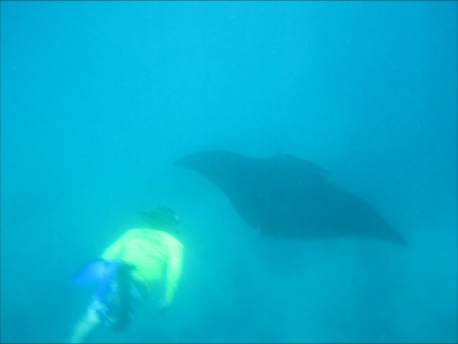
The next day, we spotted a manta from Sea Turtle so we got in the water with our snorkelling gear on and were able to swim with this graceful creature!!

Later we dinghied ashore to check out the sandy beach and Jordan climbed a coconut tree and tossed down several coconuts which we took back to Sea Turtle. Over the next several days, we drank the juice and gorged on the sweet meat.

Once again the next day (June 26th), we spotted a couple of manta rays. Unfortunately we had broken our underwater GoPro camera so we were using another not very good camera. The manta was coming real close and doing multiple somersaults - almost as if it was performing for us. Jordan dove and swam alongside of it but sadly we were only able to get poor shots of this spectacular encounter.

Jordan approaching the manta ray

Performing somersaults as we view his underbelly

Later in the day, our friends Bruce and Jeannie of SV Jabula caught up with us but were too tired to join us ashore to watch the sun sink away and relax in front on the bonfire.

Jordan stoking the fire

Sunday, June 24, 2012

Hiva Oa

After a fun day of breadmaking lessons from friends Bruce and Jeannie (SV Jabula), we pulled anchor from Daniel's Bay (Nuku Hiva) on the 20th of June at 10:00 to head for another Marquesan island called Ua Pou (pronounced Wa-Poo). It was just starting to sprinkle a bit and once we cleared the bay, we looked back and saw it was entirely socked in and pouring. But we were in 60% cloud cover and no rain - perfect timing to leave!

Distant island of Ua Pou...


...and getting a closer look.


We bypassed the main village on Ua Pou as there was a NE wind making it difficult to get to and it would have been a very rolly anchorage. We scouted out several anchorages on the SW side but none were suitable so we decided to continue on to Hiva Oa, doing an overnighter on a close reach point of sail.

About 1 hour from Hiva Oa as we were going through a channel, we were surrounded by about 15 dolphins with some jumping high out of the water. I briefly caught this one in the distance.


At Hiva Oa, we stern tied with 20 other boats on June 21st at Taahuku Bay (S09°48.258' W139°01.943') at 11:00. Here our eyes were treated to a splendid scene of verdant landscaping with steep rocky cliffs covered in tropical growth as the backdrop.

Judy washing laundry at the seaside sink and shower

One day we walked and hitchhiked into the town, Atuona, and checked in with the "Gendarmerie" (French officials). Famous French painter Paul Gauguin spent time at Hiva Oa and was buried in the cemetery of Autuona at the age of 54 in 1903.

Sunday, June 17, 2012

Cascade Tevaipo

We lifted anchor from Taiohae Bay on Nuku Hiva (Marquesas) at 12:15 on June 15th for a 1.5 hour motored voyage to Hakatea Bay (S08°56.594' W140°09.847'), also known as Daniel's Bay, and also on Nuku Hiva Island. This is the location of the Tevaipo Waterfall, the 3rd tallest in the world at 350 metres.

On June 17th, with Bruce and Jeannie of SV Jabula, we hiked the long trail - depending on one's hiking ability, anywhere from 1 to 2 hours. The forested trail varied with rocky areas, a lot of gnarly trees, a few muddy areas from the evening's rain, about 3 creeks to cross - some knee-deep - and a narrow path through a lush green field of groundcover.

Judy and Jordan traipsing through creek

Along the way, we travelled at times on footpaths built up by the ancient inhabitants of this valley as well as passing by remains of their long abandoned village.

Upon arrival at the falls, it was not what we had been envisioning. We had seen several pamphlets and postcards showing the entire 350-metre stretch of the waterfall surrounded by verdant green cliffs - perhaps aerial photos.

However, at the end of our hike, only the bottom of the waterfall as it fell from its upper hidden cliffs could be seen from where we stood. We ate our picnic lunch and then got into the cool pool of water where we swam to make our way in behind the large boulders.

Jordan at lower left checking to see what is behind boulders

But the view behind these boulders was quite stunning and breathtaking. We all gasped as it came into our sight - the tall black indentation of the cavern wall, the jutting peaks behind us, and the glistening lower portion of the waterfall cascading into the pool depths. After admiring the scene, we swam right under the falls and revelled in the outward spray and downrush of water.

But it was getting late...time to hike back to our respective boats after a great day.

Jordan and Bruce of SV Jabula

At the end of our hike, we met up with a local man who offered to remove the outside husk of the coconuts we had collected by thrusting them against a sharp rod sticking out of the ground. He was adorned with several of the traditional Polynesian tattoos.


Thursday, June 14, 2012

Here comes Jabula

Our good friends, Bruce and Jeannie of SV Jabula, met us at Taiohae Bay on Nuku Hiva Island in the Marquesas 3 days after we anchored. We have been waiting since 2009 to share the same anchorage with them but have always had conflicting issues or schedules to this was a real celebration!

Bruce and Jeannie in their dinghy - Bon Jour!

Jordan arranged a fishing derby for June 11th with 7 boats participating (Boomerang, Cornelia, Jabula, Lay Lady Lay, Lightspeed, Yara, and Sea Turtle), Only 1 Barracuda was caught by Lay Lady Lay, though Jabula did report 4 bites.

We noticed an odd sight while trolling for fish in the dinghy. Many, many dolphins were seen at rest near the shore edge (around 100 possible). as we approached, many started to swim by the dinghy and Jordan took underwater video of them as they frolicked. Even though we didn't catch a fish, this experience made our day!

Dolphins beneath dinghy

The next day we toured the island with Bruce and Jeannie in a rented 4x4 and bumped over a real gnarly back road. Scenery was magnificent...

View below

Oceanside

and this statue was interesting to say the least...


With an invitation from Jabula for dinner last night, we surreptitiously planted a large plastic cockroach in their galley (kitchen). (This was very mean for us to do as Jabula had a terrible infestation of cockroaches when they had to unexpectedly leave their fully stocked boat on the hard for 2 years in Mexico.)

Alarmed at the site of the creature but keeping her reaction in check, Jeannie quickly knocked it into the sink, putting a mug over it for Bruce to deal with it after company had left. But not a word was said, even for most of the day while we toured around with them. Jordan was debating whether to mention it but refrained until Jeannie gave him a nice piece of her delicious cake wherein was planted the critter. "Touché!"

Tailgate lunch with a hidden surprise

The friendly locals gave us delicious hand-picked mangoes, coconut, and pamplemousse (large sweet grapefruit). So delicious...words just can't describe the goodness when it's this fresh.

Folks are advised not to swim in Taiohae Bay where we are anchored as sharks are visibly present. We watched huge ones feeding on scraps at the fish dock. Below, caught by locals, are gigantic tuna at the cleaning table - scraps are tossed into the ocean.


Now that we are in the French Polynesia, everyone speaks French. So much for all the Spanish we learned! We keep using Spanish when trying to converse with the locals as it has become habit and unfortunately we do not know any French.

Tuesday, June 05, 2012

MARQUESAS - Nuku Hiva

Upon pulling anchor from Isla Santa Cruz of the Galápagos Islands on May 11th at 13:30, we almost turned around and returned after a couple of hours. Not because we loved our stay at the Galápagos so much, (which we did!) but because our (not so) faithful autopilot once again refused to engage properly.

But thankfully after a couple of hours of hand steering, Jordan did some adjusting to the rudder angle indicator (sensor part of autopilot) and got it working. It finally kicked in and relieved us from sitting at the helm. As we passed Isla Isabela with Galápagos' last occidental village, we decided to take a chance that it would not quit during the passage and we were off!

But our passage to the Marquesas in the French Polynesia was not what we were expecting, or should I say, hoping for. At first there were little or no winds as the ITCZ (intertropical convergence zone) - that band of dead air that wraps the global oceans at or near the equator separating the north and south air masses - was over us. So after 1.5 days motoring to get some southing in search of the trade winds, we picked them up, set our sails and didn’t touch them for 4 days, running due west along the 4 degrees latitude south with the benefit of the westbound equatorial current. We thought we would have a great sail with the nice steady trade winds but instead we were at the vicissitude of the winds, waves, and rain cells making for inconsistent conditions. As the saying goes,
"We cannot direct the wind, but we can adjust our sails."
We did a whole lot of adjusting sails!

Other than the aforementioned, this crossing was typical in many respects. After multiple passages, we now easily fall into the lazy rhythm, passing the time with such things as reading, watching movies, writing, and daily deck checks which include cleaning it of flying fish and squid! We had no more engine problems.

First day out, Jordan caught a huge yellowfin tuna, after about a 2-hour fight. It was so big and heavy that he struggled to bring it on deck - a very rotund plump fish. We saved enough for about 10 meals, the rest we had to return to the sea and share it with the fishes as we had no way of safely preserving it for a long period of time.

Too heavy to lift!

We saw few boats - a couple of freighters - about 3 days out then nothing until Day 14 where we crossed close paths with a slow moving Japanese fishing ship that Jordan made contact with to make sure he saw us. They go to great distances for their pelagic harvest.

The start of our passage was under a sliver of waning moon. We had many dark nights with only start to light our way. But slowly, it made its appearance once again as we watched it wax to full. The Milky Way here was as vivid as white powder on a black canvas so much so that at first we thought it was clouds, but after repeated nocturnal observations, it was evident. In this pearly band, the Southern Cross (the southern hemisphere's equivalent to the North Star) was showing us the way.

Day 23 - June 23rd. Getting close to land. Had a couple of dolphins at our bow, 1 mom and 1 baby. How cute is that! Also several boobie birds and seagulls making an appearance. The moon was full and so bright.

Land Ho! We spotted the first Marquesan island, Ua Huka, off in the distance the next day at 16:15.

On Day 25, we entered Taiohae Bay (pronounced Ty-o-ha-eh) at Nuku Hiva island of the Marquesas at 09:00 (S08°54.927' W140°05.881') just as the moon was relinquishing light to the rising sun. Jordan counted 39 other boats in the anchorage. We set our clocks to Marquesas time of 06:30 (2.5 hours earlier than Galápagos time). New exploring to begin!

We have completed 4 major passages in the last 6 months: from Ecuador to Easter Island, Easter Island to Chile, Chile to Galápagos, and now Galápagos to Marquesas. This put us out to sea for a total of 83 days out of 199 days which is close to half. That's a lot of time to be out to sea in a short period of time for us!

F.Y.I. The French Polynesia consists of 5 archipelagos which means 5 groups of islands. We will be visiting 3 of these groups: our first is the Marquesas, next will be the Tuamotus, and finally the Society Islands.

We will NOT be visiting the 2 more southern groups called the Gambiers or the Australes (do not confuse with Australia!) The 5 archipelagos include 120 islands spread over 4.5 million square kms in the middle of the Pacific Ocean. As we are only allowed to stay in this area for a total of 3 months, the number of islands we can visit is limited.

Wednesday, May 09, 2012

Engine problems

Our company, Aaron (Jordan's son) and Deanna (his gal) sadly left on April 30th so now we just had to finish a couple of boat jobs before leaving for the Marquesas in the French Polynesia. As soon as everything was ready, Jordan started the engine just before lifting the anchor, but lo and behold! The engine oil pressure dropped to zero within five minutes. Now what?

First Jordan checked the gauge and the sending unit where he noticed when he took it out that a gooey gelled oil slowly seeped out. Unfortunately, the motor oil was completely gelled. Jordan had never seen anything like this. It was a nightmare.

What a messy job!

After taking the engine apart, Jordan took the heat exchanger and the head to a mechanic in town, where things were tested and passed, and the head got a quick reconditioning even though it didn't need it. However, there was no clear evidence that defined the problem. So Jordan is assuming that it must have been a one-time event/problem of getting seawater into the engine during our last passage from following seas that back-surged water into the engine through the exhaust pipe.

We have a water lock muffler and a loop in the exhaust, but when the boat is tipped repeatedly and with any kind of water back pressure, it is possible that there would be ingress of seawater. We have a shut-off valve in the exhaust for such conditions but had forgotten to shut it for a day.

So important note to self (and to other sailors):
When engine is not running, shut off the exhaust even when at anchor because the rocking may even pump water back.

Only time will tell for sure if we are right in the assumption of the problem as we make our way to the Marquesas tomorrow. If the problem reoccurs, then we will have to sail the remaining distance without turning on the engine. Oh well, that's what a sailboat is for, isn't it? Will let you know what happens when we arrive at the Marquesas...

Monday, April 30, 2012

Last snorkel

Las Grietas

A quick dinghy ride and a walk over treacherous lava rocks brought us to the water between two cliffs called Las Grietas. A few brave souls actually jumped from the top of the narrow gap of the cliffs into the water below as we watched, but did not participate!

Instead, we made our way down into the water and snorkelled for the last time with Aaron and Dee, as they return to Victoria BC tomorrow. The water was the coolest that we have been in so far but it was very welcoming after the hot hike. The site was very impressive but we only saw a couple of parrot fish.

Another great day as we make our way back to town over the lava rocks - not the easiest "path" to walk on!


Sunday, April 29, 2012

Diving again

At Galápagos, Aaron (Jordan's son), Deanna (his gal), and Jordan wanted one more diving experience but the site was considered a bit dangerous for snorkelling with the strong currents so I stayed in town as they took the tour boat to Gordon Rocks. This site is famous for spotting hammerhead sharks, which none of us had seen yet.


In both of their two dives, they were lucky and spotted several hammerheads (one young lady we had talked to previously had been on over a dozen dives for the sole purpose of seeing hammerheads and never saw any). Hopefully, you can make out the "hammerhead" that gives these sharks their name in the following photo...


In their second dive, everyone wore a glove on one hand to push themselves away from the sharp rocky wall if the currents pushed them too close, as they also did when they snorkelled at Isla Seymour Norte. But no one was in danger and all was well. They spotted more of the white tip sharks, beautiful sea anemone, several different coloured starfish, and lots of colourful fish...


All in all, a successful diving trip!

Happy father and son

Saturday, April 28, 2012

Tortoises & lava tunnel

Back again at Santa Cruz after catching the early 06:00 ferry from Isla Isabela, Aaron (Jordan's son), Deanna (his gal), Jordan, and I hailed a taxi to head out to a tortoise reserve, El Chato, and then hike through a lava tunnel. We walked amongst the slow-motioned free-roaming tortoises and discovered that they could move quite quickly (well, tortoise quick) for their large girth when one tortoise challenged another by approaching it for a stare-down.

Dee standing next to a very large tortoise

Then our taxi driver took us to the entry of the lava tunnel (Tuneles de Lava) where he dropped us off and said he would meet us at the exit. I had read that flashlights were provided so we didn't bring any but the tunnel had hanging lights so we felt safe entering.

The surface was very rocky and bumpy, as lava tends to be, and you had to step very carefully so you wouldn't slip and fall. A short distance in, all the lights went out - I had brought a couple of headlamps but they were too dim to shed any light at all! Everyone stood still waiting, and hoping, for the lights to come back on. Soon they did and we continued through the tunnel.

Looks pretty dark up ahead...

We reached an area where you had to crawl through on your hands and knees, or even crouch lower if you were a large person, and were then at the exit. The tunnel was wet and damp so everyone was a bit muddy after crawling and touching the walls (the taxi driver provided a damp cloth for cleanup).

The lights had gone out a couple of times during our passage and by the time we reached the end, we were sure glad that they had not stayed out as it would have been extremely difficult, if not impossible, to find our way through to the exit without lights. Even without a flashlight, we definitely enjoyed the experience as we imagined what it was like when the lava had once flowed through this tunnel.

Jordan entering the higher of the low section of the tunnel

Judy with muddy knees after exiting

Friday, April 27, 2012

Snorkelling & flamingos

On our way to our snorkelling site today, we saw GIANT manta rays in the water close to the boat. Did I say GIANT? They were easily 5 m (14 feet) wide and can be as large as 8 m (26 feet). Each is different as they actually have marks in their stomach that are their fingerprints. Thus they can be identified by taking a picture of their stomach and then releasing them. Several have been tagged and their behaviour is being studied. It was very difficult for us to get a photo as they would go deep as soon as we were close.

The boat took us out to an area called Los Tuneles to snorkel. As we approached, we saw blue-footed boobie birds and the small Galápagos penguins on the rocks. This was a great site with all of the tunnels, or bridges, to snorkel under or through. In one area, there was even a light under the water.

Snorkellers heading towards light with entry/exit of tunnel at right/left

Other than a chocolate chip starfish spotted by Dee, we did not see too much sea life. But at the next site that we were taken to, Cabo Rose, we saw so many turtles that once again were not afraid of humans.

Picture perfect - Dee with turtle (photo courtesy of Aaron & Dee)

See www.ces.clemson.edu/~simms/cousteau/: the above photo is reminiscent of the insignia used on Jacques Cousteau's boat, the Calypso. After a fabulous day of great sites with the tour boat, we returned to Isla Isabela where we sat by the beach for a cold beer. Then we noticed this unusual sight - something that you could only see in the Galápagos!

Don't bug me, I'm sleeping!

We then walked to a nearby site for more snorkelling at Concha y Perla, well at least Aaron and Dee did. Jordan and I rested in the shade after a very busy day. They saw a turtle and another chocolate chip starfish. We ended the day watching 2 flamingos in a serene bay. Their exquisite colour and tranquility was quite breathtaking.


Wednesday, April 25, 2012

Isla Isabela Galápagos

Upon our return to Isla Santa Cruz (where we have Sea Turtle anchored), we bought ferry tickets for an April 24th journey to Isla Isabela. But early in the day, Aaron (Jordan's son), Deanna (his gal), and Jordan and I hiked out to swim and snorkel at Tortuga Bay before the ferry ride.

It was excruciatingly hot out as this is one of the hottest months at the Galápagos so the 2.5+ km walk was very tiring. The cobblestone path was lined with the tall Opuntia Cactus that is native to the Galápagos with stems that grow as large as trees. But upon arrival, the paradisiacal beach made it all worthwhile.

Long stretch of fine, white, coral sand beach (courtesy of Aaron & Dee)

There was very little sea life but the water was wonderful to swim in even if little sea life was evident when we snorkelled. We then hastily returned to catch the 14:30 ferry to Isla Isabela.

Isabela, in the shape of a seahorse, is the largest island of the Galápagos and still has 6 active volcanoes. It had a penal colony from 1946 to 1959. To punish the prisoners, they were forced to build a wall of huge blocks of lava rocks. The wall, measuring 100 m by 7 m high, still exists today and is known as the Wall of Tears. Isabela straddles the equator.

We checked into the Hospedeja Cerro Azul where our hosts, Nelton & Judith, were very helpful and warm hearted. We would recommend this (www.hostalisabelagalapagos.com) as a place to stay if you are ever at Isla Isabela. After settling in, we wandered around the beautiful beach and cute town where most roads were covered in white sand!

The next morning, Nelton drove us to the area of the Triplet Volcanos where we then hiked through lush vegetation as Nelton pointed out other volcanoes in the distance, along the top of steep ridges and down holding onto ropes...


...and finally deep down-reaching into the inactive volcano tube using more ropes and a few rickety stairs. It was a very beautiful location and thankfully cool in the tight opening of the volcano after a hot hike.


As we drove back to town, Nelton stopped at a plantation where we picked a couple of large papayas and then asked if we would like to stop at an eco-reserve for tortoises (land turtles). Unfortunately, just as we arrived at the reserve, the front-end suspension of Nelton's truck broke! (As we toured the reserve, Nelton arranged for another vehicle to pick us all up.)

We got a tour of the reserve, picking fresh bananas, passion fruit, and all the mangoes we wanted. After we had finally had enough of all the nature surrounding us, the staff sliced for us some of the mangoes and passion fruit that we had collected along the walk and cooled us off with chilled drinks.

I need a pedicure

Next was the boat tour to the nearby Las Tintoreras, which means white tipped sharks. The boat first dropped us off for some snorkelling among the seals, turtles, and myriad of other sea hosts including a small baby octopus that the guide handed us until it shot some ink out and away it went.

Octopus holding tightly

After which, they took us ashore and we walked a "loop" tour of part of the island where many blue-footed boobie birds, small penguins only found in the Galápagos, seals, bright red Sally Lightfoot crabs, and marine iguanas were lazing around. Marine iguanas are only found in the Galápagos - no other place in the world - and it was quite hilarious to watch as they "sneezed" the saltwater from their nasal glands after their foraging underwater.

Warming in the sun, sneezing out salt after ocean swim (courtesy of Dee)

Tuesday, April 24, 2012

Diving & Lonesome George

Isla Seymour Norte of the Galápagos Islands was the chosen site for diving for Aaron (Jordan's son), Deanna (his gal), and Jordan but I snorkelled again as I don't have a diving certificate. We boarded the boat with 4 other eager divers.

All suited up to dive and snorkel

This was Dee's first official dive and Jordan said that it was the best diving of his life! The sea life was once again abundant and definitely a great spot for a first dive.

Dee with Aaron on her 1st official dive

Up close and personal with one of several white tip sharks (did I say shark!)...


Masses of colourful fish were spotted - many in huge schools...


Forests of garden eels were also evident. These creatures are worm-like and retract tail first into their ocean bottom holes when you approach them...


Many starfish were sighted in varying colours such as red, yellow, blue, and chocolate chip. There is such an abundance of sea life that most people have never heard of or seen before. It is always such a treat to stumble upon them...


Jordan said it was like being in a huge fully stocked aquarium. Apparently, there were hammerhead sharks swimming near me as I snorkelled, according to the guides on the boat. But unfortunately, I never saw them!

Upon returning to Isla Santa Cruz, we walked to the Charles Darwin Research Centre where the famous land tortoise, Lonesome George, makes his home. He is the rarest creature in the world, and the last of the Pinta Island tortoises if a female Pinta cannot be found. There is even a $100,000 reward for discovery of a female Pinta! As of this date, Lonesome George is thought to be at least 100 years old. We were lucky to see him, as he does not always appear for photos.

Lonesome George trying to hide...

Monday, April 23, 2012

Snorkelling at Galápagos

We have spent the last few days doing boat jobs as we waited for Jordan's son & girlfriend (Aaron & Deanna) to arrive at Galápagos from Victoria BC. (We chose not to tour any areas until then as we could be seeing things twice.)

Once they arrived on April 21st, we checked out some tour agencies and booked a snorkelling tour for the next day at 3 sites. First site was at Isla San Cristóbel (San Cristóbel has been inhabited since 1910 as it has fresh water on the island and many of the other islands do not.)

After about a 2-hour boat ride we arrived at Isla San Cristóbel, then after a short hike, we had our 1st snorkelling for the day at La Lobería. This was a tranquil sandy beach with oodles of sea life! We immediately saw several cute sea lions lolling on the beach.

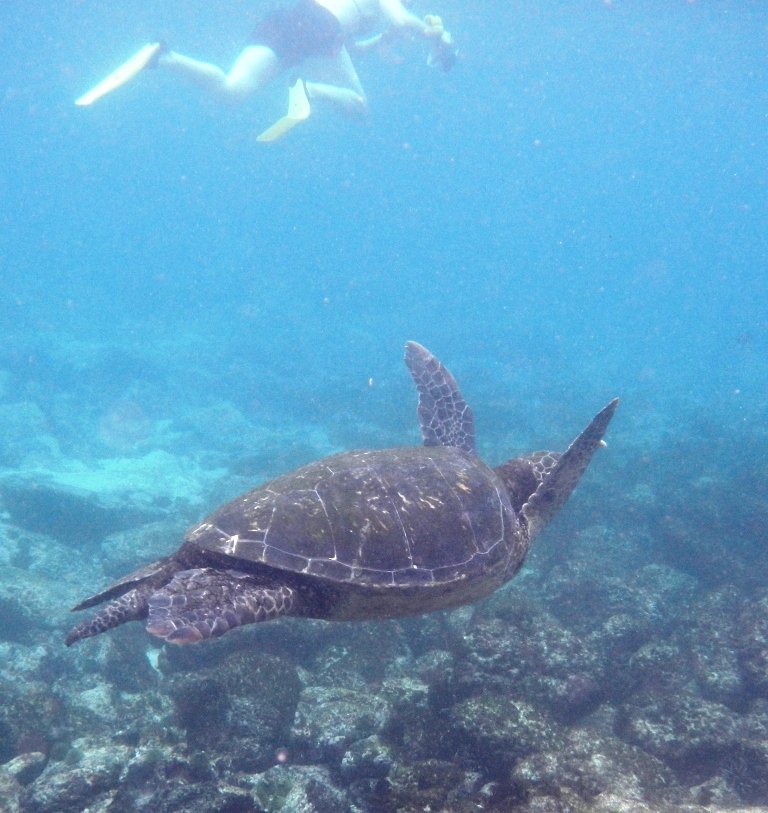
Once in the water, we were amazed at the abundance of colourful fish, rays, sea lions...and turtles were everywhere! We swam through schools of fish and alongside rays and turtles. Humans were inconsequential to the sea life and we were basically ignored, definitely not feared.

Swimming above a sea turtle (courtesy of Aaron & Dee)

The tour boat next took us to León Dormido ("lion rocks") also known as Kicker Rocks...

Photo snapped as we leave Kicker Rocks (courtesy of Aaron & Dee)

We all jumped from the boat into the water with the large rocks jutting from the ocean ahead of us. The rocks were very dramatic as we snorkelled between them, but it was difficult to see the sea life as the water was a little murky on that day. But we did spot this majestic spotted eagle ray!

Beautiful Spotted Eagle Ray

We then progressed to another island, Isla Santa Fé (southeast of Santa Cruz) which has volcanic rocks dating back 4 million years! We saw schools of colourful fish and lots of seals. The inquisitive seals entertained us by swimming all around us - even with their pups.