Monday, March 11, 2019

US Virgin Islands

After a delightful visit with old friends and exploring Saint Martin/Sint Maarten of the Caribbean, we were off to the Virgin Islands.

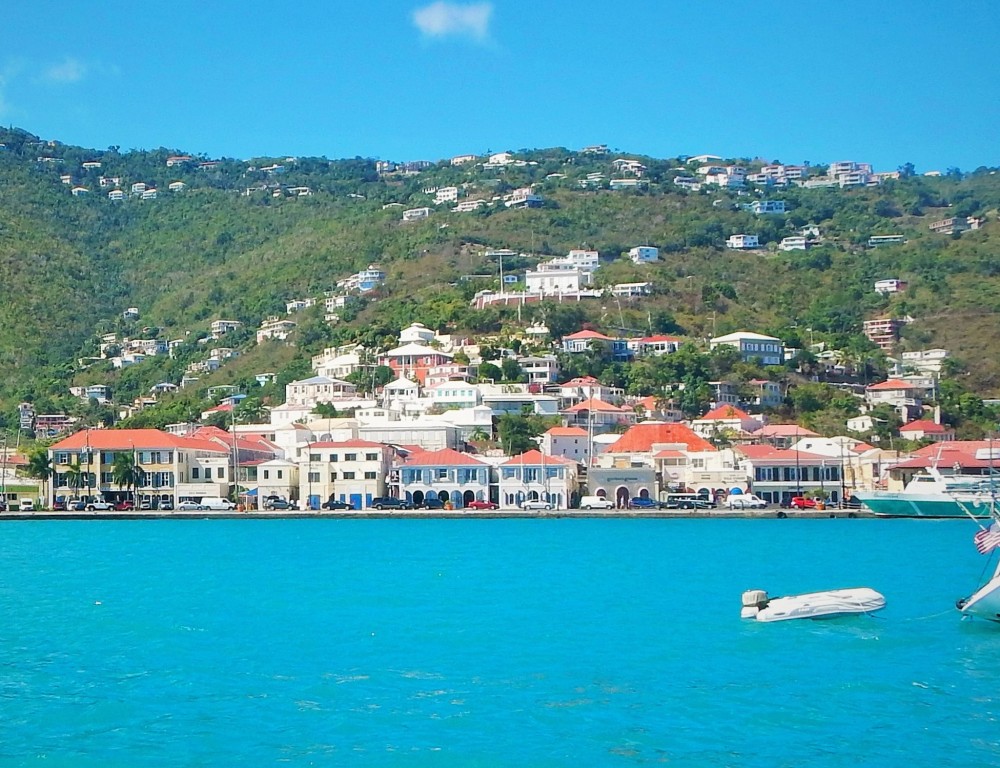
Two sovereigns claim the chain of Virgin Islands, the US (USVI) and Britain (BVI) and we would visit both, the first being the USVIs. We anchored in the harbour of the busy port of Charlotte Amalie on the Island of Saint Thomas, a convenient place for a number of chores and purchases needed.

Waterfront

Our first stop (after official check in) was to purchase a SIM card for our smart phone with a data package so that we could be connected to the world again. The second stop was the optometrist for the much needed new glasses for Jordan. He had broken his a couple of months ago, and had since been wearing them with a nerd worthy repair job. This was the first time we would be in one spot long enough for the wait time to have them done.

This spot was more popular to the ubiquitous cruiseship crowds than the cruising sailor, but we found some pleasant aspects that made our time there drift by with ease.

Another type of cruising

To get around, we made good use of the abundant Safari trucks with cheap fares and friendly riders always helpful with directions. One trip was to Brewer's Beach with a picnic lunch where we spent the day.

Safari bus

We hit it off with a US couple on a boat next to us who spends half their time here and half their time back home in Montana. We shared company in one another's cockpits and a lobster dinner at a great restaurant that overlooked the harbour.

Lobster affair

We strolled the alleys of the older part of town where old shipping warehouses have been turned into a plethora of jewellery stores, souvenier shops, and eateries that siphon in the cruiseship herds. At one cafe at Creques Alley while sipping iced cappuccinos, we were told that this is where the singing group, The Mamas and Papas, hung out and got their start jamming to the locals at the time.

Charlotte Amalie side street

Side view of Bumpa's Restaurant on bright waterfront street

With new glasses perched on his nose, it was time to head over to the British Virgins. But first, we had to apply for a pet permit from the Brits for Chanty, out cat, a not so easy task that required a US vet inspection and official paperwork sent for approval ahead of our arrival there. Wisely we had always kept current with the most important vaccinations and tests.

Once that last chore was done, we did the official US checking out and pulled anchor for a 2-hour beat up the coast to spend the night anchored in Christmas Cove in the lee of Great Saint James, a small private island (165 acres).

USVI Anchorages:
N18°20.279' W064°55.898' Feb 24 St. Thomas (Charlotte Amalie)
N18°18.468' W064°50.031' Mar 10 Great St. James (Christmas Cove)

Saturday, February 23, 2019

Saint Martin/Sint Maarten

Leaving Barbuda early afternoon, a great wing-on-wing downwind overnight sail to Saint Martin landed us in Marigot Bay. This duty free Caribbean island is shared with French Saint Martin on the north and Dutch Sint Maarten on the south.


We were advised to check in on the French side for better rates. But even though entry and mooring fees are listed in the guides, we were never charged a cent for administration or anchoring during our entire time spent here.

Choices of anchorages were either the large lagoon in the middle of the Island with access canals out both sides of the Island, or in a somewhat open Marigot Bay on the NW. We chose the latter as we wanted clearer waters to run the watermaker after a needed repair. Surprisingly, we found the needed part when we dinghied to Dutch Sint Maarten and were back in business making water.

Watermaker repair

On our second day, we were pleasantly surprised to see a boat from the distant past that we had sailed many a mile with. We first met Rene and Cheryl on SV Gyspy Blues in Nuku Hiva (Marquesas) back in 2012 and shared many anchorages with them all throughout the "coconut milk run" and down in New Zealand! It was great to catch up and share our sailing adventures and reminisce over cocktails and meals.

Gypsy Blues invited us along on a tour of the Island where we saw evidence of the devastation dealt by the direct hit of Hurricane Irma in September of 2017. This was the strongest Atlantic hurricane since records were first kept in 1851. And then in the next 2 weeks Hurricanes Jose and Maria also hit!!

Caribbean colours on our tour

They didn't return

What's left of a marina in a preferred hurricane hole!

Marigot Bay was once full of lovely boutiques and shops but we noticed most places were permanently shut down.

95% of all buildings were damaged, and of 1,000 boats impacted, 500 were total wrecks. We dinghied past wrecks on rocks, on beaches, and in the clutches of the mangroves. Others didn't make it far and sank right on their moorings or at the dock. Boats in yards were toppled and we heard stories of large catamarans lifted up and flipped over like a rag in the wind.

High and dry

Some worse than others

On Jordan's wish list was to see the planes that come in for landing and takeoff at the somewhat famous Kerosene Beach (yes the name also refers to the smell). The end of the runway is right up against the fence and beach. Jets make extremely low approaches at times, barely clearing the fence and the takeoffs have careless spectators blasted.

Words say it all

A blast at the beach

The blast is so strong it kicks up a slew of beach sand and dust and can literally blow you off your feet. Hang on!

Back to boats, a beauty we saw docked at Sint Maarten was this mega yacht belonging to Mrs. Steve Jobs...

Nice toy

Saturday, February 16, 2019

Antigua and Barbuda

As light filled the morning sky, Guadeloupe began to withdraw as we headed north to Antigua, a pleasant 40 NM sail away. There we checked in and anchored at Jolly Harbour. This island nation is actually 2 main islands, Antigua and Barbuda, about 20 NM apart.

When checking in with Customs and Immigration, they required a vet to do a cursory examination of our feline crew member, Chanty. So we had to bring her in by dinghy, not always her favourite experience.

Are we there yet? (returning to Sea Turtle)

As trade winds rise over the hills, it's typical that the forming clouds give us a rinsing. The rain isn't necessarily unpleasant as temperatures are mild and the rain is usually brief. Once when we were on our way to shore in the dinghy, we got caught in an unusual heavy deluge that lasted about an hour. The one time we didn't bring the umbrella and we got soaked!

Bailing the bathtub

So we dried out over coffee and eats. I took this opportunity to try the Caribbean Breakfast which included: Chop-up (a mix of spinach, ocra, and eggplant), Saltfish, Johnny Cake, plantain, and a boiled egg. It was an excellent choice. (Recipes online!)

After chatting up a couple on a boat from Vancouver, they convinced us to go down to the south side of the Island and see Nelson's Dockyard at English Harbour. English and Falmouth Harbours, the latter a much larger bay, are side by side separated by a narrow bit of land. We anchored at Falmouth in front of a gaggle of super mega yachts, then strolled over to the quaint setting of Nelson's Dockyard.

Former shipbuilding storehouse, now historic hotel

As the name suggests, Admiral Nelson developed this secure port to protect and service his ships. The old buildings in this picturesque setting have been preserved and now this UNESCO site is a preferred port by the richest of yachts where they moor Med-style in front of coffee bistros, restaurants, and shops.

From displays in the museum, we could picture in our mind's eye Nelson's ships cairned on the shore, crews scraping the bottoms, and repairing the copper plating. We saw depictions of the sail loft that once sat upon the round pillars that still remain.

Ancient sail loft pillars

Here we also saw a sample of the 4-person rowboat that just won a trans-Atlantic rowing competition and where the 2nd place oarsman was due in that same day.

Row, row, row your boat

At Falmouth, a taxi delivered us up to an interpretive center on Dow's Hill. Are you going to the party this evening? he asked. What party? we said. He explained that it was up on a grand vista nearby, known as Shirley Heights, the venue for dual performances. The 1st was by the Halcyon Steel Drum Orchestra and last a Reggae band. A barbecued feast was also being served and of course well stocked bars. How could we not?

It was a great setting overlooking the 2 harbours below, where a Caribbean sunset supplemented a superb performance and delicious meals. We fell into a mood that made the 'rhum' punches irresistible and kept us going back for 2nds and 3rds and...well...more.

2 harbours: English with Falmouth in the background

Halcyon Steel Band Orchestra

Hear them play in our 2-minute YouTube video by clicking HERE or clicking "Grooving to steel drums" under "Other Links" on right side of this blog page.

Returning to Jolly Harbour up the west side of the Island, we did our official checking out of Antigua, but contrary to the normal required prompt country departure after check out, we didn't leave this nation right away. We went around the corner and anchored at Deep Bay to snorkel the wreck of the Andes in less than ideal visibility.

We scrambled up the knoll to see Fort Barrington, long since abandoned and defeated by time. Along the trail were the dreaded Manchineel Trees that are very toxic. You are warned to not touch ANY part of the tree or sit under it as a drip of sap on the skin causes extreme irritation. Heaven forbid if you tried to eat the apple-like fruit of the tree!

Seen better days

We sailed a few hours north from hilly Antigua to the low laying sister Island of Barbuda, catching a nice Crevalle Jack fish on the way and laid the hook in its brilliant turquoise shoal in front of an 18 km (11 mi) long sandy beach.

For me??!!

Barbuda was a marked contrast to Antigua. Any sign of habitation, a tiny village, was off in the distance and with few other boats, we felt a tranquil seclusion. We had the creamy pink beach to ourselves as we walked about half of it, collecting numerous shells.

Miles of lonesome

Further up the beach, we saw the remains of Lighthouse Bay Resort, another victim of Irma...

Only ruins left

Anchorages:
N17°04.473' W061°53.720' Feb 06 Antigua (Jolly Harbour)
N17°00.721' W061°50.065' Feb 09 Antigua (Carlisle Bay)
N17°00.950' W061°46.464' Feb 10 Antigua (Falmouth Harbour)
N17°04.365' W061°53.792' Feb 11 Antigua (Jolly Harbour)
N17°07.655' W061°53.213' Feb 13 Antigua (Deep Bay)
N17°37.238' W061°51.140' Feb 15 Barbuda (Low Bay)

Tuesday, February 05, 2019

The Saintes and Guadeloupe

Without checking out of the French Martinique (Caribbean), we vectored north to Guadeloupe, another French territory island. About halfway though, we dropped anchor for the night at the island nation of Dominica (aka Dominique) but did not go ashore. Which in hindsight, we learned, there were some great sights on the island.

Approaching Dominica

The next morning we continued to a tight cluster of small French islands referred to as The Saintes (Isle des Saintes). Here the bright and cheery colours of the buildings and boats gave the village an authentic Caribbean feeling.

Typical design of Caribbean homes

We hiked up to the Napoleon Fort that was rebuilt in 1844 after being pulverized in 1809 by the English. It follows the curves of the hill top in a parallelogram shape and is still in very good condition with views of the harbour below. The well preserved building within housed a museum with informative displays of history and relics.

Harbour view from Fort

View of colourful cottages and boats

From The Saintes islands, we continued to Guadeloupe with our first anchorage in a cove that looked out at the Pigeon Isles close by.

Sunset over Pigeon Isles

After Jacques Cousteau visited these little islands, he emphasized the pristine and abundant underwater life and hence it is designated Jacques Cousteau Underwater Park. With dive shops on shore, Jordan signed on for a dive that he said was definitely worth it for the variety of life and clarity of waters. Note that Caribbean lobsters have no claws.

Coral colours

Blue spiny lobster

Coral cauldron

A pleasant day was spent touring the Island in a rental. We climbed up and over the Island by way of a windy road through the dense jungle in the National Park. Visited the Rum Museum with displays of the industry's history of rum making, intricate models of naval ships, and a prodigious insect exhibit of over 5,000 specimens.

At one spot, we ventured down a desolate dirt road that brought us to a stunning shore setting that we had all to ourselves. We cracked open a bottle of red wine and some deli delights and had a tailgate picnic as we watched waves cross emerald green shallows to meet their crashing end on a sandy beach as the ocean breeze added a freshness to the setting.

As we relaxed back on board Sea Turtle, the late sky painted us a brilliant rainbow over the quiet village of Deshaies (pronounced Day-ay) that was the anchorage backdrop.

Deshaies drama

For a delightful final day on Guadeloupe, we visited the Botanical Gardens of Deshaies. We wandered the winding pathways where tropical scents wafted through a diverse and vivid flora that covered 7 ha (17 acres) displaying 1,000 species of stunning plants, varieties of bright colourful parrots, and graceful pink flamingos.

Garden tranquility

Parrot pose

Origami of the orchid

But our best sighting was a long and vivid green flash of the setting sun! But where's the camera??!!

Anchorages:
N15°34.988' W061°27.996' Jan 29 Dominica (Prince Rupert Bay)
N15°51.981' W061°35.450' Jan 30 Iles des Saintes (Terre de Haut)
N16°10.316' W061°46.827' Feb 01 Guadeloupe (bay across Pigeon Isles)
N16°18.364' W061°47.873' Feb 03 Guadeloupe (Deshaies)

Monday, January 28, 2019

Martinique memories

Having crossed the wide open Atlantic, our landfall was at Martinique, a French territory island in the middle of the Caribbean chain of islands known as the Lesser Antilles that run in a line north to south. Generally they run from the Virgin Islands (to the north) to Grenada (in the south), not too far off the coast of South America.

Those trade winds that carried us across the Atlantic sweep over these islands and most sailing is done along their west sides, the lee side, where the sea state is less boisterous. As sailor's make their way either south or north along these islands, the wind is usually on the beam making it great sailing for the most part.

We were presented with a striking contrast as we pulled into Sainte Anne Bay after our lonely 21-day passage. There we saw a startling mass of masts that crowded the anchorage. Is this what we were to expect of the Caribbean?

Boats, boats, and more boats

Our stay on the French Caribbean island of Martinique was short, staying at a couple of bays and at the marina for a couple of days. Martinique, the Isle of Flowers, is a blend of rich volcanic mountains, lush green hills, and white and black sand beaches.

It was here we first noticed sad remains of boats destroyed or heavily damaged September 5, 2017 by Hurricane Irma that swept through these parts.

Boat at the bottom

As usual after a long passage, Sea Turtle required a lot of washing down, both inside and out, so we made the unusual move to the dock at La Marin Marina where we used almost 1,000 litres of water for the job! But thankfully the water bill came in at a modest 9 Euros ($13.50 CAD).

Then back at anchor, it was the bottom that needed a cleaning. This last passage left a growth of gooseneck barnacles like a 5-day stubble. Jordan underestimated the toxicity of the bottom paint that had been enhanced by a deadly additive on application. Where his skin rubbed against the hull, it left the effects of severe swelling and red skin of his left forearm, a bloodshot left eye, and a fever of 103° with chills. It took several weeks before the effects wore off. We have never before experienced any symptoms from toxic paint scraping during our 9 years of sailing. So thankful I wasn't in the water for the cleaning this time!

We motorsailed away from south Martinique and headed up the west coast of the island under slight showers and where the grey skies broke to paint a beautiful rainbow.

Exiting under a rain shower

We anchored at the small town of Sainte-Pierre (still at Martinique) that sits at the base of Mount Pelee which erupted in 1902, where, in just a couple of minutes the entire town of 28,000 was wiped out with the exception of 2 persons. One was saved by his prison walls and the other was saved as he lived on the edge of the town. Everyone ignored the warning signs. Poor Sainte-Pierre, once the capital, had also been wiped out by a hurricane storm surge in 1780, killing 9,000. Sainte-Pierre has never been restored to its former glory.

Mount Pelee sleeping

A taxi trip north along the shore delivered us to Habitation Ceron, a botanical garden and rainforest with a 300-year old Zamana tree, cocoa trees to make chocolate, and trickling streams. We wandered the jungle trails on the perimeter of the former 17th century sugarcane estate with refinery ruins still standing.

Time worn, jungle cloaked

Zamana tree and me

Unfortunately we had a disappointing experience at its open-air restaurant with exorbitant prices and food drowned in sauces. I decided to try the local crayfish at $30 but was shocked when I was presented with ONE tiny crayfish drowned in a bowl of sauce!! But we did enjoy the refreshing rainforest walk.

A short distance away was a secluded beach setting with black sand, white rocks, and rolling sapphire waters that made it a photo op.

Volcanic sand

Anchorages of Martinique:
N14°25.625' W060°53.385' Jan 17 Sainte Anne Bay
N14°28.149' W060°52.045' Jan 22 La Marin Marina
N14°26.207' W060°53.178' Jan 24 Sainte Anne Bay
N14°28.145' W061°05.440' Jan 26 Anse Chaudiere
N14°44.434' W061°10.674' Jan 27 Sainte-Pierre

Thursday, January 17, 2019

Atlantic passage

I always remembered a conversation I had many years ago with an old salt who had sailed the 7 seas and he told me that the east to west passage across north Atlantic was the easiest of them all. When he did it, he said he flew wing-on-wing and never touched the canvas for 2 weeks.

Well Judy and I were hoping that would be the case for us. However we didn't get off to a good start. As soon as we departed from Mindelo, Cape Verde, we were immersed in some pretty strong wind and waves as we passed between 2 of the islands and that was not so bad other than in all that excitement we discovered a serious problem in the rigging that necessitated an emergency stop on the back side of the most western island of Cape Verde.

Problem fixed, we were off to seek the conveyor belt trade winds to carry us across.

Long after those imperious mountain peaks of the Cape Verdes dissolved like ghosts into the Sahara induced haze, we knew it would be the last land we would see for 20 or more days.

This passage was typical in that after a few days we settled into an indolent rhythm where the desultory days blend one into the other and it would matter not if the voyage was 10 or 30 days or if it was Sunday or Wednesday or if it was the 1st or the 15th of the month.

Sea cat's berth

However we were diligent in our routine of watches. We do 3 hours on and 3 hours off during the night and every 18 minutes, a 360° visual regardless day or night. The other relentless event is our cat Chanty's demand to be let out each morning for her "walk around the block" to fetch her breakfast that without fail is waiting on deck. It's those flying fish accompanied by an occasional squid that make their fateful last nocturnal flights.

Morning catch

Most of our idle time is spent on such things as reading, watching DVDs occasionally, playing Scrabble, and writing and ruminating. However the lonely lazy days were made more interesting in a few delightful ways, mostly involving, what else? Fish.

Once, our languid aura was broken by the frantic tolling of the bell on the fishing rod and it was all hands on deck, including Chanty. It was a big Mahi Mahi. These ubiquitous pelagic roamers are one of the fastest growing fish in the sea. As we watched the vivid iridescent hues of blues and greens of its skin dissolve into a lackluster grey before our eyes as it expired on board, there is a certain measure of guilty regret of the sacrifice not to mention we, sadly, quite likely snatched it from its travelling mate.

An ocean rainbow

The latter fact was made evident one night when we were on deck awash with spreader lights. There we saw in the deep blackness a pair swimming tight formation right alongside like sleek escorts for the lumbering mothership. And again in the morning, the same thing, maybe the same ones?

If Chanty could talk, this would be her tale:
"We were given a start one night as I was being held in Dad's arms in the companionway while he was doing his 360° visual check, when a flying fish whizzed by my face like a ballistic missile, ricocheted off the inside of the dodger, and crash landed inside the boat, leaving a tracer of scales. I dispatched him at once."
Flying fish shrapnel

In another chance sighting as we were slowly sailing along, I saw a fin sticking out of the water. A sunfish? They are known to lay on the surface. No. This one was moving and then I saw the corresponding tail following. It was a big shark, and judging the space between the dorsal and tail, I would estimate his overall size to be maybe 4 metres or more.

Well along, we were given notice, with rafts of gilded seaweed, that we had entered the Sargasso Sea. The sea was a palate of royal colours as the opulent gold was in a perfect compatible contrast with the rich aqua marine of the deep ocean. Its presence lasted for days and frustrated any attempts of trailing a fishing line.

Golden sargasso seaweed

Twice we were visited by pods of breaching pilot whales. In one pod, there were about a dozen that included a wee one swimming in unison with mom as though attached while another fellow, like a black submarine, maybe 5 metres long, cruised right along beside us barely moving a muscle.

A pod of pilots

After several days, our loneliness was interrupted when Judy spotted another ship. As we focused on the blip on the horizon, there is a mustering of inquisitive thoughts like, who are they? Where are they going? It is easy to conjure up romantic thoughts of adventurous itinerant mariners heading to exotic ports, that is, until the modern tech of AIS gives the pragmatic answer. It was a Japanese fishing vessel about as far away from home as it could get.

When the lambent light of twilight gave way to night, most nights were sailed in a blanket of darkness. The moon being elsewhere would leave us in the care of brilliant stars, from the North Star to the Southern Cross. It is those nights in this vast remoteness that you realize just how utterly alone and remote you are. It isn't a scary isolation, but a privileged tranquil peace that very few people ever experience. It is a rare and precious opportunity for reflection and contemplation.
"The pessimist complains about the wind; the optimist expects it to change; the realist adjusts the sails."  by William Arthur Ward
As far as the sailing conditions were concerned, our expectations inspired by that old salty sailor's experience were not met.

Starting out, it took us about 3 days to break free of the clutches of tangled wind and confused seas that the lees of the Cape Verde islands produce when the winds eventually became relatively constant in direction and strength.

Before leaving, the forecast we had for the first week suggested we should head SW before turning west for a straight shot across.

We were in daily contact with Adam back home who was constantly consulting online weather forecasting and routing us. He warned of a 5-day calm that was forecast to develop on our plotted course and suggested we drop more south to avoid it. So we extended our SW trajectory to 12° north and then turned west. That was just about the time that the butter melted.

Well it turned out the weather feeds from Adam, our land based router, paid off. We only had about 10 hours of faint winds in which we motored as we skirted that particular calm area,. After that it was back to downwind sailing but not exactly constant. At times it was wing-on-wing with a poled out genoa on portside and poled out staysail on the other. Then other times, it was just genoa, Sometimes it was down to a wisp of 5 to 10 knots and at times 25 plus.

Then about 4 days from arrival, we hit light and variable winds that had us ghosting on frequent sail changes and adjustments combined with motor sailing.

Where's the wind?

The majority of days were sunny. There were only a couple of days that had the sun play hide and seek with a myriad of clouds that polka dotted the sky. Once we had a light rain shower, a welcomed chance to towel off the salty decks.

On the morning of the 21st day and after about 2,200 nautical miles covered, we rounded the southern point of Martinique (Caribbean) and into the big bay at La Marin in the lee of the verdant tropical hills. When we dropped the hook, a kind of hush fell over us and it was as though our reliable ship Sea Turtle fell into a sound sleep in - what seemed strange - calm and peaceful waters.

Even though this passage wasn't a sleepy trade wind run as had by that old salt we talked with, it had its delightful moments and left us with yet another feeling of accomplishment.

Passage from Cape Verde to Caribbean Dec 27 to Jan 17
N14°25.625' W060°53.385' Jan 17 Martinique (Sainte Anne)