Sunday, May 18, 2014

Historic Hoi An

At noon on May 15th, we caught a bus for a short 5-hour ride south from Hue, through Danang to Hoi An (North Vietnam). It was a nice but unusual bus. There were 2 aisles with 3 rows of seats stacked 1 above the other. The seats were more recliners than seats and 1 could not adjust them to the fully upright position for lack of headroom. It was just "lay back and enjoy the ride."

Hoi An is a delightful town with a rich history of ancient merchants from Asia to Europe, trading exotic wares from their shops for markets around the globe. This town, unlike Hue, escaped any destruction from US bombings and today is a UNESCO World Heritage Site.

The buildings in the old sector were originally the small trading houses that the denizens built shoulder to shoulder with a noticeable European architectural flair. Now most are neat and classy shops and restaurants catering to the tourists.

European influence

The narrow streets of the old town are off limits to any vehicles, only pedestrians allowed. The best time is when the heat of the day gives way to the cool evening and it brings out residents and visitors alike that maunder along the canal promenades and bridges, cameras a clickin' and all to the delight of the local proprietors.

Handcrafted lanterns hanging everywhere

Back in the 1590s, the Japanese constructed an arched bridge across Hoi An's small canal to connect them to the Chinese traders. The covered bridge is a big tourist draw and was constructed with 2 monkeys at 1 entrance and 2 dogs at the other. Why? One tale says many emperors were born in the Years of the Monkey or Dog. Another tale says the bridge was started in the Year of Monkey and completed in the Year of the Dog.

On May 16th, we joined a full bus for a 45-minute ride into the hills to visit the archaeological site of My Son (pronounced Me Sone - rhymes with Bone). There we hiked through the cleared jungle to see ancient temple ruins discovered by the French about 100 years ago. Before that, they lay hidden and undiscovered for 300 years.

1 of many temples

What is most striking is that these structures were built of bricks without mortar. Each brick fit flat and snug with nary a crack between.

Craftsmanship of years ago

Before the French left, they absconded with choice busts, and sadly the site was bombed by the US trying to rout out the Viet Cong during the war. But enough was there to appreciate what it would have been like in its heyday.

Jordan with headless Buddha

Later that day back at the old town, we visited a shop that taught and produced the most elaborate and intricate pictures done by embroidery. So meticulously detailed were they that one had to get up close to see that they weren't framed photos. This was the best work we had seen.

And upstairs, they sold silk garments and they actually had the various stages of the live silk worms' growth and development. We saw how the workers stripped the cocoons' fine silk strands, about 15 at a time, to make 1 thread.

Making silk thread from cocoons

Silk worms eating mulberry leaves

Most of Hoi An's activities happen on the canal front. That is where the bustling and colourful market is and is run mostly by the local women.

Market activity


Occasionally we would see elderly with dark stained mouths from chewing betel nut, an Asian habit that provides a mild stimulant with a fresh peppery taste, but also causes oral cancer. With her colourful smile, she was selling supposedly "ancient" coins along the sidewalk.

Betel nut beauty

Boats abound. Fishing, transportation, and tours...

Along the riverfront

Motorcycle ferry

In the early evening, it was time to head back north. We caught a 1-hour shuttle bus to deliver us to the Danang train station for our overnight train ride back up to Hanoi. Only problem was, the booking agent received the wrong time for us to board from the train station and we missed our train by 12 hours! We lost our fare and not only that, all the trains were booked for a couple of days.

As it was getting late, we booked into a Danang hotel, went online, and booked a flight for the next morning to Hanoi. We have learned long ago to roll with the punches and duck the unexpected curve balls that intrepid travelling throws at you. C'est la vie.

Thursday, May 15, 2014

Hue

With a few days remaining on our trip to North Vietnam, we decided to take an extemporaneous trip south on May 13th and check out a couple of towns that sounded interesting.

We chose an overnight train that once again left Hanoi at 23:00 for a 12-hour ride to Hue (pronounced "Way" with a slight H sound in front). Hue is the former capital of Vietnam - now it is Hanoi. Scudding along rails in the last few hours, we were presented with some beautiful scenery of meandering rivers bordered by the pervasive rice paddies with backdrops of towering limestone hills.

View from train


The City of Hue is bisected by the 80-km long Huong River (aka Perfume River). The nickname derives from all the flowers that fall into it which give it a nice aroma. Our hotel was on the south side, a couple blocks off the River.

After our midday check-in, we hiked across the bridge to the north half of the City and to the old citadel (Imperial City) of the last reigning dynasty. The walls of the citadel, 10 km long and 2 m thick, are still intact as is most of the surrounding moat.

Bridge over moat to citadel

Within the outer walls is the intact walled compound of the late dynasty surrounded by a 2nd moat. Restoration work is being done to its walls and the vestigial buildings within. The sinecure dynasties reign ended in mid 1900 and on display were many old photos that showed the privileged lives of the nobility and their ample entourage in an exquisite setting while the masses bestowed a reverence worthy of gods.

Inside royal courtyard


Vietnam to spend $61 million to restore the citadel by 2015!

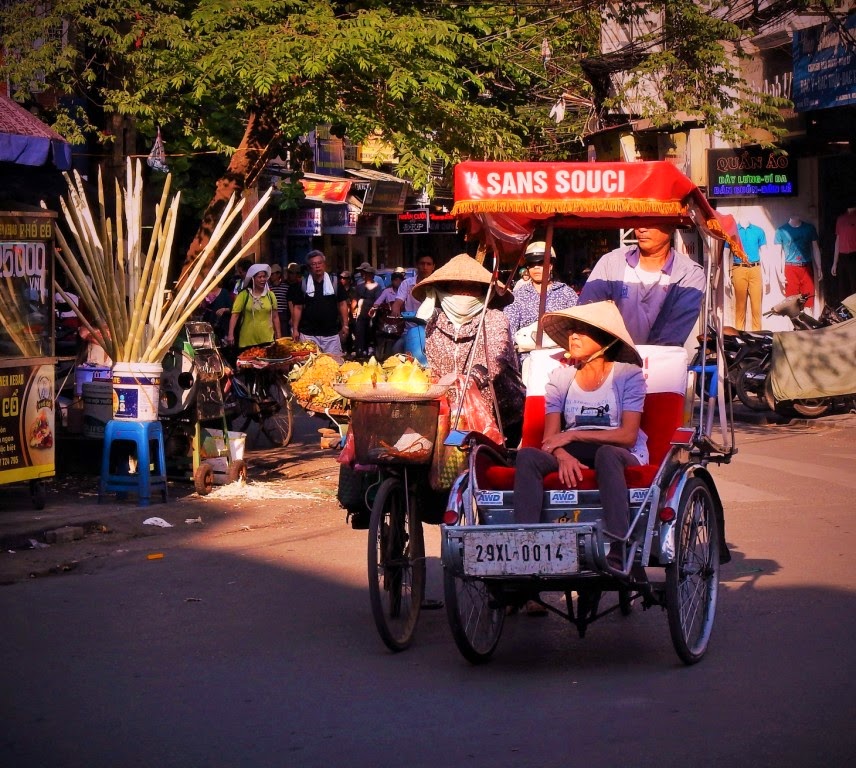
Later in the afternoon, we got a guided tour ride back to our hotel by an informative rickshaw pilot. He told Jordan to sit in the back in the King's position, while I was to sit in front, the Queen's position!

The Queen and King

After a refreshing heat extracting shower, we headed over to a luxury hotel and caught the elevator to the 16th floor rooftop bar to watch a resplendent sunset bring in the night.

From there, we walked to a popular touristy street and found the Why Not? bar next to the Why Not? hotel beside the Why Not? restaurant where Jordan had learned that a pool table existed. Being a pretty good player, he thoroughly impressed his opponents.

What we noticed in Hue, as well as most all places in Vietnam, was the unusual and prolific habit of face masks to protect against the environment. Some take it to the extremes like the 2nd photo below where a local jokingly said they were from another planet.


Alien motorcyclists!

The next morning, we booked a private boat ride on the river to see some pagodas, tombs, and temples. It was a total letdown. It was an impersonal noisy boat, the scenery was repetitive, and the temples were a sad display of a diminished veneration. We were also pushed to buy souvenirs from the boat owner. Oh well. Off to the next town...


Monday, May 12, 2014

Sapa trails

Day 2 in Sapa (northern Vietnam). A long 12-kilometre trek. This one was more of a slow, long descent and along the wider Muong Hoa Valley bottom as we careened our way down uneven, ankle-twisting hills and glens.

Trekking view

We passed through 3 villages with the last being the most beautiful in the area. The Dzay minorities of the Ta Van Village exhibit a strong Chinese culture.

Riveting rice paddies

Working in the paddies

Along the pathway, we were afforded the privilege of taking this lady's photo by buying her beautifully embroidered cloth bracelets. Even at this late stage in her life, she is still happily either selling, or making and selling, wares.

A gentle geriatric

We never found any boys selling product. Only girls. We were told that boys stay home with, or go to work with, their fathers.

Fortunately on this trek, a bus picked us up for a lazy return. While we waited for the bus at a hillside store, there were many young girls with their mothers all trying to sell their stuff. They obviously knew tourists would be there waiting for a bus. The store owner had a good setup as all the tourists were needing cold sodas after a hot trek and the young sellers were also busily buying candy and sodas!

That afternoon, we departed for the train station for our overnight return to Hanoi. We had a few minutes before boarding so we jumped in a taxi for a 5 minute ride to see the border to China, another first for us!

China in the background (maybe another day!)

Saturday, May 10, 2014

Sapa trekking

We made our escape out of the big city of Hanoi (North Vietnam) to the high fertile valley retreat of Sapa. It was an all inclusive trekking excursion.

We boarded the 22:00 train late in the evening of May 9th for the 10-hour overnight ride north into the highlands close to the China border. In our air conditioned sleeper cabin, we quickly fell into a relaxed aura over wine and snacks to the mellifluous clickity clack and lullaby rocking of the ride. We both liked it as it was just like being on a rocking boat. We shared our cabin with a friendly travelling Dutch couple. The basic cabins consisted of 2 sets of narrow bunk beds with a half metre narrow table in between.

Early dawn light invited us to a splendid scenery of the meandering river through the fertile lowlands with the steep highland hills as the backdrop. A 06:00 knock on our cabin door indicated tea or coffee time before our arrival.

Rollin', rollin'...

As soon as we disembarked, a small group of us were met by an efficient and pre-arranged driver for a 45-minute mini-bus ride. As we climbed along the winding road, we left the sticky hot and humid air of the lower land and enjoyed scenery of the steep slopes.

The tranquil town of Sapa clings to a mountainous perch and looks down the quilted slopes of the ubiquitous rice paddies speckled with tiny villages and up at misty cloud-shrouded peaks that even see snow in the winter months. As a town, it was first established as a tranquil getaway about a century ago by the French, and on our arrival, it was easy to see why. It was a mostly sunny warm day as we checked into the Summit Hotel that hung on the hillside with a commanding scenic view...

...and wow, what a view!

Right after a buffet breakfast, we started our first trek. Our pleasant, short, young guide Su (pronounced "shoe", you know, what you wear on your feet) was smartly dressed in her attractive, everyday, traditional, handmade and dyed clothing of her H'Mong Village. It was a 6-kilometre, 4-hour descent to the bottom of the valley and back.

Sweet Su showing us the way

When we reached the hundreds of stoned stairs, villagers were set up all along the edges with their wares and several of them were a bit pushy in trying to sell, but they are only trying to earn extra money from the "rich" tourists. They do have excellent items of homemade silver jewellery, limestone carvings, and exquisitely embroidered bags, wall hangings, blankets, etc. We also watched the H'Mong people of the Sin Chai Village make hemp clothing and use indigo dye.

Down, down we went, now along the meandering paths snaking through the terraced rice paddies and through the Cat Cat Village.

What's a view like this worth?

Our descent culminated at a suspension bridge over the small river in the "V" of the valley. The dulcet cascades over boulders and through vegetative fringed pools made this a delightful respite.

Peaceful halfway point

After an arduous climb back, we freshened up for our late lunch at the hotel then sauntered down to the center of town to explore the local market and wares. On display were the creations and crafts of the people from the surrounding villages.

What first caught our eye was the unique and attractive textiles and dress of these slight but industrious people. Each village signature can be seen by its distinct style of outfit and jewellery.

"You like?"

Oxen herding through town

The first English words that all most likely learn was the introductory "Where are you from?" which everyone would begin with. Once for fun, Jordan tested their response and said something like "From Yaklovac." But with a nod as though they knew such a place, the next inevitable words were "You buy from me?" Yep, sounds like they really were interested in where we were from!

Lovely ladies

Friday, May 09, 2014

Mulling museums

We strolled through 3 museums during our stay in Hanoi. First stop was the Vietnam National Museum of History housed in a colonial French building of 1932. Displays included artifacts from the earliest periods to recent history. The plethora of exhibits included weapons, funerary jars, casting bronze drums, and religious decorum to mention a few.

From there, we moved to the Hao Lo Prison Museum. This prison was significant for a couple of reasons worth mentioning. First, and sadly, it was where the resistant fighters to the French occupation were incarnated and where they were subjected to brutal treatments, torture, and death.

No means of escape

Then during the Vietnam/US war, it was where the downed US pilots were held and they coined the term "the Hanoi Hilton". The US prisoners, including Senator James McCain, were treated very well and were allowed many comforts and privileges. All were released at the end of the war. No doubt a propaganda statement of good will.

Another day we rented a motorcycle and went to the Vietnam Museum of Ethnology, (www.vme.org.vn) about 7.5 km from our hotel. Not far in distance, but it took a long time to get there (and back) due to poor or no signage and heavy traffic. Ethnology means "the study of the characteristics of various peoples and the differences and relationships between them". After paying the entry fee, we were directed to the motorcycle parking by the busy staff.

Parkade security

On first entering the Museum, we noticed a bicycle with 800 fish carts attached to it. Next to it, was a framed picture of the man who actually rode this bicycle exactly as shown.

Our photo of Museum's picture

The well done exhibits represented many of the cultures of the 54 distinct peoples of Vietnam's history, many of which still occupy the country and have proudly maintained their unique features and customs. The Tay ethnic group designed the Museum in the shape of the Dong Son drums which are large round drums made of bronze.

Displayed were samples including cotton and silk clothing, aluminum and silver jewellery, weapons, woven baskets, and musical instruments. The intricate designs of embroidery, the striking colourful appliques, and the dying process of clothing displayed the workmanship involved in the creations of these contrasting ethnic villagers.

Throughout our stay in Vietnam, we saw many wearing the "pointed" hats and an example of how they are made was shown in the Museum.


Also exhibited on the grounds of the Museum were examples of some of the peoples' houses such as those of the Cham of southern and central Vietnam, Sedang of the Central Highlands, H'Mong who inhabit the highest reaches of the mountains of northern Vietnam, and many others.

Wednesday, May 07, 2014

Cruising Halong Bay

A 3.5-hour mini bus ride from Hanoi City (North Vietnam) got us to the coast and the famous Halong Bay. Along the way, we stopped for a break at an artisan market where we admired the stone sculptures and embroidery work. They make pictures, both large and small, all from embroidery stitches. Hardest to make are the black and white pictures and this place had only 2 young women that could accomplish the deed.

Stitching diligently

What's made this Bay so popular is its cluster of 1,962 limestone islands and islets rising out of the sea in fantasy formations. (It was pointed out to us that this number of islands is the same as the year that Vietnamese icon Ho Chi Minh died, endearingly referred to as Uncle Ho.)

We had booked a 2-day, 1-night cruise through only a small part of these fabled islands. At the boarding pier, we were discouraged to see so many tourists and so many Vietnamese cruise boats. Granted, there was some 2nd world character to these boats and one could call it an intimate cruise experience in that typically they had only about 10 double cabins. Our boat was under-booked with only 6 of us!

Embarking

Once out among the better stops, our views were distracted by the numerous other boats. We just felt that this mysteriously beautiful setting where one could understand how it inspired ancient legends of dragons should have been visited in quiet solitude. Nevertheless, the geographical weirdness was not missed.

Inspiring spires

Floating villages that once made their living from the sea now serviced the tourists by paddling them 4 at a time to the shore or under the natural bridges in a bamboo boat or by hawking menial treats.

Floating village

Natural bridge

Bamboo hulled boat

One island had a stepped path to the top for a photo op. Another had us enter a very large and impressive cave.

View from the top

We gave good marks to the cruise for their attentive service, our superior cabin, and the excellent food. On the way back before disembarkation, the kitchen staff did a small cooking class showing us how to make ornamental food presentations and how to make traditional spring rolls. The ones we made, we ate with lunch.

Lotus and sunflower

Later in the afternoon, the mini bus dropped us off to the pleasant welcome of our hotel staff in Hanoi.

Monday, May 05, 2014

Essence of Hanoi

A simple joy of Hanoi (North Vietnam) was just wandering the streets and alleys, taking in the culture, and sampling the foods that make the place special.

On the street, honking motor-scooters competed with rickshaws, vendors with baskets, bicycles, pedestrians, and cars.

Rickshaw riding

A scene that spans centuries

To cross the streets or intersections, one simply steps out slowly and w e a v e s their way through the hordes of oncoming traffic with confidence from knowing that the drivers are always watching. It seems to work. We didn't see any road kill!

Running the gauntlet

The sidewalks serve a multitude of occupants and purposes. Pedestrians compete with parked motor-scooters, street vendors, eateries, as well as shop wares that spill out to the curb. We, like many others, usually ended up just walking on the road, giving way to traffic as their honking dictated.

Sidewalks but no room for walking

The umpteen sidewalk eateries (literally) were abuzz with locals and brave tourists like us. They were always an easy find. We just had to watch for the smoke from their grills or use our noses to follow the aromas to the best ones, always the busiest, and usually on the corners.

It was a great way to sample new foods because we could pick out what we wanted from the display of different dishes laid out. We squatted on low tiny stools by tables with amputated legs and ate amid the din and close proximity of all types of interesting and bustling passing traffic.

Sidewalk dining

A slightly known but special treat is the Pho Cocktail. It blends Gin or Vodka with typical flavours that go into the local soup (Pho). Sounds strange, but the party in your mouth makes this drink one that you will try over and over, which we did!

What was strikingly obvious about the Vietnamese was how energetically enterprising they were. We saw no panhandlers. Their days started early and they seemed always on the go.

Feather duster vendor

Currency is the Dong: currently 1 Canadian dollar equals approximately 20,000 Dong, and $52 equals 1,006,921 Dong. Wow - we're multi-millionaires in Dong currency!

The local women were almost always dressed up. They wore stilettos riding motor-scooters with dresses, skirts, and even shorts. They wore their clothing tight and short and often transparent blouses with fancy bras. Slim is the word here, very few overweight people. A nice change from many other countries!

Sunday, May 04, 2014

NORTH VIETNAM

We figured that our auto-pilot would not be repaired and returned to us in Danga Bay (Malaysia) for about 3 weeks. We decided to take one of the many "away from the boat trips" that we plan on doing while in this area of the world. So after checking cheap flights, we chose North Vietnam as our destination.

As Canadians, we could get a "Visa Upon Arrival" as long as we had a pre-approval letter in hand. This letter could be gotten from the Vietnamese Embassy in nearby Singapore in a week or so, but we were to leave in 2 days. So we chose our only option which was to get the letter overnight from an online private agency for a fee.

Our flight departure was at 06:30 from Kuala Lumpur, about 350 km north of Danga Bay, so we took a 5-hour late evening bus ride the night before. It was a nerve racking trip, not because of poor roads (it was a modern highway), but the driver was either inebriated or unstable because his driving was erratic and all over the lanes. We almost got off the bus but couldn't find a taxi.

Kuala Lumpur is a very large city so we expected its airport to be more elaborate but it was a letdown with poor services and lack of seating for persons awaiting arriving planes. People were sitting or sleeping on the floor. Decorating was extremely minimal.

Upon our arrival at the Hanoi Airport in Vietnam, we simply presented our printed paperwork, paid $90, and were handed our Visas. We then cleared Customs and Immigration with no problems. Sometimes things just work out in your favour (not like our auto-pilot!)

At one of the Airport counters, we asked for a map and were talked into signing up for a cruise of the famous Halong Bay. They also booked us a very nice hotel at $25 US a night. We were then packed on a mini bus for the 45-minute ride to Hanoi's Old Quarter where many travellers stay.

The sprawling city of Hanoi with its 7 million population is the largest city in northern Vietnam. The hectic traffic was our first indication of the busy and energetic nature of the Vietnamese people.

We soaked up the scenes that make the Old Quarter so interesting. Generally situated around a small lake, it is an interesting mix of narrow streets and very narrow tall buildings draped with a cobweb of wires.

"Which one to connect?"

Interestingly, we learned that the reason for such skinny buildings was that for decades, if not centuries, up till around 1950, taxes were based on the width of buildings. When we inquired why buildings were still being built that way, the answer was that it's what the people are familiar with.

Many building were a mere 3 metres wide (including the thickness of outside walls) with some even narrower, and anywhere from a few stories to several stories high. What they lack in width, they make up for in depth. One art gallery in the Old Quarter is just over 2 metres wide! The hotel we stayed at was about 4 metres wide and 9 stories.

A few skinnies - a mere 2.2 metres wide

A hotel - 4 metres wide, 10 stories

A traditional outdoor entertainment of the humble lives of the rice farmers was water puppetry. We attended an authentic popular reproduction of this at the indoor Thang Long Water Puppet Theatre.

Included in the repertoire of 400 of the ancient wooden puppets were human figures, dragons, frogs, a fox, ducks, fish, a unicorn, and a mythical phoenix bird. The scene was of a pagoda in a waist deep pond where, behind a screen, up to 8 puppeteers operated.

Pagoda stage with band at left (photo copied from web)

The puppets effectively did their splashing and cavorting to a storyline while attached to unseen strings and submerged control rods. We were warned that "water scooping" would happen and those in front rows could get wet, but no one did during the performance we were at. Water scooping involved the puppets splashing scoops of water with their paddles.

"Rowing" merrily (photo copied from web)

The entertainment was supported by a small band and singers who also provided the voices for the puppets. Even though it was in Vietnamese, it was still to the delight of even this modern audience (www.thanglongwaterpuppet.org).

Lots of movement (photo copied from web)