Wednesday, April 25, 2012

Isla Isabela Galápagos

Upon our return to Isla Santa Cruz (where we have Sea Turtle anchored), we bought ferry tickets for an April 24th journey to Isla Isabela. But early in the day, Aaron (Jordan's son), Deanna (his gal), and Jordan and I hiked out to swim and snorkel at Tortuga Bay before the ferry ride.

It was excruciatingly hot out as this is one of the hottest months at the Galápagos so the 2.5+ km walk was very tiring. The cobblestone path was lined with the tall Opuntia Cactus that is native to the Galápagos with stems that grow as large as trees. But upon arrival, the paradisiacal beach made it all worthwhile.

Long stretch of fine, white, coral sand beach (courtesy of Aaron & Dee)

There was very little sea life but the water was wonderful to swim in even if little sea life was evident when we snorkelled. We then hastily returned to catch the 14:30 ferry to Isla Isabela.

Isabela, in the shape of a seahorse, is the largest island of the Galápagos and still has 6 active volcanoes. It had a penal colony from 1946 to 1959. To punish the prisoners, they were forced to build a wall of huge blocks of lava rocks. The wall, measuring 100 m by 7 m high, still exists today and is known as the Wall of Tears. Isabela straddles the equator.

We checked into the Hospedeja Cerro Azul where our hosts, Nelton & Judith, were very helpful and warm hearted. We would recommend this (www.hostalisabelagalapagos.com) as a place to stay if you are ever at Isla Isabela. After settling in, we wandered around the beautiful beach and cute town where most roads were covered in white sand!

The next morning, Nelton drove us to the area of the Triplet Volcanos where we then hiked through lush vegetation as Nelton pointed out other volcanoes in the distance, along the top of steep ridges and down holding onto ropes...


...and finally deep down-reaching into the inactive volcano tube using more ropes and a few rickety stairs. It was a very beautiful location and thankfully cool in the tight opening of the volcano after a hot hike.


As we drove back to town, Nelton stopped at a plantation where we picked a couple of large papayas and then asked if we would like to stop at an eco-reserve for tortoises (land turtles). Unfortunately, just as we arrived at the reserve, the front-end suspension of Nelton's truck broke! (As we toured the reserve, Nelton arranged for another vehicle to pick us all up.)

We got a tour of the reserve, picking fresh bananas, passion fruit, and all the mangoes we wanted. After we had finally had enough of all the nature surrounding us, the staff sliced for us some of the mangoes and passion fruit that we had collected along the walk and cooled us off with chilled drinks.

I need a pedicure

Next was the boat tour to the nearby Las Tintoreras, which means white tipped sharks. The boat first dropped us off for some snorkelling among the seals, turtles, and myriad of other sea hosts including a small baby octopus that the guide handed us until it shot some ink out and away it went.

Octopus holding tightly

After which, they took us ashore and we walked a "loop" tour of part of the island where many blue-footed boobie birds, small penguins only found in the Galápagos, seals, bright red Sally Lightfoot crabs, and marine iguanas were lazing around. Marine iguanas are only found in the Galápagos - no other place in the world - and it was quite hilarious to watch as they "sneezed" the saltwater from their nasal glands after their foraging underwater.

Warming in the sun, sneezing out salt after ocean swim (courtesy of Dee)

Tuesday, April 24, 2012

Diving & Lonesome George

Isla Seymour Norte of the Galápagos Islands was the chosen site for diving for Aaron (Jordan's son), Deanna (his gal), and Jordan but I snorkelled again as I don't have a diving certificate. We boarded the boat with 4 other eager divers.

All suited up to dive and snorkel

This was Dee's first official dive and Jordan said that it was the best diving of his life! The sea life was once again abundant and definitely a great spot for a first dive.

Dee with Aaron on her 1st official dive

Up close and personal with one of several white tip sharks (did I say shark!)...


Masses of colourful fish were spotted - many in huge schools...


Forests of garden eels were also evident. These creatures are worm-like and retract tail first into their ocean bottom holes when you approach them...


Many starfish were sighted in varying colours such as red, yellow, blue, and chocolate chip. There is such an abundance of sea life that most people have never heard of or seen before. It is always such a treat to stumble upon them...


Jordan said it was like being in a huge fully stocked aquarium. Apparently, there were hammerhead sharks swimming near me as I snorkelled, according to the guides on the boat. But unfortunately, I never saw them!

Upon returning to Isla Santa Cruz, we walked to the Charles Darwin Research Centre where the famous land tortoise, Lonesome George, makes his home. He is the rarest creature in the world, and the last of the Pinta Island tortoises if a female Pinta cannot be found. There is even a $100,000 reward for discovery of a female Pinta! As of this date, Lonesome George is thought to be at least 100 years old. We were lucky to see him, as he does not always appear for photos.

Lonesome George trying to hide...

Monday, April 23, 2012

Snorkelling at Galápagos

We have spent the last few days doing boat jobs as we waited for Jordan's son & girlfriend (Aaron & Deanna) to arrive at Galápagos from Victoria BC. (We chose not to tour any areas until then as we could be seeing things twice.)

Once they arrived on April 21st, we checked out some tour agencies and booked a snorkelling tour for the next day at 3 sites. First site was at Isla San Cristóbel (San Cristóbel has been inhabited since 1910 as it has fresh water on the island and many of the other islands do not.)

After about a 2-hour boat ride we arrived at Isla San Cristóbel, then after a short hike, we had our 1st snorkelling for the day at La Lobería. This was a tranquil sandy beach with oodles of sea life! We immediately saw several cute sea lions lolling on the beach.

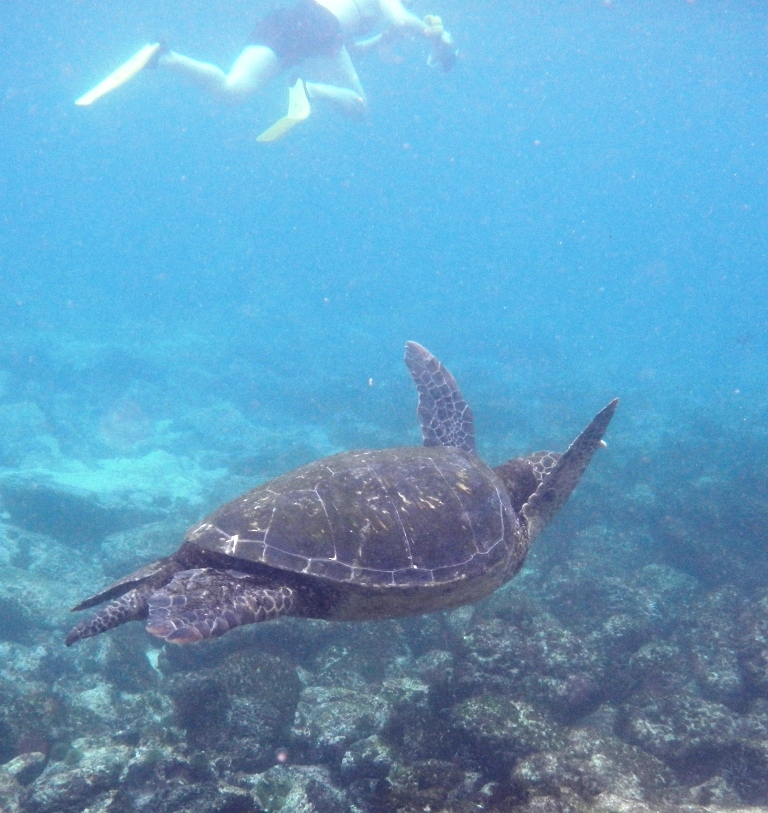
Once in the water, we were amazed at the abundance of colourful fish, rays, sea lions...and turtles were everywhere! We swam through schools of fish and alongside rays and turtles. Humans were inconsequential to the sea life and we were basically ignored, definitely not feared.

Swimming above a sea turtle (courtesy of Aaron & Dee)

The tour boat next took us to León Dormido ("lion rocks") also known as Kicker Rocks...

Photo snapped as we leave Kicker Rocks (courtesy of Aaron & Dee)

We all jumped from the boat into the water with the large rocks jutting from the ocean ahead of us. The rocks were very dramatic as we snorkelled between them, but it was difficult to see the sea life as the water was a little murky on that day. But we did spot this majestic spotted eagle ray!

Beautiful Spotted Eagle Ray

We then progressed to another island, Isla Santa Fé (southeast of Santa Cruz) which has volcanic rocks dating back 4 million years! We saw schools of colourful fish and lots of seals. The inquisitive seals entertained us by swimming all around us - even with their pups.

Monday, April 16, 2012

On our way to Galápagos

We finally got underway from Isla Robinson Crusoe once the strong blow settled down to a comfortable south wind that then pushed us northward on our passage to Galápagos. We quickly settled into the passage routine that we have become familiar with, and for the first week, it was pretty much uneventful.

About 600 nautical miles off the coast of southern Peru, and about 12,000 feet off the sea bed, on Jordan's watch during the day he was surprised to see us passing a numbered float. Then looking around he saw a few that seemed to be in a line that we crossed. His first concern was a net strung between the floats but there was no indication of such and it didn't seem feasible that they were tethered to the sea bed at that depth. So we came to no conclusion as to what they were.

Late one night, again on Jordan's watch, under an almost full moon that was far to the west, he was startled to see a distinct white semi-circle arc that rose off the dark east horizon. He had never seen anything like it in his life but soon figured out that it was of course a moon rainbow! He woke me up so I could see it too. What a fascinating sight!

On about the 8th day, the winds died to almost nothing so we started the Perkins purr and let out the fishing line and soon caught a nice little Dorado fish that gave us 4 good meals. We have not been putting out the line while sailing under a wind as the seas are usually rocking us around so landing a fish on a rolling deck is not too comfortable. Also while motoring, we usually turn on the watermaker because the motor makes more than enough amps to power it. By now we only have seen one ship, a southbound freighter about 8 NM off our port side.

Where is everyone?

On the night of the full moon, again on Jordan's watch, we were visited by a lone pilot whale. Jordan pulled back on the power and it came right up beside us as if to say hello briefly before cruising off on his solo whale passage.

One day away from Galápagos landfall. Lots of motoring in the last few days. We are evidently into the ITCZ (InterTropical Convergence Zone) that disseminates the northern hemisphere atmospheres from their southern relatives (also called the Doldrums by sailors). This is a zone of calms and unsettled weather, lots of big cumulus clouds that can give you some gusts and rain showers. This is a zone that circles the world's seas at or around the area of the equator, but around here it typically extends from the equator to about 5 degrees north, so it has dropped down to the south by about 300 miles. However we did pick up a nice light tail wind for the last day and we cruised along nicely under a billowing spinnaker before the winds died for our last night.

Bright spinnaker poled in very light wind

When we started the motor just before sunset, it died shortly after (ran out of fuel on the port tank). It's a bit of a pain when that happens because the Perkins gets cranky and needs to have the lines bled - about a 20-minute job. While Jordan was doing that, he did a visual around the engine compartment and noticed the fan belt was in the advanced stages of wear. So he dug out a new spare. It was the right length, but it was too thick and it wouldn't stay on the narrower gauge pulleys so we continued on with the old one. Now this old belt was the same one we left Victoria with.

It worried Jordan because this fan belt runs the water pump and, if it broke, the engine would overheat. We don't have an alarm for an overheated engine, just a temperature gauge. So we adjusted our usual 20-minute watch check, which includes checking the gauges, down to every 10 minutes. When Jordan woke up the next morning, he said it came to him in his waking consciousness that he could cut down the width of the replacement belt by hacksawing off about 3/16" which he did and tidied up the edge with a super sharp knife. He quickly replaced it and it worked perfectly!


Also during the last night, Jordan, on his watch, heard a thump and thought we ran over something. He jumped up but of course couldn't see anything but heard a splash close by. He thought we might have ran over a whale, but then saw streaks of phosphorescence around the boat and knew it was dolphins playing with Sea Turtle. One no doubt got too close to the bowsprit support. Boy, Jordan sure has had eventful watches on this passage!

After 17th day, Land Ho! Always an exciting sight.

We dropped anchor at about 02:00 local time on April 15th in Academy Bay (Port of Ayora) on the main island of Santa Cruz in the Galápagos (S00°44.876' W090°18.509'). Jordan got the outside of the boat organized (dinghy inflated, washed down the deck in the light freshwater rain, put up the bimini, etc.) while I got the interior reorganized for normal life again. Just as we finished, a panga full of officials came aboard and we got all the check-in process done. Very efficient but expensive - $658 US. That included the agent's fee, park fees, non-toxic boat fumigation, immigration, and clearance when we are ready to go. They gave us 25 days for our length of stay. But we are not allowed to take Sea Turtle to any of the other islands. We would have had to pay about double and I think we also would have had to let them know ahead of time that we were coming, which we did not do.

We then finally relaxed in the cockpit with margaritas in hand, anchored amongst about 25 other transient sailboats that have made this their stop also on their way west to the South Pacific. The surrounding waters were so green, not the usual blue. Indeed, a very beautiful anchorage.

Thursday, March 29, 2012

Isla Robinson Crusoe

We finally pulled in the dock lines at 11:00 on March 18th leaving Puerto Montt Chile (S41°30.159' W072°59.399') for our long passage north. The first 8 hours of the trip took us between islands and through channels before the open ocean. The extreme tidal range here is only matched by the strong tidal currents, so even though it is only an 8-hour run out to the Pacific, you can't do it with one ebbing tide, so we stopped overnight at a cove called Ensenada Codihue (S41°48.113' W078°21.644') before continuing.

The next morning after traversing through the Canal de Chacao, we picked up the ebb current and were doing 12 knots over land. We soon reached the expansive Ocean with 7 or 8 dolphins escorting us a distance to wish us fair winds!

Winds were very light at first but by evening we had 15 knots pushing us. The stars were incredibly brilliant in the moonless inky sky. Early the next morning, a snap shackle broke on the head sail sheet (line) so Jordan replaced the sheet. Winds and seas really picked up by 11:00 so we doused the head sail and hoisted and poled the staysail but were still doing 5.5+ knots.

The next day under mostly cloudy skies, the wind speed increased to 17 to 25 knots with rolly 10-foot-plus waves. Jordan saw a huge sunfish directly in front of us and almost ran over it! That night it was very dark with light clouds and still no moon.

The night of March 22nd and most of the next day, we were pushed along in a gale that Sea Turtle handled with no problem. Just a few days ago I was telling another sailor that since we left Victoria, we had never experienced a gale at sea. So there we have it now.

Land Ho! March 23rd at 13:45! Made a difficult anchorage in Cumberland Bay at 18:00 (S33°38.359' W078°49.541') at Isla Robinson Crusoe with winds blowing and williwaws gusting. Four other sailboats were also present.

Isla Robinson Crusoe is part of the Juan Fernández Archipelago consisting of tiny Isla Santa Clara which is 1.5 km from Robinson Crusoe and uninhabited, and also Isla Alejandro Selkirk, about 180 km west of Robinson Crusoe. Alejandro Selkirk has a few fishing villages only during the fishing season who then relocate to Robinson Crusoe. Robinson Crusoe has a current population of about 850 at the only village of San Juan Bautista. No hospital or bank here but there is a school, cemetery, new soccer field, tourism office, Chile Armada, a few markets and bars, and police. About every 3 weeks, the village receives supplies via a ship from mainland Chile.

Busy unloading supplies onto the dock

Two years ago in February of 2010, Chile experienced the 2nd strongest earthquake ever recorded. The resulting tsunami hit the village here causing extensive damage and 16 persons perished. There is a great deal of reconstruction happening but you can still see the remains of foundations as stark evidence of the disaster. Incidentally, the largest recorded earthquake was in the 1960s, if I remember the facts, and it was also in the same vicinity.

A little privacy please?

Another notable fact: The Robinson Crusoe novel was based on the real life experience of Alexander Selkirk who, in 1704 after an argument with the captain, jumped ship at this Island (not at Isla Alejandro Selkirk) with minimal supplies and not only survived but coped quite well for 4 years before he was picked up. (The islands were renamed in the 1960s to attract tourists and I assume that Isla Robinson Crusoe was named as such as more people are aware of the fictitious character than the real one.)

The Island is something you might see out of the South Pacific with verdant spiry peaks ringing obvious prehistoric volcano hollows. The village is on the north side, protected from the predominant south winds.

Snapped from atop a peak when we were hiking

Their meager economy is dependent mostly on lobster fishing, some government jobs, and a yet to grow tourist industry. Visitors have to take a small charter flight that lands on the arid east end of the Island about 15 km away, and as the terrain between is precipitously near vertical in most places, no road connects the village. So most are ferried by a 2-hour boat ride. The other option is by land but only half the way is by road - then you either hike or arrange a horse ride for about 7 km up and over stunning ridges topped in mist a lot of the time.

Topographic of Robinson Crusoe

(Bahia Cumberland, where Sea Turtle is anchored, is front and center in topographic photo.) There are lots of steep hiking trails and camping spots to different vistas, one of which we did named Salsipuedes. The trail took us through eucalyptus and pine forests, and up vertical switchbacks to a ridge with vertical drops straight down to the sea as evidenced by this topographic at the tourist office. It was a great photo op of Sea Turtle anchored in front of the village.

Sea Turtle and village WAY down there

During World War I, the British navy was in the vicinity and intercepted a radio call from the German battleship Dresden searching for coal for its engines. They coralled it in the bay and shelled it until it sank to about a 150-foot depth. We saw where the shells from the battle lodged into the rock face.

We tried to do emailing but it was intermittent on and off, mostly off, and when it was on, painfully slow. We got some basic emails done though. The winds were strong during our stay and even though we were on the protected side of the Island, extremely strong gusts funnelled down the lee side of the mountains, through the village, and knocked us about on a strained but holdfast anchor. We tried to get fresh lobster but all the fishermen were holed up because of the high seas in their netting areas. So we found a restaurant to accommodate us but were disappointed as the large lobsters were served cold and with no hot butter!

One night, 2 big deep-sea fishing boats came into the bay to escape the high winds but they didn't anchor, they just meandered around under power and large bright lights for the crew to mingle around an open fire on their aft decks. At one point, we were down below and I felt a bang. Jordan jumped up and out the hatch as the big boat was trying to back away. Jordan told them in no uncertain terms to get the hell away and stay away. To add insult to it all, the next morning our decks were speckled with black soot from their bonfire. What a mess!

When it came time to leave, the procedure is to get a new zarpe (exit permit) from the Armada office. Once that is done, we had to go directly to the boat and not come ashore again. However the plan to pull anchor was delayed a day and a half as the winds were atrocious.

But early on the 28th, with the winds decreased enough, we pulled anchor and said our goodbyes through the camera lens for our long passage north, nonstop to Galápagos about 2,000 nautical miles. (For you land lubbers, that is about 4,000 km or 2,700 mi.) Robinson Crusoe was a great island to visit as we thought about the man that was marooned were we stood!

As the Chileans say, "Ciao, ciao" (goodbye)

Sunday, March 18, 2012

Leaving mainland Chile

Jordan has found time to get back into painting again while we are hanging around Chile. He recently finished an acrylic of boats (a photo of his finished painting below) and it now adorns Sea Turtle's wall. (Personally, I think he's very talented!!)


Garlic cloves are huge here. One clove is as large as the whole head of garlic that we buy back home in Victoria. Barnacles are also huge and on restaurant menus! Fresh fruit and veggies are readily available from vendors on the streets, even right in front of major grocery stores! And dogs. Everywhere you look, dogs are sleeping. Also fat and happy! We counted 6 in 1 small area.

Did we ever mention that power here is 220 volt? We've noticed most buildings are wooden with exterior walls clad in cedar shingles - some with just a section but entire houses are covered with them also. Tides - well tides vary a lot here, about 20 feet. In this photo at low tide, Jordan is reaching up towards the square light, way up...


...and here at high tide, Jordan can now touch that same light!


Jordan has re-installed our repaired autopilot and it passed a try-out with flying colours! Due to an error that the customs agent made on our paperwork when we sent the unit to the States, we were forced to pay custom dues when it was returned to us in Chile. We tried in vain to remedy this error made by a customs official, but customs did not care. Their error cost us an additional $250 for a total of $700 to send it, have it returned, and payment of the custom dues. But on the other hand, we received excellent service from the maker of our autopilot!

We are finally able to depart mainland Chile. Not that we haven't loved Chile but it's getting late in the season, meaning their winter is fast approaching. By going south to the glacier and throughout the islands via Sea Turtle and going north via rental car through all the different districts, including the Lake District and the Atacama Desert, we experienced and saw so much. We would highly recommend Chile as a place to visit.

Today we leave for a quick stop at Isla Robinson Crusoe, 1 of the 3 Juan Fernández Islands, which belong to Chile. It's about a 5-day sail north from Puerto Montt where we are and about 600 km (300 miles) off the mainland...

Sunday, March 04, 2012

Iguazú waterfalls

Once back in Santiago Chile at our nice hotel, we had a lazy day before our booked flight out to Argentina and Iguazú National Park in the north which has been proclaimed one of the New 7 Wonders of the World. Someone described it as making Niagara Falls look like a trickle.

The park protects a large area of special rainforest containing an enormous variety of plants and animals. We spotted the bright red bird Surucua Trogon, the Great Dusky Swift which nests behind the waterfalls, an unknown yellow bird, and eagle-eye Jordan pointed out to us a Toucan flying by. Coatis that look a bit like raccoons were scooting around everywhere.

Click on http://whozoo.org/AnlifeSS2001/bettsass/BS_Coati.htm for more information about this interesting animal.


But the best part of this National Park is the 275 different waterfalls that can be viewed from both Argentina and neighbouring Brazil. We had planned on spending our first day at the falls on the Argentinean side and then taking a bus to view them the next day from the Brazilian side. But we found out that we would now have to obtain a costly visitors' visa in advance from an embassy to enter Brazil, something that Canadians did not have to do before. What a shame, as we would have liked to see the falls from the Brazil side plus we would have spent money in Brazil - so both sides lose - we don't see the falls and Brazil doesn't gain our tourist spending dollars.

Fortunately, the best up-close viewing of the falls is in Argentina (Brazil offers a more panoramic view only). The temperature here is very hot and humid, even in the winter. The tallest fall, 82 m high x 700 m long x 150 m wide (U-shaped), is called Devil's Throat.

We boarded the Park train through an area of jungle to the vicinity of Devil's Throat where we then hiked across metal boardwalks to cross the river and to the very edge of the falls. The views were magnificent. We took lots and lots of photos, but as usual, photos just don't do it justice - so much better in person to understand the actual scale of what you are viewing. And hearing! The sound of millions of gallons of water crashing right next to you standing there! At some viewing places, the thundering falls shoot out a heavy mist and soaked us. Definitely need a waterproof camera. The views were so captivating and mesmerizing, hard to imagine. Jordan likened the scene as fairytale-like waterfall scenery, too perfect to be real almost.

A small portion of Devil's Throat

After taking the train back to the station, we next hiked the upper level and then the lower level where waterfalls are everywhere. We again took lots and lots of photos and rainbows were very abundant on this splendid sunny day!

1 of many rainbows seen

We also hiked way down to board the powerful inflatable open boat to take the ride up-close and almost beneath the falls. Everyone got completely soaked and when asked by the driver, Y otra? (And another?) everyone yelled Si! (Yes!) We must have done it at least 3 or 4 times and loved it each drenching time. What a thrill! We also purchased the video of the falls and the boat adventure as a keepsake, where everyone is laughing and drenched!

Falls as seen from water level in the boat

As is commonly stated,
From the Brazilian side you see the falls, from the Argentinean side you live them.
When this close, all you see is mist (between wet closed eyes) where you are really living them!


Right after our boat ride, a big black cloud rolled over and it started to rain quite hard. We were already wet and finished touring all the areas that we were interested in so that was good timing!

Other available activities included a photo safari or walking through the rainforest (but as it was raining hard, we decided to bypass), a boat ride to Isla San Martín for more great views of the Devil's Throat (but access to the Island was closed for some unknown reason), and a gentle boat ride through the upper river and islands (but hey, we had just had the wild ride!) There is also a full moon visit to Devil's Throat in the evening but there was not a full moon when we were there.

A slideshow of 15 photos is inserted in our Photo Gallery (on the right of this blog). Once the Photo Gallery opens, click on the green title page of Igauzú Falls which will take you to a new screen. Click again on the green title page and then wait for a few seconds as the slideshow starts. Hope you enjoy...

The following day was when we had expected to be in Brazil, but as that fell through, we spent a lazy day around the hostel swimming pool until it started to pour! A couple of hours later, we caught the taxi to the airport for our flight back to Santiago.

Upon landing in Santiago, we found out that Chile charges some countries a "reciprocity" fee to enter their country by air - including Canada. Only the international airport at Santiago charges incoming visitors. What this means is that we would have to pay a high fee to cross the border from Argentina to Chile as Canada charges this high fee for Chileans to enter Canada. We had to pay $132 US each to get back into Chile even though we had left Chile twice already and paid no fee to enter or re-enter, but we were either driving or boating and entering a smaller city.

Should Canada re-think their practices and amounts charged to foreign countries as we now have to follow the same practices and pay the same amounts when we travel to those countries?

After landing and clearing from Santiago, we made a quick trip back in our rented car to Puerto Montt and Sea Turtle. It's always wonderful for us to return to our home - our boat - especially after covering 7,288 km by car!

Monday, February 27, 2012

Chile by car

As we had to wait for our autopilot to be repaired and returned to us in Chile, we decided to rent a car and take a tour of Chile by land. We experienced such a variety of landscape, people, and temperature. Unknowingly, we were travelling during a festive holiday period and had a labourious time finding reasonable, if any, accommodation. Most towns and cities were packed with people and traffic, making it difficult to get around.

Chile has great roads and terrific signs almost everywhere - it would be hard to get lost along the roads (but maybe in some of the cities with much smaller and less frequent signs). Along Chile's PanAmerican highway, there are many toll booths and on our journey we paid a total of $82,100 Chilean Pesos which equalled about $160. We found hotel rates and general prices to be about equal to or higher than Victoria BC prices whereas we had been expecting cheaper.

Throughout our travels, we drove through many small crowded beach towns such as La Serena and Bahía Inglesa with its white sandy beach. We also went through 3 highly recommended cities (Valdivia, Valpraiso, and Viña del Mar) but because of all the people and traffic it was hard to really appreciate them so we did not linger long. We enjoyed Santiago, with its old colonial buildings right next to its modern sleek buildings - such a contrast - and we had a delightful quaint hotel that felt European; it was right beside a beautiful park that we strolled through.

So many people at Bahia La Serena...

A highlight was going through the Atacama Desert, the driest desert of the world with some areas of no recorded rain. Ever! It was not what we expected for a desert. The Atacama has such a varied landscape from sand dunes, totally smooth rolling hills of striated colours, flat areas with sage brush, and areas with moon-like sharp jutting rocks. The many colours we noted included black, grey, white, tan, green, pink, red, and even purple - a real eye treat! Even though we were travelling during the south's summer, the desert was only about an average daytime temperature of 27 degrees.

How many colours can you count?

Mining is also very, very extensive throughout the desert. Nitrates were highly mined until the Panama Canal was built but now copper is mined extensively. We saw areas of hillsides streaked with layers of chalk/gypsum and Jordan wrote on the road with it. Several old adobe mining villages were present. We also drove past huge mining projects that have changed topography on mountainous scales.

Jordan atop 1 of the smaller mining trucks

Upon reaching Arica at the northern border of Chile, we had planned on crossing into Peru to see the ruins of Machu Picchu. Unfortunately, the only border crossing between Chile and Peru was inaccessible due to the closure of the flooded bridge from heavy rains experienced earlier a ways upstream (Andes). We then decided to head towards Bolivia where we could cross into Peru from Bolivia.

Once again, no luck as upon reaching Bolivia, we were told that we could not take our rented car across the border as we did not have proper paperwork to take the car out of Chile. So we walked across the border - just to get our passports stamped with Bolivian stamps! That turned out to be a mistake as it then became difficult to re-enter Chile.

As it turned out, the Bolivian officials are not very concerned with officialdom. They had left for "lunch" to a city 1.5 hours away. But in actuality, they had left for the day to celebrate the festivities of the holiday period (Carnival). After a lot of driving and running around, we, along with a backpacking couple, finally found someone to stamp our passports with the required Bolivia "exit" stamp so that we could properly enter Chile.

We also found out that it was raining extensively in Peru and many people were stranded up on Machu Pichu because of washouts, etc. So all in all, it turned out best that we had not made it to the ruins. Maybe we will try again when we are on the Atlantic side of South America.

We returned to Arica for the night and then headed back towards Santiago, this time along the coast for part of the way where we saw several areas of seaweed being harvested. We stopped at an ancient cemetery beside the highway in the middle of nowhere where wooden structures were falling apart from age.

Sandy desert on 1 side, Pacific Ocean on the other

Driving by the ESO Paranal Astrophysical Observatory (www.eso.org) one day, we thought it would be interesting to check out but tours had to be pre-arranged so we were not allowed to enter.

Later, we walked along a beach where we collected a few beautiful purple sea urchin shells. The next day, we went to see the largest swimming pool in the world (S33°20'57" W71°39'10.6"). Several years ago, I had seen a picture and always wanted to see it for real. Situated in the private residential resort of San Alfonso del Mar in the city of Algarrobo, we were not allowed access but we did snap a photo from a distance. It is 1 km long and holds 250 million L of water. This man-made saltwater lagoon keeps fresh seawater in permanent circulation, drawing it in from one end and pumping it out at the other. With water so clear you can see the bottom even at the deep end of 115 feet. We saw a sailboat on it too! This pool is in the Guinness Book of Records.

Pool with ocean and beach sand in front - sailboat on left

Next it was back to Santiago where we would leave the car for a couple of days to catch a flight on the 28th of February for another adventure!

Tuesday, February 14, 2012

Change of plans

Here we are, back at Puerto Montt Chile. Our auto-pilot would not work and we didn't want to hand-steer 24 hours a day for a week and then again for much longer heading north. So we returned after trying for a couple of hours to get it to work, but no such luck. Now we are waiting for it to be repaired in USA. Spent all day yesterday with officials preparing the paperwork and another 3 hours today. All should be shipped, repaired, and returned within 2 to 3 weeks maximum. Hopefully...

In the meantime, we will take some land trips while we wait for the auto-pilot to be returned.

Have you ever noticed the titles at the top of our blog postings - just below the large photo of Sea Turtle? "The Wind in the Willows", "I Am Drawn", and today I just added a new one entitled "Night Watch". Night Watch was written by a fellow Bluewater Cruising Association sailor, Carolyn Daly of SV Shannon, and was presented to us as a gift when we departed for our adventures in 2009. Please take a peek!

Saturday, February 11, 2012

Puerto Montt onwards

Retrieving the anchor on February 1st at 07:45, we planned to stop at one more anchorage before reaching Puerto Montt Chile. But that didn't quite work out...

The SW wind did not happen as predicted and hoped for so we were once again motoring in glassy seas. These last 3 weeks have almost always been motoring with little to no wind or beating against a head wind. But we did have a couple of real great sailing days.

Then Jordan sensed an unusual ticking/slapping sound coming from the rear of the engine compartment. So he immediately stopped the engine, opened up the compartment, and discovered the culprit - the engine compartment ventilation hose had gotten snagged on the rotating shaft and spun tightly around it with disintegrating shards of rubber and wire all over the place. It took about an hour to free the shaft of the debris while we drifted with the tide.

We were now behind schedule and couldn't make a good anchorage before nightfall so we decided to do an overnighter. After an uneventful evening, we arrived back to Puerto Montt at 14:30 on February 2nd.

The last 3 weeks had been full of new experiences and unique sites, the memories of which we will carry on board for a long time.

Back at Puerto Montt, we got busy as usual catching up on gmail, blog, and calls to family, a list of boat job and stuff to get. We caught a taxi cab back to Club Nautico one day and the driver, Claudio, asked if we wished to join him and his family for dinner one evening. We were very surprised to receive such a kind invitation from a total stranger but we wholeheartedly accepted.

Two days later, Claudio picked us up at the marina and drove us quite a distance down the coast and out to his home. There was Claudio, his wife, and two daughters and lots of delicious food, fun stories, pictures, and entertainment by their young grandson. We were delivered back to Sea Turtle laden with homemade plum juice, red current jam, buns, and cranberry cake. Super folks!

We finished all errands today, including provisioning, and it was rather late (20:00). Too late to make a dinner. So we had a loaf of French bread, cheese, paté, and good Chilean red wine. Jordan said it reminded him of when he was young and single backpacking in Europe and he would get a bottle of wine, fresh French bread, and delicious cheese, then catch a train (he had a month long EuroRail pass).

Beautiful sunset at Puerto Montt marina, Club Nautico

Puerto Montt has been a great place to get things, get things done, and actually be at the dock (at a mere $9 a day). The last time we were at the dock was over half a year ago and the next time may be well over that. So with zarpe (exit permit) in hand, we are leaving Puerto Montt tomorrow morning for Isla Robinson Crusoe, part of the Juan Fernández Archipelago. This is about a 7-day passage north and about 300 miles off the Chilean coast.

Wednesday, February 01, 2012

Great service

Yesterday was a real mixed bag of sun, clouds, and rain showers. And a mixed bag of winds too - gusts from gaps and rain bursts, mostly NW so we sailed on a reach. We made a deep windy anchorage at Puerto Melinka on Isla Ascension (S43°53.910' W073°45.088') at 15:00.

Since Puerto Montt (Chile), Jordan's first words upon anchoring have been "It's so quiet." But now there were many motorboats zipping in and out, not quite so quiet! Puerto Melinka is a small outpost town that you can spot far out with all of its colourful buildings nestled into the sloping hillside.

Vibrant town of Melinka

After checking in with the Armada officials, which was very quick with no forms to fill out or money to pay, we asked if a restaurant serving pescado (fish) was nearby. An Armada official phoned ahead to say we were coming and gave us a ride there. We walked to a nearby internet place for a quick email check and then went to the restaurant. Upon arrival, we were not presented with a menu or asked what we wanted. Our meal was immediately set in front of us - large platter of shelled crab, 2 large fish fillets, a salad platter, and strawberries & cream for dessert - pre-ordered by the Armada official. Another first!

It was windy and rainy all night and again in the morning. Our next passage would be to cross the exposed gulf so we decided to stay another night at Puerto Melinka as the heavy winds were from the wrong direction. Early afternoon, Jordan jerry-jugged fuel to Sea Turtle, paying the most to date at $7 per gallon (1.75 per litre)!

What's for dinner? Salmon again!!

Monday, January 30, 2012

Opposing elements

Awoke January 28th to a bright rainbow in the sky just off our bow which quickly disappeared as it rained for a short spell. The winds seemed to have abated so with dinghy stored and anchor up, we headed off at 09:00. We waved goodbye with cameras snapping as we passed behind the salmonera (fish farm) Mainstream III for the last time.

Floating facility with salmon pens at front of building (to right of photo)

A couple of hours later, the wind started to blow noticeably stronger and on the nose again! There are so many available protected anchorages around all the islands and we were near a good one, Puerto Americano of Isla Tangbac. So under total cloud cover and using the radar we zig zagged into the harbour and dropped anchor (S45°00.771' W073°42.475') at noon. We passed a fishboat already anchored also seeking respite.

Snug inside, we listened to the winds whistling and howling outside as we once again enjoyed a few movies and delicious salmon. Only made 13 nautical miles, fighting the current and choppy waves.

Today was a tough day. We left Isla Tangbac at 08:00 hoping for a south wind that never happened. We motored, sailed for about 3 hours, and motor-sailed in NW winds ranging from 5 to 15 knots. The wind kept changing suddenly with no warning. We almost pulled into an anchorage at noon but decided to see what the conditions would be up ahead - we could always turn back if it kept getting worse. But we managed to continue, and just as it started to sprinkle, pulled into the tight entrance at Isla Filomena (S44°28.244' W073°38.473') at 17:30 with dolphins everywhere escorting us in. Upon anchoring, we heard the rushing of water and spotted a small waterfall again.

Saturday, January 28, 2012

Surprise!

This morning, we once again went into the salmonera (fish farm) facility of Mainstream III to say goodbye to everyone and check the weather. José, the boss man, said it was to be nasty out and gave Jordan a great website for Chilean weather, but it's in Spanish! (http://meteoarmada.directemar.cl)

Sea Turtle's only bruise from yesterday was black smudges on her hull from large tire bumpers where we were tied up to the facility dock and could not use our bumpers.

As the day's outlook was not good, we motored a short distance up the sunny and protected inlet behind Mainstream III and dropped anchor (S45°11.467' W073°41.579'). We also stern and bow tied to shore in case the wind also became nasty up here later.

Early afternoon, we hopped in the dinghy to see what was farther up the inlet but it became even too shallow for the outboard. Perhaps at high tide it would have been possible. So we turned around and dinghied towards Mainstream so we could see how the outer channel looked (Canal Moraleda). It was still pretty miserable. Back to Sea Turtle. A day to spend relaxing, watching movies...

I heard a boat motor and went up top to see who was around. We were surprised to see 3 of the crew from Mainstream. Even more surprised when they held up 2 huge salmon for us! We accepted only 1 which Jordan estimated as a 12-pounder. The kindness and thoughtfulness of these folks was unbelievable. Later that evening, when cooked, the salmon was so very tender and delicious.

That was an easy catch!

It rained sporadically throughout the night. What happened? Our entire passage from Puerto Montt all the way south to the glacier at San Rafael was so sunny and warm. But now on our way north back to Puerto Montt the weather has become mostly cloudy with rain and has turned rather chilly!

Friday, January 27, 2012

Near disaster...

Upon arising at our anchorage at Isla Melchor in Chile, it was still very windy out. We decided to venture out of the cove into the main channel at 09:45 to see if it was as windy.

After about an hour, with wind on the nose and running with the tide into short wind-against-tide waves, it was getting worse so we turned in to hug the shoreline where it was very deep but less choppy seas and wind. We went past a large fish farm at the mouth of an inlet, taking note that we could turn back and anchor in there if the opposing wind became too much. At noon, the engine quit, indicating the need to switch fuel tanks.
"When the engine died in this situation, my heart beat just a bit faster. It reminded me when I was piloting a small plane back from L.A. and over the water adjacent to San José, at night, the engine died. My heart came to full attention as I switched to the other tank. All was well, but for an instant it puts you in a high state of alert", Jordan recalls.
He quickly unfurled a rag of a headsail (meaning a small amount of headsail) and turned us around to run with the wind, at the same time gaining us some shore space. He switched the tanks...engine didn't start...tried to bleed the lines...and a critical dilemma struck! A nut on one of the bleeders of the Perkin's engine broke and this was something that he could not even attempt to fix without anchoring. We had no spare.

So we headed back towards the fish farm spotted earlier. It was sailing up the inlet to anchor or sail up to the side of the fish farm floating facilities and tie up. Either way, challenging in those boisterous conditions.

It was a very treacherous area. Tight spaces, shallow areas, and hidden rocks, but Jordan's skill amazed me. We were blaring the horn at the fish farm but people waving inside thought we were just saying hello so no one came out to help. He was able to sail with only a minor crash right up to the floating facility. I was ready with a bow line and at the right moment Jordan jumped onto the facility's deck and cleated the line (S45°11.467' W073°40.882') as the wind threatened to push Sea Turtle past. There was only one chance to do this, for if we miscalculated, we would have for sure drifted into the fish pens and lines.

What a great spot to be in trouble! This floating facility, called Mainstream Aysen III, consisted of what looks like a large float home 2 stories above a work area. It is approximately 100 meters away from nearly an acre of fish pens with about 15 4-inch feed lines running from the building to the pens.

The folks inside Mainstream III came out to see what the heck was going on. The first thing Jordan indicated was we had engine trouble which evoked an immediate response of "you need mechanic?" There were 8 friendly people there - José the boss, Luis the mechanic, Luis the chef, (same name as the mechanic) and 5 others. We were invited in to eat lunch and have coffee while the engine cooled down - the best cerviche we have ever tasted!

Looking down at the large pens from inside Mainstream facility

As we ate, we watched the large salmon jumping in the 14 pens of the salmonera (fish farm). We were told that an airport nearby was closed down because of the high winds. We were also offered use of their internet and showers. (Was that a hint?!!)

After lunch, Luis then came out to look at the engine and he and Jordan fabricated a piece in the shop. With his able assistance, the engine started at 15:30! What a relief.

Luis the helpful mechanic with Jordan and Judy

Once again, the use of showers was offered and also dinner. We graciously accepted, so after we put away all the tools, many of the 8 folks asked for a tour of Sea Turtle. We laughed as they posed at the helm for photos and came below for more pictures.

After a delicious dinner, it was still windy and getting dark so we were permitted to stay tied up to the salmonera. We retired feeling safe and secure, with freshly made buns and half a large salmon in hand. It rained sporadically throughout the night.

Thursday, January 26, 2012

Crabby folks

On this hot sunny morning, we set out to hike up past the small cascading waterfall and stream on the east side of Isla Traiguén (Chile) to see if we could reach the lake for Jordan to fish from. With rubber boots in the backpack, we made it past the waterfall as we hugged the shore edge.

Slouching beneath the surrounding foliage, we soon had to don our rubber boots to wade into the stream as we progressed. We also crossed it at a fairly shallow point being careful not to slip on the mossy rockbed. Eventually we had to turn back as the trees and foliage became too dense to get through, the passable rocky shoreline became non-existent, and the stream and pools became too deep. Oh well, it was a challenging hike and an enjoyable picnic lunch.

Row, row, row your boat

When motoring, Jordan had felt a vibration in the last couple of days. When he looked down in the clear water, he saw a rope wrapped around the prop. With a sharp knife attached to a pole, he was able to slowly cut it free. We probably picked it up while running over kelp flotsam. Usually running over kelp isn't a problem with our boat, a cutaway keel.

We pulled anchor at 15:45. We were now heading NW in no wind and calm glassy seas once again. At 19:30, we turned into the cove of Caleta Sepulcro on Isla Melchor with an otter on shore and dolphins jumping high and twisting sideways in the bay.

We chose this cove to be our next anchorage for 2 reasons: it was a reasonable distance from our current anchorage and the guidebook stated fishermen will sell freshly caught crab here. We were excited to see several crab traps in the water and a rowboat with 2 persons aboard tending the traps. Would they be willing to sell any crab?

We approached them after forlornly watching them bail buckets of water from their old rowboat and they gladly agreed to trade 2 large crabs for some wine. What a deal! With everyone grinning, we parted company.

"Crabby" folks

Jordan then tried to set the anchor in the shallow cove of Isla Melchor but it wouldn't grab. Third time lucky! (S45°17.017' W073°43.956')

The crab was absolutely delicious, freshly pulled from the ocean. Later, the cove became quite windy so checking was necessary to make sure we weren't dragging but everything was fine throughout the night.

Wednesday, January 25, 2012

Fly away

After a "cool" day at the glacier yesterday, we were now heading north, instead of south, back to Puerto Montt Chile. When we pulled anchor at 07:45, we noticed that Orca IV had already left, wanting an early start too. After a windy night, it was now bright and sunny. Running with the morning tide, we clocked 12 knots per hour over-ground speed. New record for Sea Turtle!

Early afternoon, we moored at a cove, Caleta Lynch, in the Canal Costa (S45°46.569' W073°33.544') as we waited for the tide to change - a perfect little refuge cove that fishermen use to escape from nasty weather. There was a handy rope tied to the mooring ball but it was so slimy Jordan decided not to use it and just tied directly to the bright orange ball.

After Jordan had a brief nap and slaughtered at least 30 of the MONSTROUS annoying flies (common in January and February), we proceeded on. (We later learned that if you swat at these flies, they send out a signal to their comrades for help.) A couple of bottlenose dolphins came to our bow, and as Jordan watched, one kept turning sideways to look up at him. But when he leaned over and waved so the dolphin could see him, it dove and joined his buds heading south.

Under clouds, we turned into Caleta Christian on the east side of Isla Traiguén (S45°31.282' W073°34.488') at 21:00. (Our first anchorage at Isla Traiguén on January 21st had been on the west side.) The east side is a picturesque cove with a cascading sibilant stream off our bow caressing our mood.

Judy on bow of Sea Turtle

Tuesday, January 24, 2012

Ventisquero San Rafael

My mind is brimming with wondrous exclamations of the sights and sounds of our experiences of the last week. And today was such a pinnacle.

We got an early start as we motored out of the Chilean fjord with no wind, but the tide was in our favour giving us a good over-ground speed. After about 20 nautical miles south, we reached the treacherous passage through a shallow and rock fringed bay where we encountered our first "bergy bits"!

What are bergy bits?? Bergy bits is a nickname for iceberg pieces that have broken free from a glacier. Some were floating by, some were washed ashore by tidal forces, and some were large enough to be stationary - sitting on the ocean floor at low tide as the currents flowed past.

Careful navigation required (only 10% exposed above water surface)

Jordan at the helm was constantly dodging these pieces of ice, the very large and the very small. Bergy bits were everywhere! He didn't want to hit even the smallest because they are quite literally as hard as rocks.

This area of the bay we found to be confusing as the markers did not make sense to us. "Red Right Return" (a sailing term) did not seem to apply here. The tide was also lower than what we had predicted according to the nearest tide table and we hit bottom twice. But Jordan eventually meandered his way through the markers, low tide shallows, and scads of bergy bits before finding the river entrance of Rio Tempanos. Not a passage that we would recommend for the feint of heart!

Traversing up the freshwater river was easier than through the bay as the river was deeper and there was only one direction to go but Jordan still had to dodge many bergy bits. Then we finally came to the lake, called Laguna San Rafael, about 4 miles across and strewn with icebergs and bergy bits.

Sea Turtle nose-to-nose with 1 large bergy bit

The ventisquero (glacier) here was difficult to spot at first because of the low clouds and hazy day. We continued to make our way towards it and then, finally, there it was! Absolutely breathtaking!!

But wait...what's that...the engine suddenly quit! Jordan was puzzled because plugged filters had previously given warning signs in advance, but this time it was a sudden stop. We very slowly drifted towards Ventisquero San Rafael as Jordan changed the 3 fuel filters and bled the lines successfully in about an hour. I was feeling a little bit anxious but I spent the time taking more photos of the glacier and pieces that were floating by and never hitting us.

We had made VHF contact with Patagonia Express (a tourist catamaran) and they were standing by on VHF in case our engine wouldn't start. But all was well and we soon motored over closer to the face of the glacier.

Still 1/2 km away from the glacier

Orca IV, another sailboat, had also arrived and we agreed to swap photos of boats with the glacier as a backdrop. Here is Sea Turtle in front of this beautiful icy blue glacier...

Sea Turtle (courtesy of Orca IV)

Can you spot the zodiac dinghy in the photo below? Just an indication of the size of this glacier...


In total, we spent hours taking photos (over 500!) and just peering at this monstrous beauty. Listening to the rumble, creaks, and groans and watching the calving - pieces breaking away and crashing into the lake. Spectacular! The colours of the glacier and the bergy bits are indescribable...intense blues, pale blues, greenish blues, snowy white, glassy clear.

Incredible colours in the ice

We celebrated this momentous occasion with, of course, Chilean Pisco Sours chilled with ancient glacier ice that Jordan scooped from the lake!

Tasty but VERY hard ice to break

Now if you know me, you know I'm a fair-weather gal. But I wanted to do this passage as much as Jordan for the excitement of seeing a glacier before they're all gone. But we were both surprised that we only had this one chilly day. The rest of the time, we were actually over-dressed and too warm. I was even taking photos of the glacier on Sea Turtle's deck in bare feet and too enthralled to remove my windbreaker!

It was hard to tear ourselves away but finally at 16:30 we had to leave so the tide would be running with us. The passage leaving was much easier as most bergy bits had flowed back into the lake with the pressure of a rising tide in the bay downstream and some had also melted considerably.

We soon came back to near our first anchorage at Estero Elefantes (S46°24.315' W073°47.867') that we had left early this morning and settled in for another windy night. Orca IV also anchored nearby.

Monday, January 23, 2012

3 more islands

On January 20th, we headed back down the 2 canals from the Chilean lodge to continue our southern explorations. On our way, we spotted one of the very few waterfalls, which surprised us, as we expected by the rainy reputation of this area to see more in all the surrounding hills and mountains.

By 20:15, we set anchor at Isla Orestes (S45°02.310' W073°27.782') with Sea Turtle's stern tied to a tree. This is a very pretty, tiny, protected cove and Jordan trolled in the dinghy fishing for awhile with no luck. We then watched a fabulous sunset with amazing reflections on the water...

Me taking a photo of Jordan taking a photo!

We left mid-morning on the 21st and stopped at Puerto Aguirre at Isla Las Huichas (S45°09.860' W073°31.258') to buy some fruit, bread, and an ice cream cone for Jordan! Yes, it's still sunny and warm out.

This is a check-in port but the officials didn't seem at all interested in us - just glanced at our papers and waved us off! You can jerry-jug fuel here but it has been reported to be dirty.

Friendly locals directed us to a "restaurant" where we had lunch in a family's home. As the woman prepared spaghetti, soup, and salad, her husband and another fellow sat down to eat with us with a big screen TV a few feet away.

We then continued motoring south on glassy seas with winds of 0 to 3.5 knots. We motored through rock infested islets, anchoring in a secure cove off Isla Traiguén (S45°36.775' W073°47.616') but not before I had rock-watch-duty on the bow as we pulled in. Again, we were greeted to this cove by a couple of dolphins. Secured at 20:30.

We left early on the 22nd (08:30) as we knew we had a long run to make that day. At first, we had no wind then 5 to 15 knots on the nose, but with the current, we were hitting up to 8 knots. But by early evening, we were only doing 0.2 knots with the counter-current and washing machine tide waves. And we were in a treacherous pass.

We finally made it to our intended anchorage at 20:30 hidden behind a string of rocky islets (S46°24.230' W073°47.802') in the fjord Estero Elefantes. It was windy an hour later and the clouds were completely socked in but we had a good hook holding.

Tomorrow will be an exciting and long-awaited day...