Thursday, June 14, 2012

Here comes Jabula

Our good friends, Bruce and Jeannie of SV Jabula, met us at Taiohae Bay on Nuku Hiva Island in the Marquesas 3 days after we anchored. We have been waiting since 2009 to share the same anchorage with them but have always had conflicting issues or schedules to this was a real celebration!

Bruce and Jeannie in their dinghy - Bon Jour!

Jordan arranged a fishing derby for June 11th with 7 boats participating (Boomerang, Cornelia, Jabula, Lay Lady Lay, Lightspeed, Yara, and Sea Turtle), Only 1 Barracuda was caught by Lay Lady Lay, though Jabula did report 4 bites.

We noticed an odd sight while trolling for fish in the dinghy. Many, many dolphins were seen at rest near the shore edge (around 100 possible). as we approached, many started to swim by the dinghy and Jordan took underwater video of them as they frolicked. Even though we didn't catch a fish, this experience made our day!

Dolphins beneath dinghy

The next day we toured the island with Bruce and Jeannie in a rented 4x4 and bumped over a real gnarly back road. Scenery was magnificent...

View below

Oceanside

and this statue was interesting to say the least...


With an invitation from Jabula for dinner last night, we surreptitiously planted a large plastic cockroach in their galley (kitchen). (This was very mean for us to do as Jabula had a terrible infestation of cockroaches when they had to unexpectedly leave their fully stocked boat on the hard for 2 years in Mexico.)

Alarmed at the site of the creature but keeping her reaction in check, Jeannie quickly knocked it into the sink, putting a mug over it for Bruce to deal with it after company had left. But not a word was said, even for most of the day while we toured around with them. Jordan was debating whether to mention it but refrained until Jeannie gave him a nice piece of her delicious cake wherein was planted the critter. "Touché!"

Tailgate lunch with a hidden surprise

The friendly locals gave us delicious hand-picked mangoes, coconut, and pamplemousse (large sweet grapefruit). So delicious...words just can't describe the goodness when it's this fresh.

Folks are advised not to swim in Taiohae Bay where we are anchored as sharks are visibly present. We watched huge ones feeding on scraps at the fish dock. Below, caught by locals, are gigantic tuna at the cleaning table - scraps are tossed into the ocean.


Now that we are in the French Polynesia, everyone speaks French. So much for all the Spanish we learned! We keep using Spanish when trying to converse with the locals as it has become habit and unfortunately we do not know any French.

Tuesday, June 05, 2012

MARQUESAS - Nuku Hiva

Upon pulling anchor from Isla Santa Cruz of the Galápagos Islands on May 11th at 13:30, we almost turned around and returned after a couple of hours. Not because we loved our stay at the Galápagos so much, (which we did!) but because our (not so) faithful autopilot once again refused to engage properly.

But thankfully after a couple of hours of hand steering, Jordan did some adjusting to the rudder angle indicator (sensor part of autopilot) and got it working. It finally kicked in and relieved us from sitting at the helm. As we passed Isla Isabela with Galápagos' last occidental village, we decided to take a chance that it would not quit during the passage and we were off!

But our passage to the Marquesas in the French Polynesia was not what we were expecting, or should I say, hoping for. At first there were little or no winds as the ITCZ (intertropical convergence zone) - that band of dead air that wraps the global oceans at or near the equator separating the north and south air masses - was over us. So after 1.5 days motoring to get some southing in search of the trade winds, we picked them up, set our sails and didn’t touch them for 4 days, running due west along the 4 degrees latitude south with the benefit of the westbound equatorial current. We thought we would have a great sail with the nice steady trade winds but instead we were at the vicissitude of the winds, waves, and rain cells making for inconsistent conditions. As the saying goes,
"We cannot direct the wind, but we can adjust our sails."
We did a whole lot of adjusting sails!

Other than the aforementioned, this crossing was typical in many respects. After multiple passages, we now easily fall into the lazy rhythm, passing the time with such things as reading, watching movies, writing, and daily deck checks which include cleaning it of flying fish and squid! We had no more engine problems.

First day out, Jordan caught a huge yellowfin tuna, after about a 2-hour fight. It was so big and heavy that he struggled to bring it on deck - a very rotund plump fish. We saved enough for about 10 meals, the rest we had to return to the sea and share it with the fishes as we had no way of safely preserving it for a long period of time.

Too heavy to lift!

We saw few boats - a couple of freighters - about 3 days out then nothing until Day 14 where we crossed close paths with a slow moving Japanese fishing ship that Jordan made contact with to make sure he saw us. They go to great distances for their pelagic harvest.

The start of our passage was under a sliver of waning moon. We had many dark nights with only start to light our way. But slowly, it made its appearance once again as we watched it wax to full. The Milky Way here was as vivid as white powder on a black canvas so much so that at first we thought it was clouds, but after repeated nocturnal observations, it was evident. In this pearly band, the Southern Cross (the southern hemisphere's equivalent to the North Star) was showing us the way.

Day 23 - June 23rd. Getting close to land. Had a couple of dolphins at our bow, 1 mom and 1 baby. How cute is that! Also several boobie birds and seagulls making an appearance. The moon was full and so bright.

Land Ho! We spotted the first Marquesan island, Ua Huka, off in the distance the next day at 16:15.

On Day 25, we entered Taiohae Bay (pronounced Ty-o-ha-eh) at Nuku Hiva island of the Marquesas at 09:00 (S08°54.927' W140°05.881') just as the moon was relinquishing light to the rising sun. Jordan counted 39 other boats in the anchorage. We set our clocks to Marquesas time of 06:30 (2.5 hours earlier than Galápagos time). New exploring to begin!

We have completed 4 major passages in the last 6 months: from Ecuador to Easter Island, Easter Island to Chile, Chile to Galápagos, and now Galápagos to Marquesas. This put us out to sea for a total of 83 days out of 199 days which is close to half. That's a lot of time to be out to sea in a short period of time for us!

F.Y.I. The French Polynesia consists of 5 archipelagos which means 5 groups of islands. We will be visiting 3 of these groups: our first is the Marquesas, next will be the Tuamotus, and finally the Society Islands.

We will NOT be visiting the 2 more southern groups called the Gambiers or the Australes (do not confuse with Australia!) The 5 archipelagos include 120 islands spread over 4.5 million square kms in the middle of the Pacific Ocean. As we are only allowed to stay in this area for a total of 3 months, the number of islands we can visit is limited.

Wednesday, May 09, 2012

Engine problems

Our company, Aaron (Jordan's son) and Deanna (his gal) sadly left on April 30th so now we just had to finish a couple of boat jobs before leaving for the Marquesas in the French Polynesia. As soon as everything was ready, Jordan started the engine just before lifting the anchor, but lo and behold! The engine oil pressure dropped to zero within five minutes. Now what?

First Jordan checked the gauge and the sending unit where he noticed when he took it out that a gooey gelled oil slowly seeped out. Unfortunately, the motor oil was completely gelled. Jordan had never seen anything like this. It was a nightmare.

What a messy job!

After taking the engine apart, Jordan took the heat exchanger and the head to a mechanic in town, where things were tested and passed, and the head got a quick reconditioning even though it didn't need it. However, there was no clear evidence that defined the problem. So Jordan is assuming that it must have been a one-time event/problem of getting seawater into the engine during our last passage from following seas that back-surged water into the engine through the exhaust pipe.

We have a water lock muffler and a loop in the exhaust, but when the boat is tipped repeatedly and with any kind of water back pressure, it is possible that there would be ingress of seawater. We have a shut-off valve in the exhaust for such conditions but had forgotten to shut it for a day.

So important note to self (and to other sailors):
When engine is not running, shut off the exhaust even when at anchor because the rocking may even pump water back.

Only time will tell for sure if we are right in the assumption of the problem as we make our way to the Marquesas tomorrow. If the problem reoccurs, then we will have to sail the remaining distance without turning on the engine. Oh well, that's what a sailboat is for, isn't it? Will let you know what happens when we arrive at the Marquesas...

Monday, April 30, 2012

Last snorkel

Las Grietas

A quick dinghy ride and a walk over treacherous lava rocks brought us to the water between two cliffs called Las Grietas. A few brave souls actually jumped from the top of the narrow gap of the cliffs into the water below as we watched, but did not participate!

Instead, we made our way down into the water and snorkelled for the last time with Aaron and Dee, as they return to Victoria BC tomorrow. The water was the coolest that we have been in so far but it was very welcoming after the hot hike. The site was very impressive but we only saw a couple of parrot fish.

Another great day as we make our way back to town over the lava rocks - not the easiest "path" to walk on!


Sunday, April 29, 2012

Diving again

At Galápagos, Aaron (Jordan's son), Deanna (his gal), and Jordan wanted one more diving experience but the site was considered a bit dangerous for snorkelling with the strong currents so I stayed in town as they took the tour boat to Gordon Rocks. This site is famous for spotting hammerhead sharks, which none of us had seen yet.


In both of their two dives, they were lucky and spotted several hammerheads (one young lady we had talked to previously had been on over a dozen dives for the sole purpose of seeing hammerheads and never saw any). Hopefully, you can make out the "hammerhead" that gives these sharks their name in the following photo...


In their second dive, everyone wore a glove on one hand to push themselves away from the sharp rocky wall if the currents pushed them too close, as they also did when they snorkelled at Isla Seymour Norte. But no one was in danger and all was well. They spotted more of the white tip sharks, beautiful sea anemone, several different coloured starfish, and lots of colourful fish...


All in all, a successful diving trip!

Happy father and son

Saturday, April 28, 2012

Tortoises & lava tunnel

Back again at Santa Cruz after catching the early 06:00 ferry from Isla Isabela, Aaron (Jordan's son), Deanna (his gal), Jordan, and I hailed a taxi to head out to a tortoise reserve, El Chato, and then hike through a lava tunnel. We walked amongst the slow-motioned free-roaming tortoises and discovered that they could move quite quickly (well, tortoise quick) for their large girth when one tortoise challenged another by approaching it for a stare-down.

Dee standing next to a very large tortoise

Then our taxi driver took us to the entry of the lava tunnel (Tuneles de Lava) where he dropped us off and said he would meet us at the exit. I had read that flashlights were provided so we didn't bring any but the tunnel had hanging lights so we felt safe entering.

The surface was very rocky and bumpy, as lava tends to be, and you had to step very carefully so you wouldn't slip and fall. A short distance in, all the lights went out - I had brought a couple of headlamps but they were too dim to shed any light at all! Everyone stood still waiting, and hoping, for the lights to come back on. Soon they did and we continued through the tunnel.

Looks pretty dark up ahead...

We reached an area where you had to crawl through on your hands and knees, or even crouch lower if you were a large person, and were then at the exit. The tunnel was wet and damp so everyone was a bit muddy after crawling and touching the walls (the taxi driver provided a damp cloth for cleanup).

The lights had gone out a couple of times during our passage and by the time we reached the end, we were sure glad that they had not stayed out as it would have been extremely difficult, if not impossible, to find our way through to the exit without lights. Even without a flashlight, we definitely enjoyed the experience as we imagined what it was like when the lava had once flowed through this tunnel.

Jordan entering the higher of the low section of the tunnel

Judy with muddy knees after exiting

Friday, April 27, 2012

Snorkelling & flamingos

On our way to our snorkelling site today, we saw GIANT manta rays in the water close to the boat. Did I say GIANT? They were easily 5 m (14 feet) wide and can be as large as 8 m (26 feet). Each is different as they actually have marks in their stomach that are their fingerprints. Thus they can be identified by taking a picture of their stomach and then releasing them. Several have been tagged and their behaviour is being studied. It was very difficult for us to get a photo as they would go deep as soon as we were close.

The boat took us out to an area called Los Tuneles to snorkel. As we approached, we saw blue-footed boobie birds and the small Galápagos penguins on the rocks. This was a great site with all of the tunnels, or bridges, to snorkel under or through. In one area, there was even a light under the water.

Snorkellers heading towards light with entry/exit of tunnel at right/left

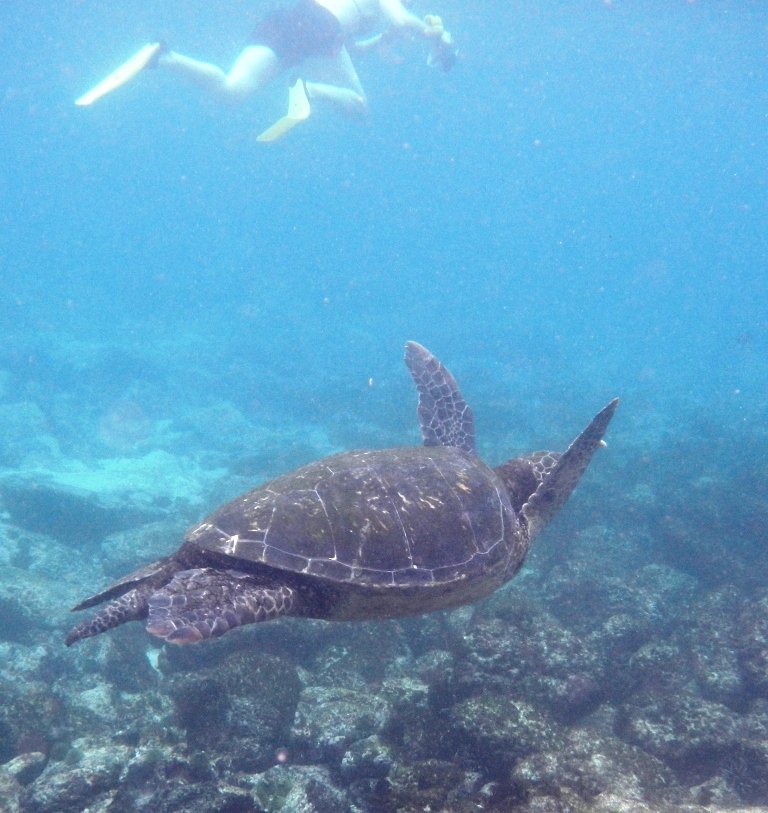
Other than a chocolate chip starfish spotted by Dee, we did not see too much sea life. But at the next site that we were taken to, Cabo Rose, we saw so many turtles that once again were not afraid of humans.

Picture perfect - Dee with turtle (photo courtesy of Aaron & Dee)

See www.ces.clemson.edu/~simms/cousteau/: the above photo is reminiscent of the insignia used on Jacques Cousteau's boat, the Calypso. After a fabulous day of great sites with the tour boat, we returned to Isla Isabela where we sat by the beach for a cold beer. Then we noticed this unusual sight - something that you could only see in the Galápagos!

Don't bug me, I'm sleeping!

We then walked to a nearby site for more snorkelling at Concha y Perla, well at least Aaron and Dee did. Jordan and I rested in the shade after a very busy day. They saw a turtle and another chocolate chip starfish. We ended the day watching 2 flamingos in a serene bay. Their exquisite colour and tranquility was quite breathtaking.


Wednesday, April 25, 2012

Isla Isabela Galápagos

Upon our return to Isla Santa Cruz (where we have Sea Turtle anchored), we bought ferry tickets for an April 24th journey to Isla Isabela. But early in the day, Aaron (Jordan's son), Deanna (his gal), and Jordan and I hiked out to swim and snorkel at Tortuga Bay before the ferry ride.

It was excruciatingly hot out as this is one of the hottest months at the Galápagos so the 2.5+ km walk was very tiring. The cobblestone path was lined with the tall Opuntia Cactus that is native to the Galápagos with stems that grow as large as trees. But upon arrival, the paradisiacal beach made it all worthwhile.

Long stretch of fine, white, coral sand beach (courtesy of Aaron & Dee)

There was very little sea life but the water was wonderful to swim in even if little sea life was evident when we snorkelled. We then hastily returned to catch the 14:30 ferry to Isla Isabela.

Isabela, in the shape of a seahorse, is the largest island of the Galápagos and still has 6 active volcanoes. It had a penal colony from 1946 to 1959. To punish the prisoners, they were forced to build a wall of huge blocks of lava rocks. The wall, measuring 100 m by 7 m high, still exists today and is known as the Wall of Tears. Isabela straddles the equator.

We checked into the Hospedeja Cerro Azul where our hosts, Nelton & Judith, were very helpful and warm hearted. We would recommend this (www.hostalisabelagalapagos.com) as a place to stay if you are ever at Isla Isabela. After settling in, we wandered around the beautiful beach and cute town where most roads were covered in white sand!

The next morning, Nelton drove us to the area of the Triplet Volcanos where we then hiked through lush vegetation as Nelton pointed out other volcanoes in the distance, along the top of steep ridges and down holding onto ropes...


...and finally deep down-reaching into the inactive volcano tube using more ropes and a few rickety stairs. It was a very beautiful location and thankfully cool in the tight opening of the volcano after a hot hike.


As we drove back to town, Nelton stopped at a plantation where we picked a couple of large papayas and then asked if we would like to stop at an eco-reserve for tortoises (land turtles). Unfortunately, just as we arrived at the reserve, the front-end suspension of Nelton's truck broke! (As we toured the reserve, Nelton arranged for another vehicle to pick us all up.)

We got a tour of the reserve, picking fresh bananas, passion fruit, and all the mangoes we wanted. After we had finally had enough of all the nature surrounding us, the staff sliced for us some of the mangoes and passion fruit that we had collected along the walk and cooled us off with chilled drinks.

I need a pedicure

Next was the boat tour to the nearby Las Tintoreras, which means white tipped sharks. The boat first dropped us off for some snorkelling among the seals, turtles, and myriad of other sea hosts including a small baby octopus that the guide handed us until it shot some ink out and away it went.

Octopus holding tightly

After which, they took us ashore and we walked a "loop" tour of part of the island where many blue-footed boobie birds, small penguins only found in the Galápagos, seals, bright red Sally Lightfoot crabs, and marine iguanas were lazing around. Marine iguanas are only found in the Galápagos - no other place in the world - and it was quite hilarious to watch as they "sneezed" the saltwater from their nasal glands after their foraging underwater.

Warming in the sun, sneezing out salt after ocean swim (courtesy of Dee)

Tuesday, April 24, 2012

Diving & Lonesome George

Isla Seymour Norte of the Galápagos Islands was the chosen site for diving for Aaron (Jordan's son), Deanna (his gal), and Jordan but I snorkelled again as I don't have a diving certificate. We boarded the boat with 4 other eager divers.

All suited up to dive and snorkel

This was Dee's first official dive and Jordan said that it was the best diving of his life! The sea life was once again abundant and definitely a great spot for a first dive.

Dee with Aaron on her 1st official dive

Up close and personal with one of several white tip sharks (did I say shark!)...


Masses of colourful fish were spotted - many in huge schools...


Forests of garden eels were also evident. These creatures are worm-like and retract tail first into their ocean bottom holes when you approach them...


Many starfish were sighted in varying colours such as red, yellow, blue, and chocolate chip. There is such an abundance of sea life that most people have never heard of or seen before. It is always such a treat to stumble upon them...


Jordan said it was like being in a huge fully stocked aquarium. Apparently, there were hammerhead sharks swimming near me as I snorkelled, according to the guides on the boat. But unfortunately, I never saw them!

Upon returning to Isla Santa Cruz, we walked to the Charles Darwin Research Centre where the famous land tortoise, Lonesome George, makes his home. He is the rarest creature in the world, and the last of the Pinta Island tortoises if a female Pinta cannot be found. There is even a $100,000 reward for discovery of a female Pinta! As of this date, Lonesome George is thought to be at least 100 years old. We were lucky to see him, as he does not always appear for photos.

Lonesome George trying to hide...

Monday, April 23, 2012

Snorkelling at Galápagos

We have spent the last few days doing boat jobs as we waited for Jordan's son & girlfriend (Aaron & Deanna) to arrive at Galápagos from Victoria BC. (We chose not to tour any areas until then as we could be seeing things twice.)

Once they arrived on April 21st, we checked out some tour agencies and booked a snorkelling tour for the next day at 3 sites. First site was at Isla San Cristóbel (San Cristóbel has been inhabited since 1910 as it has fresh water on the island and many of the other islands do not.)

After about a 2-hour boat ride we arrived at Isla San Cristóbel, then after a short hike, we had our 1st snorkelling for the day at La Lobería. This was a tranquil sandy beach with oodles of sea life! We immediately saw several cute sea lions lolling on the beach.

Once in the water, we were amazed at the abundance of colourful fish, rays, sea lions...and turtles were everywhere! We swam through schools of fish and alongside rays and turtles. Humans were inconsequential to the sea life and we were basically ignored, definitely not feared.

Swimming above a sea turtle (courtesy of Aaron & Dee)

The tour boat next took us to León Dormido ("lion rocks") also known as Kicker Rocks...

Photo snapped as we leave Kicker Rocks (courtesy of Aaron & Dee)

We all jumped from the boat into the water with the large rocks jutting from the ocean ahead of us. The rocks were very dramatic as we snorkelled between them, but it was difficult to see the sea life as the water was a little murky on that day. But we did spot this majestic spotted eagle ray!

Beautiful Spotted Eagle Ray

We then progressed to another island, Isla Santa Fé (southeast of Santa Cruz) which has volcanic rocks dating back 4 million years! We saw schools of colourful fish and lots of seals. The inquisitive seals entertained us by swimming all around us - even with their pups.

Monday, April 16, 2012

On our way to Galápagos

We finally got underway from Isla Robinson Crusoe once the strong blow settled down to a comfortable south wind that then pushed us northward on our passage to Galápagos. We quickly settled into the passage routine that we have become familiar with, and for the first week, it was pretty much uneventful.

About 600 nautical miles off the coast of southern Peru, and about 12,000 feet off the sea bed, on Jordan's watch during the day he was surprised to see us passing a numbered float. Then looking around he saw a few that seemed to be in a line that we crossed. His first concern was a net strung between the floats but there was no indication of such and it didn't seem feasible that they were tethered to the sea bed at that depth. So we came to no conclusion as to what they were.

Late one night, again on Jordan's watch, under an almost full moon that was far to the west, he was startled to see a distinct white semi-circle arc that rose off the dark east horizon. He had never seen anything like it in his life but soon figured out that it was of course a moon rainbow! He woke me up so I could see it too. What a fascinating sight!

On about the 8th day, the winds died to almost nothing so we started the Perkins purr and let out the fishing line and soon caught a nice little Dorado fish that gave us 4 good meals. We have not been putting out the line while sailing under a wind as the seas are usually rocking us around so landing a fish on a rolling deck is not too comfortable. Also while motoring, we usually turn on the watermaker because the motor makes more than enough amps to power it. By now we only have seen one ship, a southbound freighter about 8 NM off our port side.

Where is everyone?

On the night of the full moon, again on Jordan's watch, we were visited by a lone pilot whale. Jordan pulled back on the power and it came right up beside us as if to say hello briefly before cruising off on his solo whale passage.

One day away from Galápagos landfall. Lots of motoring in the last few days. We are evidently into the ITCZ (InterTropical Convergence Zone) that disseminates the northern hemisphere atmospheres from their southern relatives (also called the Doldrums by sailors). This is a zone of calms and unsettled weather, lots of big cumulus clouds that can give you some gusts and rain showers. This is a zone that circles the world's seas at or around the area of the equator, but around here it typically extends from the equator to about 5 degrees north, so it has dropped down to the south by about 300 miles. However we did pick up a nice light tail wind for the last day and we cruised along nicely under a billowing spinnaker before the winds died for our last night.

Bright spinnaker poled in very light wind

When we started the motor just before sunset, it died shortly after (ran out of fuel on the port tank). It's a bit of a pain when that happens because the Perkins gets cranky and needs to have the lines bled - about a 20-minute job. While Jordan was doing that, he did a visual around the engine compartment and noticed the fan belt was in the advanced stages of wear. So he dug out a new spare. It was the right length, but it was too thick and it wouldn't stay on the narrower gauge pulleys so we continued on with the old one. Now this old belt was the same one we left Victoria with.

It worried Jordan because this fan belt runs the water pump and, if it broke, the engine would overheat. We don't have an alarm for an overheated engine, just a temperature gauge. So we adjusted our usual 20-minute watch check, which includes checking the gauges, down to every 10 minutes. When Jordan woke up the next morning, he said it came to him in his waking consciousness that he could cut down the width of the replacement belt by hacksawing off about 3/16" which he did and tidied up the edge with a super sharp knife. He quickly replaced it and it worked perfectly!


Also during the last night, Jordan, on his watch, heard a thump and thought we ran over something. He jumped up but of course couldn't see anything but heard a splash close by. He thought we might have ran over a whale, but then saw streaks of phosphorescence around the boat and knew it was dolphins playing with Sea Turtle. One no doubt got too close to the bowsprit support. Boy, Jordan sure has had eventful watches on this passage!

After 17th day, Land Ho! Always an exciting sight.

We dropped anchor at about 02:00 local time on April 15th in Academy Bay (Port of Ayora) on the main island of Santa Cruz in the Galápagos (S00°44.876' W090°18.509'). Jordan got the outside of the boat organized (dinghy inflated, washed down the deck in the light freshwater rain, put up the bimini, etc.) while I got the interior reorganized for normal life again. Just as we finished, a panga full of officials came aboard and we got all the check-in process done. Very efficient but expensive - $658 US. That included the agent's fee, park fees, non-toxic boat fumigation, immigration, and clearance when we are ready to go. They gave us 25 days for our length of stay. But we are not allowed to take Sea Turtle to any of the other islands. We would have had to pay about double and I think we also would have had to let them know ahead of time that we were coming, which we did not do.

We then finally relaxed in the cockpit with margaritas in hand, anchored amongst about 25 other transient sailboats that have made this their stop also on their way west to the South Pacific. The surrounding waters were so green, not the usual blue. Indeed, a very beautiful anchorage.

Thursday, March 29, 2012

Isla Robinson Crusoe

We finally pulled in the dock lines at 11:00 on March 18th leaving Puerto Montt Chile (S41°30.159' W072°59.399') for our long passage north. The first 8 hours of the trip took us between islands and through channels before the open ocean. The extreme tidal range here is only matched by the strong tidal currents, so even though it is only an 8-hour run out to the Pacific, you can't do it with one ebbing tide, so we stopped overnight at a cove called Ensenada Codihue (S41°48.113' W078°21.644') before continuing.

The next morning after traversing through the Canal de Chacao, we picked up the ebb current and were doing 12 knots over land. We soon reached the expansive Ocean with 7 or 8 dolphins escorting us a distance to wish us fair winds!

Winds were very light at first but by evening we had 15 knots pushing us. The stars were incredibly brilliant in the moonless inky sky. Early the next morning, a snap shackle broke on the head sail sheet (line) so Jordan replaced the sheet. Winds and seas really picked up by 11:00 so we doused the head sail and hoisted and poled the staysail but were still doing 5.5+ knots.

The next day under mostly cloudy skies, the wind speed increased to 17 to 25 knots with rolly 10-foot-plus waves. Jordan saw a huge sunfish directly in front of us and almost ran over it! That night it was very dark with light clouds and still no moon.

The night of March 22nd and most of the next day, we were pushed along in a gale that Sea Turtle handled with no problem. Just a few days ago I was telling another sailor that since we left Victoria, we had never experienced a gale at sea. So there we have it now.

Land Ho! March 23rd at 13:45! Made a difficult anchorage in Cumberland Bay at 18:00 (S33°38.359' W078°49.541') at Isla Robinson Crusoe with winds blowing and williwaws gusting. Four other sailboats were also present.

Isla Robinson Crusoe is part of the Juan Fernández Archipelago consisting of tiny Isla Santa Clara which is 1.5 km from Robinson Crusoe and uninhabited, and also Isla Alejandro Selkirk, about 180 km west of Robinson Crusoe. Alejandro Selkirk has a few fishing villages only during the fishing season who then relocate to Robinson Crusoe. Robinson Crusoe has a current population of about 850 at the only village of San Juan Bautista. No hospital or bank here but there is a school, cemetery, new soccer field, tourism office, Chile Armada, a few markets and bars, and police. About every 3 weeks, the village receives supplies via a ship from mainland Chile.

Busy unloading supplies onto the dock

Two years ago in February of 2010, Chile experienced the 2nd strongest earthquake ever recorded. The resulting tsunami hit the village here causing extensive damage and 16 persons perished. There is a great deal of reconstruction happening but you can still see the remains of foundations as stark evidence of the disaster. Incidentally, the largest recorded earthquake was in the 1960s, if I remember the facts, and it was also in the same vicinity.

A little privacy please?

Another notable fact: The Robinson Crusoe novel was based on the real life experience of Alexander Selkirk who, in 1704 after an argument with the captain, jumped ship at this Island (not at Isla Alejandro Selkirk) with minimal supplies and not only survived but coped quite well for 4 years before he was picked up. (The islands were renamed in the 1960s to attract tourists and I assume that Isla Robinson Crusoe was named as such as more people are aware of the fictitious character than the real one.)

The Island is something you might see out of the South Pacific with verdant spiry peaks ringing obvious prehistoric volcano hollows. The village is on the north side, protected from the predominant south winds.

Snapped from atop a peak when we were hiking

Their meager economy is dependent mostly on lobster fishing, some government jobs, and a yet to grow tourist industry. Visitors have to take a small charter flight that lands on the arid east end of the Island about 15 km away, and as the terrain between is precipitously near vertical in most places, no road connects the village. So most are ferried by a 2-hour boat ride. The other option is by land but only half the way is by road - then you either hike or arrange a horse ride for about 7 km up and over stunning ridges topped in mist a lot of the time.

Topographic of Robinson Crusoe

(Bahia Cumberland, where Sea Turtle is anchored, is front and center in topographic photo.) There are lots of steep hiking trails and camping spots to different vistas, one of which we did named Salsipuedes. The trail took us through eucalyptus and pine forests, and up vertical switchbacks to a ridge with vertical drops straight down to the sea as evidenced by this topographic at the tourist office. It was a great photo op of Sea Turtle anchored in front of the village.

Sea Turtle and village WAY down there

During World War I, the British navy was in the vicinity and intercepted a radio call from the German battleship Dresden searching for coal for its engines. They coralled it in the bay and shelled it until it sank to about a 150-foot depth. We saw where the shells from the battle lodged into the rock face.

We tried to do emailing but it was intermittent on and off, mostly off, and when it was on, painfully slow. We got some basic emails done though. The winds were strong during our stay and even though we were on the protected side of the Island, extremely strong gusts funnelled down the lee side of the mountains, through the village, and knocked us about on a strained but holdfast anchor. We tried to get fresh lobster but all the fishermen were holed up because of the high seas in their netting areas. So we found a restaurant to accommodate us but were disappointed as the large lobsters were served cold and with no hot butter!

One night, 2 big deep-sea fishing boats came into the bay to escape the high winds but they didn't anchor, they just meandered around under power and large bright lights for the crew to mingle around an open fire on their aft decks. At one point, we were down below and I felt a bang. Jordan jumped up and out the hatch as the big boat was trying to back away. Jordan told them in no uncertain terms to get the hell away and stay away. To add insult to it all, the next morning our decks were speckled with black soot from their bonfire. What a mess!

When it came time to leave, the procedure is to get a new zarpe (exit permit) from the Armada office. Once that is done, we had to go directly to the boat and not come ashore again. However the plan to pull anchor was delayed a day and a half as the winds were atrocious.

But early on the 28th, with the winds decreased enough, we pulled anchor and said our goodbyes through the camera lens for our long passage north, nonstop to Galápagos about 2,000 nautical miles. (For you land lubbers, that is about 4,000 km or 2,700 mi.) Robinson Crusoe was a great island to visit as we thought about the man that was marooned were we stood!

As the Chileans say, "Ciao, ciao" (goodbye)

Sunday, March 18, 2012

Leaving mainland Chile

Jordan has found time to get back into painting again while we are hanging around Chile. He recently finished an acrylic of boats (a photo of his finished painting below) and it now adorns Sea Turtle's wall. (Personally, I think he's very talented!!)


Garlic cloves are huge here. One clove is as large as the whole head of garlic that we buy back home in Victoria. Barnacles are also huge and on restaurant menus! Fresh fruit and veggies are readily available from vendors on the streets, even right in front of major grocery stores! And dogs. Everywhere you look, dogs are sleeping. Also fat and happy! We counted 6 in 1 small area.

Did we ever mention that power here is 220 volt? We've noticed most buildings are wooden with exterior walls clad in cedar shingles - some with just a section but entire houses are covered with them also. Tides - well tides vary a lot here, about 20 feet. In this photo at low tide, Jordan is reaching up towards the square light, way up...


...and here at high tide, Jordan can now touch that same light!


Jordan has re-installed our repaired autopilot and it passed a try-out with flying colours! Due to an error that the customs agent made on our paperwork when we sent the unit to the States, we were forced to pay custom dues when it was returned to us in Chile. We tried in vain to remedy this error made by a customs official, but customs did not care. Their error cost us an additional $250 for a total of $700 to send it, have it returned, and payment of the custom dues. But on the other hand, we received excellent service from the maker of our autopilot!

We are finally able to depart mainland Chile. Not that we haven't loved Chile but it's getting late in the season, meaning their winter is fast approaching. By going south to the glacier and throughout the islands via Sea Turtle and going north via rental car through all the different districts, including the Lake District and the Atacama Desert, we experienced and saw so much. We would highly recommend Chile as a place to visit.

Today we leave for a quick stop at Isla Robinson Crusoe, 1 of the 3 Juan Fernández Islands, which belong to Chile. It's about a 5-day sail north from Puerto Montt where we are and about 600 km (300 miles) off the mainland...

Sunday, March 04, 2012

Iguazú waterfalls

Once back in Santiago Chile at our nice hotel, we had a lazy day before our booked flight out to Argentina and Iguazú National Park in the north which has been proclaimed one of the New 7 Wonders of the World. Someone described it as making Niagara Falls look like a trickle.

The park protects a large area of special rainforest containing an enormous variety of plants and animals. We spotted the bright red bird Surucua Trogon, the Great Dusky Swift which nests behind the waterfalls, an unknown yellow bird, and eagle-eye Jordan pointed out to us a Toucan flying by. Coatis that look a bit like raccoons were scooting around everywhere.

Click on http://whozoo.org/AnlifeSS2001/bettsass/BS_Coati.htm for more information about this interesting animal.


But the best part of this National Park is the 275 different waterfalls that can be viewed from both Argentina and neighbouring Brazil. We had planned on spending our first day at the falls on the Argentinean side and then taking a bus to view them the next day from the Brazilian side. But we found out that we would now have to obtain a costly visitors' visa in advance from an embassy to enter Brazil, something that Canadians did not have to do before. What a shame, as we would have liked to see the falls from the Brazil side plus we would have spent money in Brazil - so both sides lose - we don't see the falls and Brazil doesn't gain our tourist spending dollars.

Fortunately, the best up-close viewing of the falls is in Argentina (Brazil offers a more panoramic view only). The temperature here is very hot and humid, even in the winter. The tallest fall, 82 m high x 700 m long x 150 m wide (U-shaped), is called Devil's Throat.

We boarded the Park train through an area of jungle to the vicinity of Devil's Throat where we then hiked across metal boardwalks to cross the river and to the very edge of the falls. The views were magnificent. We took lots and lots of photos, but as usual, photos just don't do it justice - so much better in person to understand the actual scale of what you are viewing. And hearing! The sound of millions of gallons of water crashing right next to you standing there! At some viewing places, the thundering falls shoot out a heavy mist and soaked us. Definitely need a waterproof camera. The views were so captivating and mesmerizing, hard to imagine. Jordan likened the scene as fairytale-like waterfall scenery, too perfect to be real almost.

A small portion of Devil's Throat

After taking the train back to the station, we next hiked the upper level and then the lower level where waterfalls are everywhere. We again took lots and lots of photos and rainbows were very abundant on this splendid sunny day!

1 of many rainbows seen

We also hiked way down to board the powerful inflatable open boat to take the ride up-close and almost beneath the falls. Everyone got completely soaked and when asked by the driver, Y otra? (And another?) everyone yelled Si! (Yes!) We must have done it at least 3 or 4 times and loved it each drenching time. What a thrill! We also purchased the video of the falls and the boat adventure as a keepsake, where everyone is laughing and drenched!

Falls as seen from water level in the boat

As is commonly stated,
From the Brazilian side you see the falls, from the Argentinean side you live them.
When this close, all you see is mist (between wet closed eyes) where you are really living them!


Right after our boat ride, a big black cloud rolled over and it started to rain quite hard. We were already wet and finished touring all the areas that we were interested in so that was good timing!

Other available activities included a photo safari or walking through the rainforest (but as it was raining hard, we decided to bypass), a boat ride to Isla San Martín for more great views of the Devil's Throat (but access to the Island was closed for some unknown reason), and a gentle boat ride through the upper river and islands (but hey, we had just had the wild ride!) There is also a full moon visit to Devil's Throat in the evening but there was not a full moon when we were there.

A slideshow of 15 photos is inserted in our Photo Gallery (on the right of this blog). Once the Photo Gallery opens, click on the green title page of Igauzú Falls which will take you to a new screen. Click again on the green title page and then wait for a few seconds as the slideshow starts. Hope you enjoy...

The following day was when we had expected to be in Brazil, but as that fell through, we spent a lazy day around the hostel swimming pool until it started to pour! A couple of hours later, we caught the taxi to the airport for our flight back to Santiago.

Upon landing in Santiago, we found out that Chile charges some countries a "reciprocity" fee to enter their country by air - including Canada. Only the international airport at Santiago charges incoming visitors. What this means is that we would have to pay a high fee to cross the border from Argentina to Chile as Canada charges this high fee for Chileans to enter Canada. We had to pay $132 US each to get back into Chile even though we had left Chile twice already and paid no fee to enter or re-enter, but we were either driving or boating and entering a smaller city.

Should Canada re-think their practices and amounts charged to foreign countries as we now have to follow the same practices and pay the same amounts when we travel to those countries?

After landing and clearing from Santiago, we made a quick trip back in our rented car to Puerto Montt and Sea Turtle. It's always wonderful for us to return to our home - our boat - especially after covering 7,288 km by car!