Saturday, July 19, 2014

Scooting around Langkawi

We rented a motor-scooter at Langkawi (Malaysia) to scoot around the winding scenic roads of the 25 km long Island and can easily be driven around in half a day. For a nice change, the natural tropical flora dominated instead of people. The diverse Island scenes presented themselves to us in quiet villages, remote beaches, verdant rice paddies, and the occasional secluded beachfront 5-star resorts all not out of sight from the steep slopes above.

A boat and his best friend

Rice paddies in the lowland

We spotted a barrel of cute Gibbon monkeys crossing the road via the overhanging trees above us. Around another turn up in the steep hillside, a big bird caught our eye and when we stopped, it along with its mate, flew off. From the luggage on their beaks, they were a veritable big beautiful pair of rare Hornbills. We weren't quick enough with the camera though.

Gawking Gibbon

At 1 scenic viewpoint, the loud chorus from the jungle creatures was remarkable.

Even though it's obvious that Langkawi's destiny is with tourism, we could see enduring indigenous culture in both the fundamental daily activities such as tilling the soil or fishing the seas.

Fishing boats in port

Rickety dickety docks!

We rode into a tiny village whose shamefulness was announced by strewn garbage everywhere. The scene was shared with lounging indolent men and a tribe of goats that were sifting through the garbage (the goats that is!) None of the plastic refuse made it to the garbage bin that was in plain view...quite disgusting. Fortunately for the sake of Langkawi's reputation, the village was off the beaten path.

One tourist venture we wanted to check out was the Panorama SkyCab, a cable car ride to a cooler altitude. Up up we were drawn past the vertical climbs of Machincang Mountain. At the top we could see the whole of Langkawi, the islands of Thailand to the north, and out over the infinite blue expanse of the Andaman Sea and the Indian Ocean to the west.

SkyCab going up

Near the top is a uniquely designed curved SkyBridge for pedestrian viewing that spans a gap over virgin jungle. Notice how the tower leans to accommodate for weight of the bridge. Unfortunately, it has been closed for major refurbishing since 2012. Wonder when it will reopen...

Spatial experience

The ride down looked as if it would be quick due to the downward curve but surprisingly it was not. Back at the Base Station, we strolled around the Oriental Village, full of souvenir shops and retail stores, spas, galleries, and quaint little bridges over fish-feeding ponds - an outdoor mall!

SkyCab going down

Included in our SkyCab ticket price was viewing of a 6D cinema. We declined as time was running short and we thought it might be a full-length film. Later we found it was less than 15 minutes. Oh well, next time. I later read about 6D on the internet and wished we hadn't missed it. You "live inside the movie" with all the movement.

A few facts about the SkyCab:
  • Horizontal distance: 2,079 m
  • Vertical rise: 680 m (seems higher!)
  • Inclined distance: 2,158 m
  • Turn-around trip time: 28 minutes
  • Hourly capacity: 700 passengers/hour
  • Longest free span: 950 m (between Tower 2 and Middle Station)
  • Steepest gradient: 42 degrees
  • Construction period 16 months (Apr 2001 - Aug 2002)
Once back at Sea Turtle, we wound down the day over sundowners accompanied with reflections of a fun day.

Thursday, July 17, 2014

Legendary Langkawi

We left Penang Island July 15th, passing close to lots of marine traffic going both ways in a lane that was dredged in shallows that extended a few miles out. Freighters, pilot boats, ferries, fishing boats, a cruiseship, and a big tug.

We all shared the aqua medium with a profusion of garbage. Contributors to this unnatural blight are mostly coastal populations but also indigenous maritimers with surprisingly little consideration to fragile ocean environment. Sailors are as a rule very conscious not to discard any non-biodegradable waste.

As we motored merrily along, we finally noticed some of the "fish stakes" that are mentioned on the charts at various spots along these coastal areas. These look just like skinny tree branches sticking high up out of the ocean. It would be impossible to see them at night and in fact they are hard to spot even in daylight until you get quite close.

The day started out sunny but the skies turned a dreary grey and brought with it high winds, up to gale force winds for a short bit. Winds were on the beam so it was no problem even though we were getting some waves over the deck. The winds consistently slowed, along with a directional change, which eventually put a mild breeze against us.

We had planned on possibly doing an overnight stop at Paya Island. It was said there were mooring balls we could hook onto, and it being a Marine Park, has apparently some good snorkelling. But the state and direction of the sea waves made the anchorage less than desirable so we pressed on.

As the daylight waned, we made the Langkawi archipelago of the Andaman Sea. We set anchor for the night tucked in between 2 small islands just before 20:00 close to the southwest end of the bigger Island of Langkawi (N06°14.475' E099°52.206'). This archipelago has 104 islands at high tide (99 at low tide!) with only 2 inhabited - Langkawi and nearby Tuba. This will be our last Malaysian stop before heading into Thailand waters.

The next morning, it was a short jaunt up to the main bay and harbour of the town of Kuah on the main Island, setting anchor (N06°18.817' E099°50.619') amidst about 30 other sailboats plus an abundance of other commercial vessels. Ashore in the high heat and humidity, we walked around to get familiarized with the area.

The word "Langkawi" means "reddish-brown eagle" in Malaysian. A large statue is located at the marina next to our anchorage and we noticed several of the stately birds flying overhead - a very definitive name choice.

Marina statue

As Langkawi is duty free, we plan on stocking up with a few items. We found a small supermarket and small mall - nothing as large as at Penang - and stopped for our favourite treat, iced coffee!

Tuesday, July 15, 2014

Funicular and henna

Still hanging out at the Island of Penang (Malaysia). Another attraction that we wanted to experience, and would be a first for us, was the funicular tram rail ride to the top of Penang's highest point at 830 metres above sea level. Funicular: "an inclined plane or a cliff railway". At 6 km from town centre, we caught the 204 City Bus with the locals and got off at the tram gate.

The journey to the top of the Penang hill (okay, "mountain" for Penang's sake) in the old original tram took about half an hour but the new tram cars take only 10 minutes. There was also a stop mid-way to check out the views from there.

Old original tram

Arriving at the top, it was noticeably cooler, around 21°C, which was a break from the city heat that we left below. The vistas from the summit were good, but would have been fantastic if it hadn't been for the haze. We have not yet determined for sure why there is so much haze in these areas.

At the top were temples, eating areas, nature trails, and typical tourist stuff. There was a fence of lovers' locks where padlocks with couples' names were attached, locked in perpetuity.

Locked in love

On the ride down, we got a seat in front for better viewing.

Headin' down

Early the next day, we arrived at the agency which would get our Thailand Tourist Visa from the Thai Embassy here. Doing it here would net us a 60-day Visa opposed to only 30 days for Visa Upon Arrival. We filled out the forms, took some passport photos, and handed in our passports for processing. "Come back at 4:00 pm and you will have your Visa."

So to kill the day, we rented a motor-scooter for more "to sees". Many places are closed up in the mornings and some because of Ramadan but the State Museum was open and it provided good insight into the multi-cultural history with many artifacts of everyday life of generations past.

Elaborate wedding bed

Riding around to see what else we could find, we saw the Chocolate Museum which after going through was more a retail outlet. However as chocolate lovers, we did buy a variety pack and had, what else? Iced coffee!

Then I decided to get some Henna art (an Indian custom) done on my hand. The henna dye or paint comes from the henna shrub/tree leaves. The design is made with an intricate thin bead of dye applied to give a temporary tattoo. It is especially a custom for brides to have elaborate designs applied on hands, arms, and feet for their wedding. But I wanted something a bit simpler. I asked if she could include a sea turtle on mine, you know, like our boat name!

Lost in translation, the artist was slightly unsure so Jordan drew a quick sketch of a sea turtle. She gave a nod (actually a typical Indian head wiggle) of understanding and proceeded to do a nice job.

Henna handiwork

I was told to wait for it to dry for 10 minutes before washing off the excess dye. By then it had even started to lift and peel off. Once washed, my hand was stained with the reddish brown colour and it should last for 1 to 2 weeks. At a cost of 5 Malaysian Ringgits (less than 2 dollars!), it was a real deal.

1 week later

By 17:00, our passports were returned with the pre-approved 60-day Thai Tourist Visa. With nothing keeping us from leaving, we weighed anchor the next morning and with the tide in our favour, we left the thin diesel filmed bay waters and headed north to the island of Langkawi (Malaysia).

Sunday, July 13, 2014

Going ashore

Earlier today we anchored in front of George Town at Penang Island (Malaysia). Going to shore was interesting as we tied up the dinghy at 1 of several "Clan Jetties". These structures are a composite of Chinese residential shanties built on stilts that extend from the shore out into the shallows and their front doors are accessed by a narrow centre boardwalk. Originally built many decades ago to avoid property taxes, they have endured and now have become an attraction.

Boarded walk of Chew Jetty

We used the Chew Jetty, the biggest with 75 homes/buildings, which is the most visited by tourists. But the invasion of privacy seemed to be taken in stride by the residents and in fact most have taken advantage of the situation and offer souvenirs, snacks, and services to the curious camera clicking visitors.

View of jetties from our anchorage

Wandering the city streets and alleys, we visited the remnants of Fort Cornwallis and read its history boards. We passed by the 1897 clock tower built as a monument to the Queen, and then walked through the Penang Interactive Museum which was fun and out of the ordinary.

Mirror illusion...or not?

For relief from the heat, we stopped at 1 of many coffee shops for what has become 1 of our favourite treats, iced coffee.

Trishaws, another form of rickshaws, pedalled the tourists around; sidewalk vendors and buskers delighted the crowds. Later in the days and evenings always seemed to bring out more life.

Tasty foods of all kinds

On 1 corner, we were attracted to the Eagle's "Hotel California" accompanied by a novel percussionist with his made-up instruments of pots and bins. His original guitar was built from a tennis racket!

Play it again!

It immediately reminded us of a time and place, half a world away now, when we were in Baja Mexico at the actual Hotel California that inspired the song, and where our timing was perfect for the live band playing the namesake song. Jordan, showing his age, also remembered being at the Eagle's concert in Seattle (USA) when they premiered that song in 1980.

When we returned to the Chew Jetty to dinghy back to Sea Turtle, we were shocked to see how low the tide was - we had forgotten about the extreme tides of the full moon! We were just in time and managed to escape the mud and low water level.

Moon over Penang

Saturday, July 12, 2014

Pretty in Penang

We had arrived at the south end of Penang Island (Malaysia) yesterday - July 11th - in the dwindling twilight and safely anchored on the lee side just after dark. We saved the trickier part of the channel passage for the morning light.

Just arriving at Penang

How big is Penang? It's about 25 km long and 15 km wide and is connected to the mainland of Malaysia by 2 impressive bridges. We had anchored just before the new southern and longest bridge - 24 km including the causeway - 17 km of which is over water.

Added to the impressiveness was the bridge's nightly psychedelic light show cast on its structure with alternating hues of red, blue, green, and white. This bridge was officially opened on March 1, 2014 - only 4.5 months ago - so of course didn't show on our charts.

So we upped anchor at 10:00 July 12th for a short channel passage up to George Town on the northeast end of the Island. The first navigational considerations were narrowing depths and transitting under the bridge, which to me looked too low even though Jordan assured me it was more than high enough.

The tide flow was with us so Jordan did a manoeuvre that was probably more to satiate my doubt than for safety. He turned Sea Turtle 180 degrees, idled in forward, and let the flow very slowly take us through backwards. That way if we had to abort at the last second, all he had to do was power it up. But there was lots of clear air over the mast. Whewww!

The new bridge

Then we saw through the haze the next, original bridge, much the same as the first one and still an impressive 13.5 km long and that indeed did show on our charts.

There was lots of passing and anchored commercial marine traffic and a container port (on reflection, maybe we should call them consumer ports!) We passed close by an anchored freighter to get a closer look at what it was offloading onto a barge of penury. It seemed like either sand or grain.

Offloading sand?

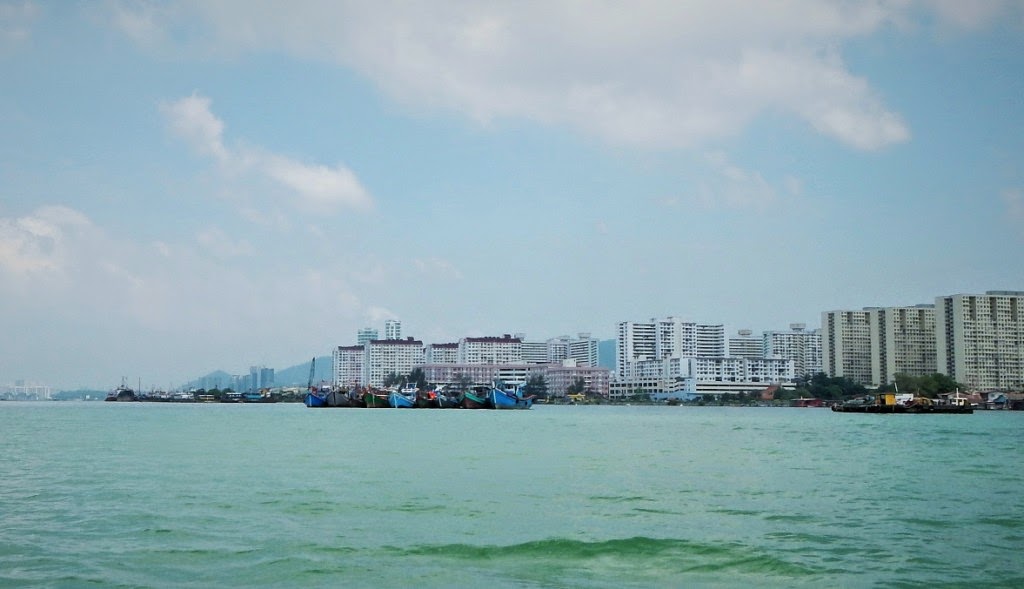
Once again, we were presented a much more populous scene than expected where over the years, growth and more recently skyscraper development filled the flat coastal lands and encroached on the fertile hillsides.

Densely populated

We anchored in front of George Town on the northeastern end of Penang Island at 12:45 (N05°24.620' E100°20.529') close to the shuttle ferry and cruiseship docks and beside another sailboat that Jordan remembered in the south of Malaysia.

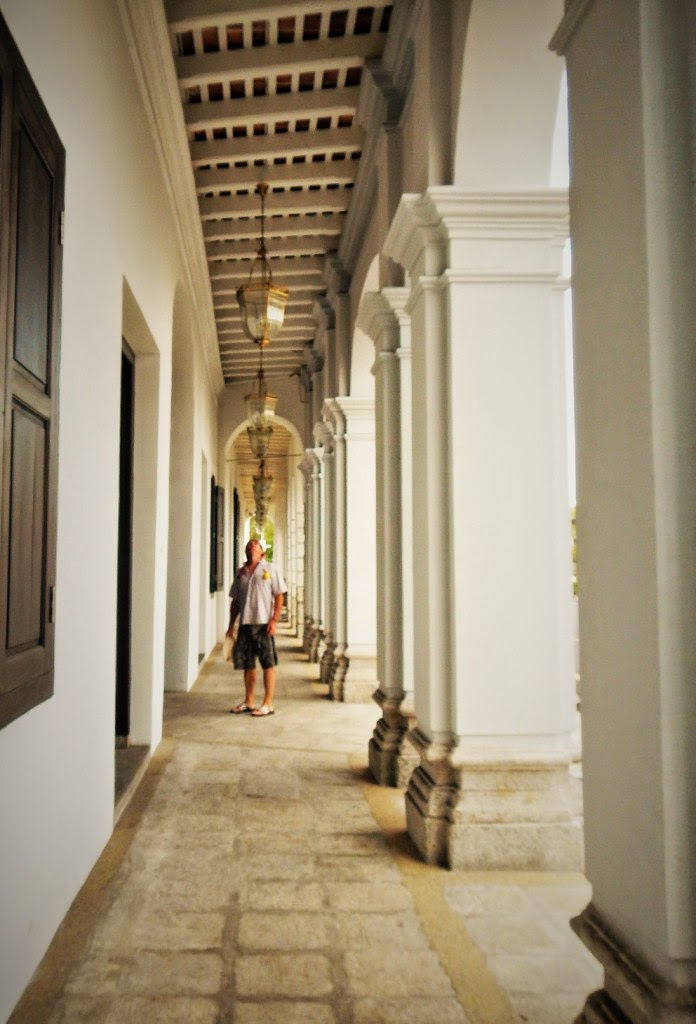
George Town's history, like Malacca, was centered on trade and brought with it merchants of Indians, Arabs, Chinese, as well as Europeans. The architecture of the era and multi-culturism still exists and remains employed. It is now seeing rejuvenation after UNESCO's classification as a world heritage site in 2008.

Classic architecture of Penang


Yes, architecture captivates Jordan!

Three islands

We left the City of Malacca (aka Melaka) Malaysia early in the morning at 07:30 on July 7th. We had a good wind on the port which pushed us along under sail at over a healthy 6 knots until 14:30 when the moribund wind had us resorting to motor power.

That night, stopping before dark would have made it an exposed anchorage so we decided to press on and make it an overnight passage. The chosen route was up a protected channel between some islands and the mainland. In the channel was the location of a huge container port that serviced Kuala Lumpur further inland.

Just before entering the channel in the dark, we had to weave our way through an anchoring field of the waiting behemoths. It was there that the conditions went from calm to a 40-knot gale in a matter of about 3 minutes. These squalls are called the "Sumatras". Jordan said that just before it hit, he sensed something in the air and fortunately, for no definitive reason, was taking down the main sail when it hit.

For some protection from the gale force winds and building seas, we ducked behind and up close to the towering stern of a super freighter that just came in and stopped. That is until the freighter put it in gear and pushed a torrent of water towards Sea Turtle. We escaped being tossed around but then had to face the Sumatra head on until it burnt itself out, about another hour during which the pounding rain scrubbed our decks!

As we motored up the narrow channel, the night darkness surrendered to the glare of the heavily lit container port where a multitude of ships were being loaded and off-loaded 24/7.

Clipping along with the tide in our favour we dodged channel markers and busy marine traffic of all sizes. At about daybreak, we were back out in the open waters of Malacca Straits for another day of motoring.

Flashy fisher

We finally anchored at 19:00 on July 8th in the lea of a small island called Lalang Island (N04°00.516' E100°32.801').

Early in the morning at 04:30, the Sumatra winds started to blow once again along with another downpour of rain and lightning show that lasted for about an hour again. We remained on anchor watch to make sure we weren't dragging, which is hard to tell in the dark and driving wind and rain. When the winds and rain died and it was evident that we were holding, we got the last of the night's sleep. However when we got up in the morning and looked about, we determined that we had dragged about 100 metres towards deeper water. So we re-anchored, then had breakfast.

With a beach visible, we rowed ashore. It was surprising to see that some in the past had set up some humble facilities of picnic tables, enclosed latrines, shelter, and water collection for visiting day users of this deserted island. Perhaps fishermen to wait out a storm?

There were also several rope swings with large colourful plastic seats, a sink, an outdoor shower, and what appeared to be a fish cleaning station with a nearby hose and tap. What was again sad to see that spoiled the tranquility was the plethora of plastic garbage washed up on shore.

Lots of hammocks and bright swings

We walked the beach from 1 end to the other and found a few shells but MANY cuttlefish bones. Today cuttlefish bones are used for caged birds as the bones are rich in calcium.

The fishermen, we suppose, set up an intriguing shrine. Its meaning or significance escaped us.

Food, incense, and 9 figures inside

It was very warm (hot!) out so I luxuriated in the sun and cooling ocean breezes for a short while before heading back to Sea Turtle...


At 14:35, we upped anchor and re-set 3 hours later at Pangkor Island (N04°14.773' E100°34.335'). This Island is just across from the mainland of Malaysia and has lots of colourful houses and fishing boats. But it is also very, very hazy, perhaps from the various coal-fired power stations. It looked like the Island's inhabitants were making energy by burning their garbage. A transitting catamaran anchored just behind us for the night.

On July 10th, we dinghied over to Marina Island. This is a man-made island and about 10 minutes away from our anchorage at Pangkor Island. Marina Island has a fairly new marina (the Island was created in 2009). Our friends had their boat stored there so we wanted to check on it for them to see if all was ship-shape, which it was. They had left Victoria the year before us.

The Marina agreed to send an employee off to a service station to collect some gas for our outboard. While we waited, we tried to have some Thai food at a restaurant there but were told it was closed because of Ramadan. Ramadan is an annual Muslim tradition of daytime fasting for a month (and also prayer, charity giving, self accountability, and for some the pilgrimage to Makkah). Obviously, the restaurant was owned by Muslims. We settled for pizza elsewhere.

Coming back to Sea Turtle, we saw several small dolphins, the 1st in a long time!

We left Pangkor Island at 08:15 on July 11th - a Friday! Superstitious sailors never leave on a Friday. But the strong early morning Sumatra winds had abated and the rain had become a drizzle. It seemed like a good time to leave as we had a long passage ahead of us.

We motored all day making our way to Penang Island (aka Pinang) where again we wanted to anchor in the lea of the Island for protection. It was just after dark before we picked our spot (N05°16.466' E100°17.700') at the southeast. Normally we don't come into protected waters after dark but the bottoms here are typically gradually shallowing mud where the soundings correspond fairly accurately with the charts.

Monday, July 07, 2014

Marvelous Malacca

There are so many sounds associated with sailing. The wind, the water rushing past the hull, rigging, stores moving around with the motion of the sea. Having gotten used to these typical sea sounds, we have tuned then out and don't notice them. However if there is a new sound, however slight, our ears perk up.

Yesterday when almost at the Malaysian "treasure island", we heard just that. It was just a faint pop. Jordan sensed it was coming from the cabinet where the watermaker pump and filters are. He immediately checked it which was fortunate because the watermaker filter housing had split and it was spraying a mist of sea water. We had an extra filter housing but were short 1 small fitting, so the repair would have to wait.

Our "treasure island" was only a couple of hours from the City of Malacca (aka Melaka) so we upped the anchor at 13:00 and headed there where we dropped anchor on July 5th (N02°10.828' E102°14.313'). Here, we thought we would be able to find the needed part.

We were immediately surprised at the sights of Malacca. It seemed to be a very clean and happening city. Our 1st thing to do was find a hardware store and hopefully the needed part. This was accomplished in short order so we had the rest of the day for exploring.

We discovered several large malls and many, many hotels. This is obviously a tourist city and it has been declared a World Heritage City. Its history is most notable for being an ancient trading port servicing the earliest merchant marines from all over the globe. Consequently there remains a motley culture and blood including Indian, Chinese, and even European.

Colonial architecture

To get oriented, we rode up in a rotating observation booth that circled a single tower structure and ascended about 100 metres to take in the panoramic view of the city. With map in hand, we could see the Chinese sector, the canal with its walkways, and even Sea Turtle all alone at anchor. What a difference from the heyday of merchant marine trade where there apparently could be as many as 100 foreign vessels anchored out front.

Bird's-eye view of Malacca

Canal cruising

We crossed a small bridge to the north side of the canal to walk down Jonker Street. We felt as if we were in China - not Malaysia! The street that Saturday night, as usual, was reserved for vendors of all kinds and pedestrians and it was packed with both. Delicious smells emanated from a great variety of interesting foods being sampled. There were creative crafts and clothes, bright art, and even souvenirs. Sadly, we even saw vendors selling "miracle cures" such as bear gall bladders.

Hub-bub of Jonker Street

Delicious fish ball soup

We enjoyed a light Chinese meal (Chinese food here is different from North American) before returning to the boat for another quiet night.

The next morning with the needed part in hand, Jordan fixed the watermaker. That done, we headed ashore to see more sights and learn more about the interesting history of this place. The displays inside the Maritime Museum - a replicated 16th century Portuguese galleon - were very enlightening. The original galleon has been lying lost somewhere on the seabed for over 500 years.

Tourists could take a tour on colourful bicycles (trishaws) decorated with glitz and glitter unique to each.

For the young at heart

The last thing we did was take advantage of the availability of a large supermarket before dinghying back to Sea Turtle for a 2nd night at anchor in front of historical Malacca.

Saturday, July 05, 2014

Treasures galore

We got an early start at 08:00 on July 4th as we motor-sailed with only the slightest of wind, continuing northward up the west coast of Malaysia. And also it was early anchoring at 15:00 in emerald green ocean waters where we found an idyllic protected spot by a beautiful little island. One in a group just south of the City of Malacca. We chose Nangka Island (N02°04.546' E102°20.036') where there was a short strip of pretty beach.

We went ashore to do some beachcombing and scouting. A man approached us from a tented area and told us we had to leave. He said we needed a permit. It seemed strange, but as he was very insistent, we decided to get back in the dinghy and head to another island close by.

As we circled the island, we talked to a couple of idle police in their drifting boat. They explained Nangka Island's restriction was because there were signs of treasure on it and there was a secure archaeological dig going on, therefore no visitors allowed. That explained it. The history of this area of the globe is saturated in intrigue.

Early European countries battled for domination here to control trade and procurement of riches which included precious spices among others. Add to that a pervasion of Asian pirates. Ships were constantly being sacked and bootie taken. They were truly swashbuckling days.

The indolent floating police then told us that perhaps we should head over to "that island" pointing to the 1 with the lighthouse. "Many mangoes" they said. Right, that's a good enough reason. So off we went to Undan Island in the dinghy. There we were met by the caretaker who said it was fine to take some mangoes and to walk up to the top for a view.

As we were collecting mangoes, the caretaker came along and insisted on helping. He knew the best tasting ones. After 2 big bags full, we said "No more!" Then as Jordan asked for a sprouting coconut that lay under a coconut tree (at that stage of sprout, the inside is our favourite coconut that the South Pacific Islanders call nafara) he said sure and then disappeared. He came back with 3 more nafaras. So in spite of being swashbuckled by the other islanders, we found treasures of our own!

Our treasure!

Back at Sea Turtle, with just a hint of breeze to subdue the heat, we had dinner in the cockpit while the birds chirped and the brilliant orange sun sunk below the horizon, making it a perfect evening...

...until we were rudely awoken at 22:30 by a loud siren and a searchlight on Sea Turtle. Jordan jumped up and some other police told us to "Move! Now! Far away!" We tried to explain it was dangerous to move a sailboat in the dark in unfamiliar waters. But they insisted. So with a bit of guidance from them, we carefully moved Sea Turtle a short distance to N02°06.330' E102°20.535', 2 islands away from the island where the buried treasure might be. After all, we might be pirates!!

As we moved to relocate, we were given a light show from a storm cell not far away. The lightning bolts had a beautiful and unusual orange tinge from the smoky haze.

Friday, July 04, 2014

Finally leaving

If Sea Turtle could speak, she would say "Get me out of here!" After 4.5 months, it came time to finally get her out of the scummy waters of Danga Bay Marina (Malaysia) where the barnacles had densely populated every part of her unprotected bottom. But just before leaving, Jordan had the horrid job of diving and cleaning the heavily encrusted prop, giving him a short-lived ear infection.

During that 4.5 months though, we had some sojourns away. There was a trip back home to BC and Alberta (Canada) to catch up on things and visit family and friends. Another trip while waiting for repair parts to return, we flew up to visit the north half of Vietnam. Then later we flew to Thailand to meet up with family. But finally it felt good to be on the move again with Sea Turtle as we headed out for the sail up the west coast of Malaysia.

We left the dock at 13:15 on July 1st and at first chance, with fingers crossed, we turned on the auto-pilot. It worked! So after a 3-hour motor down and out the channel, we set anchor in much cleaner waters (N01°18.888' E103°36.713'). This was approximately the same spot we anchored a few months ago when we had originally attempted a departure from Danga Bay and discovered that our auto-pilot was not working. We were next to a small Malaysian island between Malaysia mainland and the Island of Singapore.

Off in the distance, we could count about 50 freighters of all sizes at anchor, and at 1 of many container ports, we could count over 50 gigantic offloading cranes. Strategically, this area is the engine of growth for the developing world, and it's evident in the scale of shipping commerce and land development. It's beyond prodigious.

Ships filling the horizon

So we settled in for the night, enjoying the quiet with no blaring music.

The next morning, Jordan got out our Hookah equipment and did a complete underwater hull cleaning. But when the tide and current became too strong, he had to hang on to a rope attached to the striker plate at Sea Turtle's bow to keep from being swept away! (I really wanted to help but he thought it was too strong for me.)

We delayed pulling anchor until the tide and current were flowing with us and set off at 14:15. We had a great sail for the rest of the day, setting anchor at 19:00 (N01°20.887' E103°22.433'). We were now in the infamous Malacca Straits. As we were cruising along the coast of mainland Malaysia, we were able to anchor almost anywhere in shallow waters and out of the freighter lanes.

The next day (July 3rd) was a late start as we discovered some needed boat jobs. For the first few days, while working the boat systems at sea, a few things needed attention. Some critical, some minor - all were fixed in short order though. We pulled anchor at 10:30 and with no wind had to listen to the Perkin's purr until anchor time once again at 19:00 (N01°46.717' E102°47.008') alongside the Malaysian mainland.

So nice to be out on the water again!

Sunday, June 22, 2014

Family time

After my daughter and son-in-law (Lainey and Tim) arrived in Phuket Thailand, they soon had their touristy to-do list made out that we followed along with. At first, our stay at quiet Nai Thon Beach was relaxing but we found it a little out of the way of most of the venues on the list, so we relocated to the heart of busy Patong Beach which was more centralized.

Elephant trekking was on the list but we were all very concerned about patronizing any facility that didn't treat these majestic creatures with proper care. We had seen many that exhibited signs of stress by swaying and rocking while confined by short leg chains. We chose a facility after a recommendation by Lonely Planet and after making an inspection.

We first hand-fed the gentle pachyderms bananas that they politely reached and took with perfect dexterity by their pink mottled trunks. One youngster reached down and undid the Velcro strap on Jordan's sandal as slick as a magician.

Yummy, bananas!

We moved to and fro high on the backs of the lumbering creatures while the Thai mahouts (driver of an elephant) perched behind the elephants' ears gently prodded them on. The 1-hour trek took us through a tropical forest where we were at eye level and arm's length to tree snakes, huge fuzzy caterpillars, and humongous spiders. At 1 point about half way while weaving through the rubber trees, the 2 mahouts dismounted and let Jordan and Tim take their place to guide the lumbering giants back home.

New drivers

One evening, we attended a Muay Thai boxing competition. This uniquely Thai sport uses hands, shins, elbows, and knees - 8 points of contact compared to 2 points (fists) of Western boxing. Later we were dismayed to learn that we supported a sport where Thailand's estimated 30,000 child boxers can be as young as only 7.

No one wears protective head gear in this tough contact sport, so one's career can be marked by brain damage and even lead to early-onset dementia. But like the not uncommon canine cuisine of Asia, it is a proud part of their culture.

Ziplines were on the to-do list and it proved a good choice. It took us most of 1 day. It started and ended with an intrepid 4x4 jungle drive to the top of a high forested ridge. After climbing a steep ladder to a high tree deck, we started zipping at lofty heights. The 18 different exhilarating ziplines, connected with swinging bridges and precipitous ladders, left Lainey's nerves frayed and heart racing. Before heading back, we were served lunch within a bamboo gazebo with a view to the coast far below.

Who's next!

Steady now...

And down to the next one...

Jordan and Tim couldn't turn down the opportunity to elevate their adrenalin levels by racing high speed go-carts on a challenging track. They had the carts flat out like mad bumble bees, drifting through the corners and pushing them to the point of spinning out!

Another venue included a Gibbon monkey rehabilitation refuge where residents in cages with sad stories were coaxed back to a natural existence. And 1 day when stopping at an outdoor cafe, Lainey was enthralled by a baby monkey who seemed to want to hang out with her. She was able to feed it coconut, hold onto its soft gentle paws, and it even jumped up onto her back - giving her a big surprise!

Where did you go!

We also spent a day at Phi Phi Island. As we did not have Sea Turtle with us, we hired a speed boat for the adventure. Firstly, we stopped for a couple of quick snorkels where the water was unfortunately not the clearest. Upon arriving at Phi Phi with the swarms of other tourist boats loaded of course with swarms of tourists, we spread out on recliners with a frosty cold one till it was time to return to Phuket Island.

People and boats...

Of course then, there was the shopping, the dining, pool lounging, and beach strolling as fill ins.

Patong Beach is known for its beach scene where throngs of all types stroll or lay in beach recliners and under umbrellas, many with a drink in hand watching the parasailers soar and jet skis buzz (jet skis were ruled illegal in Phuket, but no one told the operators it seems).

Patong is also known for its throbbing night life that could be called "little Bangkok". One street becomes a packed pedestrian-only strip at night where a plethora of mind bending scenes compete for attention.

Unbelievable night life

Open air bars are predominant replete with scantily dressed, gyrating pole dancers grinding it out to entice the strolling spectators in for a drink (or more). Street performers working their stuff. Ladies of the night trolling for affection (and more), preferably with a rich farang of any age or shape, share the scene with a prodigious amount of lascivious lady-boys that could fool the best of us.

What's a farang, you say? A farang is a term used for a white person who comes to Thailand from another country (and can sometimes be used derogatorily).

Of course, there are the ever-present massage parlours both respectful and others with the "happy ending". On the last day, Jordan chose the former that emphasized stretches and was more a work-out than a relaxation. And on our last evening, Tim decided to try out 1 of the "fish foot cleaners". We had also seen them in Bali but never tried them! Tim thought it felt ticklish and very weird indeed.

Foot fun

We opted out on other to-do things that the "kids" went for such as a shooting range, cobra show, tiger petting, parasailing, and ATV riding. Instead, we scouted out some marina facilities that we might want once we get up here with Sea Turtle.

We also were able to intercept the Pea Green Book that we sent off almost 5 years ago for its around the world voyage (but that's another story you can read about on www.peagreenbook.blogspot.com).

Normally, we are not inclined towards the typical tourist attractions but it was fun to share in them with family.

Tuesday, June 10, 2014

Wat Chalong and Big Buddha

Visiting glorious Thailand for 2 weeks, with Sea Turtle still in Malaysia, we decided to explore the island on our rented motor-scooter and see what we could find.

The next day, still on our own, we were heading towards 2 southern beaches. Generally, Phuket's west side has pockets of touristy beaches connected with scenic winding roads. In contrast, the east side is a busy commercial built-up area.

Along the way, we spotted an elaborate Buddhist temple compound, Wat Chalong. Buddhism is the predominant faith in Thailand and this is the largest and most ornate of Phuket's Buddhist temples. There, devotees performing 1 of various rituals, pasted gold leaf in hushed reverence, to 2 statues in the main hall where residuals of the glitter ended up on the floor, and our feet!

Ornate temple

Sticking gold leaf to statues

Another diametrical ritual that broke the quiet ambiance was the exploding string of firecrackers inside a courtyard brick oven-like structure, the significance of which eluded us.

Off in the distance perched high on a hill was the prominent Big Buddha that had its eyes on Phuket Town below and most of the southern part of the Island. Signs vectored us to the steep 6 km road to the top.

The gigantic Big Buddha is 45 m tall and 25 m wide at the base and is made of reinforced concrete with Burmese marble overlay. This impressive and revered landmark is a work in progress that started about 10 years ago by a wealthy devotee and to date is about 75% complete (rebar evident around base). Along the stairs leading up to the base and around Big Buddha are thousands of brass bells, tinkling in the breeze, displayed as tokens of recognition of individual donors for the construction.

Big Buddha

From the top, we admired stunning vistas; and from the bottom, Jordan rubbed a brass gong that echoed amazing sounds far off into the distance.

Next stop, off to the airport to pick up the "kids"...

Monday, June 09, 2014

Playing tourist in THAILAND

Our repaired auto-pilot finally arrived and Jordan got it all installed, making us pretty much ready to sail to our next destination, Thailand. But we had another conflicting commitment that came with a dreaded deadline that prevented us from leaving.

You see, we broke from 1 of our rules of sailing conduct (in regards to meeting with visitors) which is "You can meet us wherever you like, or whenever you like, but not both." We promised to meet my daughter Lainey and her husband Tim on June 10th in Thailand but their arrival date had come too soon for us to make it up there with Sea Turtle. So, we decided to fly up and play tourist with them for 2 weeks.

So Jordan and I caught a bus from Malaysia to Singapore on June 8th, and less than 2 hours later, we landed in Phuket Thailand. It had been smokin' hot in Malaysia and we found it to be slightly cooler in Phuket, only 30°C!

This was my first time ever in Thailand but Jordan had been before so he was my own private tour guide!

We were immediately approached by several cab drivers, all demanding exorbitant fees of 1,000 Baht, equal to about $30 for what Jordan knew to be a 10-minute ride. We refused but finally settled for 500 Baht which was still too much. We were dropped off at Nai Thon Beach, a quiet seaside village where Jordan had stayed in the past.

Before finding a room, we got our bearings over our favourite Thai dish (Pad Thai) at a beachside restaurant as we were serenaded by the turquoise surf with the compliments of a refreshing breeze.

Adjusting to the Thai scene

We didn't pre-book any accommodation as it was not only low season, but tourism was down significantly because of the military coup of the dysfunctional government, We easily found nice bungalows for $25 a night and arranged for motor-scooter rental for $10 a day.

As we had arrived a couple of days ahead of our visitors, we took the opportunity to cross across Phuket Island to find our friends on Morning Glory who were working on their boat. After about a half hour ride, we met up with them and traded stories over yet another beachside restaurant.